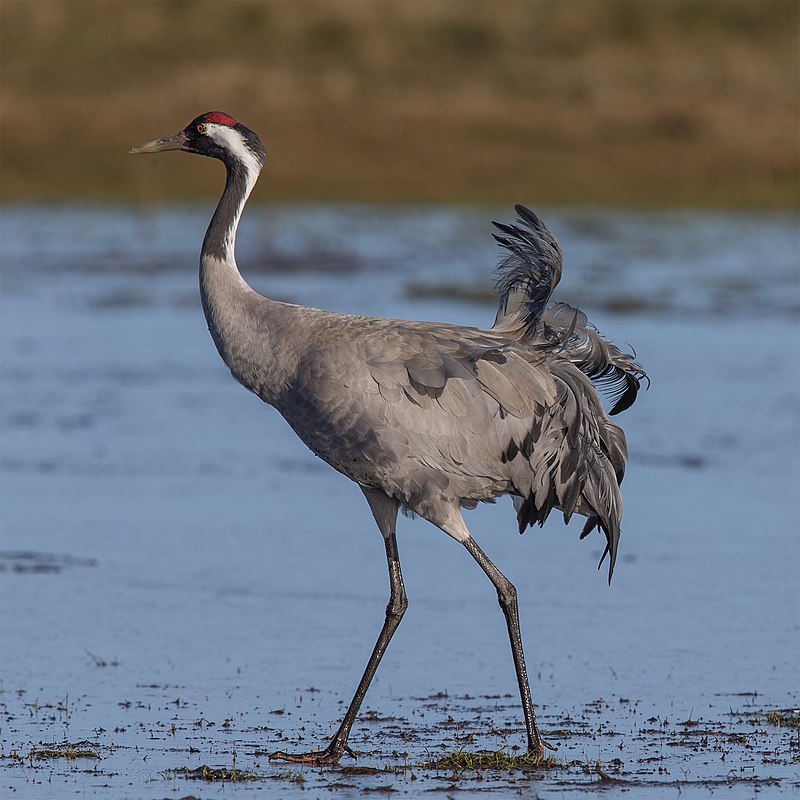
File:Common_crane_grus_grus.jpg · Wikimedia Commons · See Wikimedia Commons
Kranich
Sign in to saveAlso known as Eurasian Crane, Common crane, Grus grus
Vogelart aus der Familie der Kraniche
OverviewAI-generated
The common crane, scientifically known as Grus grus, is a species within the family Gruidae. It belongs to the order Gruiformes, class Aves, and phylum Chordata. The organism is an oviparous omnivore with a wingspan of 2.22. It typically lays a litter size of 2 eggs, which have an incubation period of 30 days.
Its taxon range includes the Nanling Mountains and Africa. The species has been recorded as endemic to Nandur Madhmeshwar Bird Sanctuary, Little Rann of Kutch, Thol Lake, and Dehing Patkai National Park. It inhabits freshwater environments. The International Union for Conservation of Nature lists its conservation status as Least Concern, a designation recorded in 2025.
In the wild, the common crane has a maximum longevity of 43 years. It has received the award of Bird of the Year. The taxon is also referred to by the common names garan, Kranich, and Grulla común.
Synthesized by Vinony from 36 facts across 6 sources: Wikidata, IUCN Red List, iNaturalist, WoRMS, Encyclopedia of Life, Vinony graph. Generated from structured data (not the Wikipedia text) and checked against those facts — may still contain errors.
Species
Least Concerncommon crane
Species
- PhylumChordata
- ClassAves
- OrderGruiformes
- FamilyGruidae
Maximum longevity: 43 years (wild)
via IUCN
Wikidata facts
- Instance of
- taxon
- Parent taxon
- Grus
- Award
- Bird of the Year
- Image
- 2017.07.04.-01-Wendisch Rietz--Kranich.jpg
Show 14 more facts
- taxon rank
- species
- IUCN conservation status
- Least Concern
- taxon name
- Grus grus
- Commons category
- Grus grus
- Commons gallery
- Grus grus
- taxon common name
- grou-eurasiático
- wingspan
- 2.22
- litter size
- 2
- egg incubation period
- 30
- endemic to
- Majuli
- short name
- G. grus
- has characteristic
- oviparity
- main food source
- omnivore
- taxon range
- Africa
Sources (10)
via Wikidata · CC0
Article · Deutsch
Der Kranich (Grus grus), auch Grauer Kranich oder Eurasischer Kranich, ist ein Vertreter der Familie der Kraniche (Gruidae). In Europa kommt er weitgehend als einzige Kranichart vor; erst ab der Schwarzmeerregion beginnt das Verbreitungsgebiet des Jungfernkranichs. Kraniche bewohnen Sumpf- und Moorlandschaften in weiten Teilen des nördlichen und östlichen Europa, aber auch einige Gebiete im Norden Asiens. Sie nehmen das ganze Jahr über sowohl tierische als auch pflanzliche Nahrung auf. Der Bestand hat in den letzten Jahrzehnten stark zugenommen, so dass die Art zurzeit nicht gefährdet ist. Die Schönheit der Kraniche, ihre spektakulären Balztänze und ihr gut zu beobachtender Zug haben schon in früher Zeit die Menschen fasziniert. In der griechischen Mythologie war der Kranich Apollon, Demeter und Hermes zugeordnet. Er war ein Symbol der Wachsamkeit und Klugheit und galt als „Vogel des Glücks“. In der Heraldik ist der Kranich das Symbol der Vorsicht und der schlaflosen Wachsamkeit. In der Dichtung steht der Kranich symbolisch für das Erhabene in der Natur.
Abstract from DBpedia / Wikipedia · CC BY-SA
Gallery (14)
Available in 97 languages
- Español
- Français
- Deutsch
- 中文
- 日本語
- Русский
- Português
- Italiano
- العربية
- हिन्दी
- Aragonese
- Armenian
- Asturian
- Azerbaijani
- Bahasa Indonesia
- Bangla
- Bashkir
- Basque
Show 78 more
- bat_smg
- be_x_old
- Belarusian
- Bhojpuri
- Breton
- Bulgarian
- Burmese
- Catalan
- Cebuano
- Central Kurdish
- Chechen
- Chuvash
- Corsican
- Croatian
- Czech
- Danish
- Egyptian Arabic
- Esperanto
- Estonian
- Faroese
- Finnish
- Fon
- Galician
- Georgian
- Greek
- Gujarati
- Hebrew
- Hungarian
- Inari Sami
- Interlingua
- Irish
- Kabardian
- Kashubian
- Kazakh
- Kotava
- Kurdish
- Latvian
- Limburgish
- Lithuanian
- Low German
- Luxembourgish
- Macedonian
- Marathi
- Mongolian
- Navajo
- Nederlands
- Nepali
- Northern Frisian
- Norwegian
- Norwegian Nynorsk
- olo
- Palatine German
- Piedmontese
- Polski
- Romanian
- Serbian
- Serbian (Latin)
- simple
- Sindhi
- Slovak
- Slovenian
- Svenska
- Swahili
- Tamil
- Tiếng Việt
- Türkçe
- Ukrainian
- Veps
- Waray
- Welsh
- Western Frisian
- Western Mari
- Western Panjabi
- Wu Chinese
- zh_yue
- فارسی
- ไทย
- 한국어
via Wikidata sitelinks · CC0