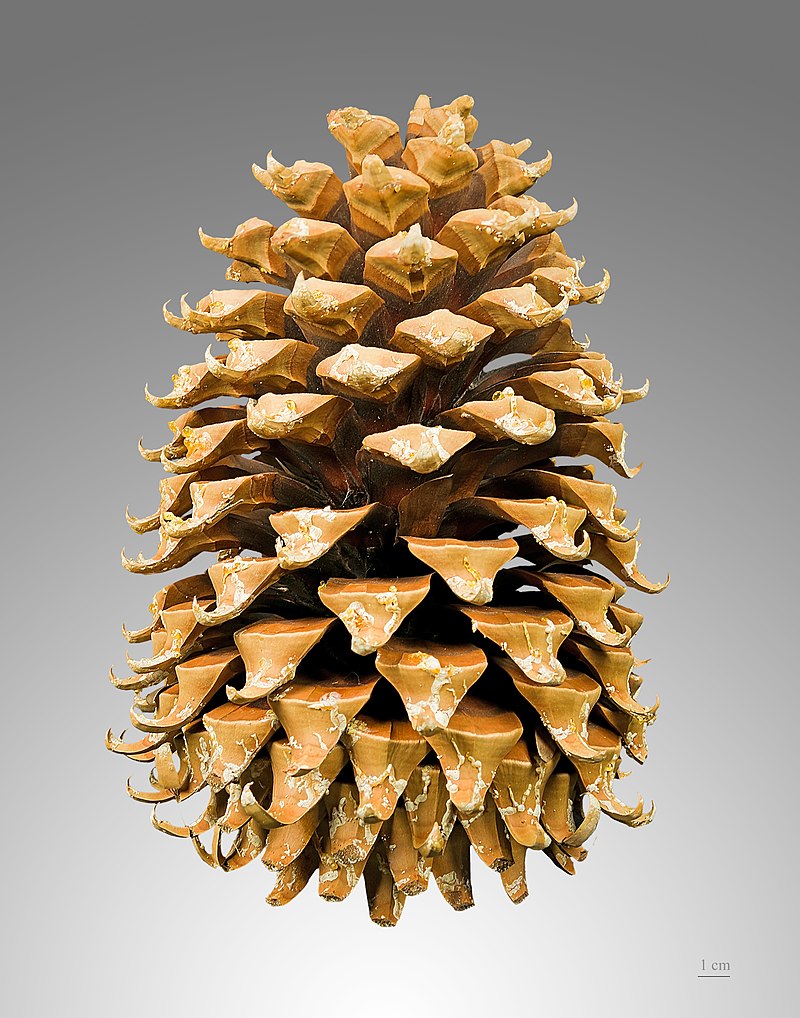
File:Pinus_coulteri_MHNT_Cone.jpg · Wikimedia Commons · See Wikimedia Commons
cône
Sign in to saveAlso known as Conifer cones, Cone, Strobilus, conifer cone, Plant Cone, pinecone, strobilus, strobile
organe reproducteur des conifères
A cone is a seed-bearing structure found on gymnosperm plants like pine trees and firs, where seeds develop between overlapping scales. Cones matter because they're how these plants reproduce and spread their seeds, making them essential to the life cycle of many important tree species.
AI-generated from the Wikipedia summary — may contain errors.
Research
73,864 papers- Cone visual pigments.ReviewBiochimica et biophysica acta · 2014Imamoto Y, Shichida YDOI: 10.1016/j.bbabio.2013.08.009
- Mechanism of Cone Degeneration in Retinitis Pigmentosa.ReviewCellular and molecular neurobiology · 2023Song DJ, Bao XL, Fan B et al.DOI: 10.1007/s10571-022-01243-2
- Maintaining Cone Function in Rod-Cone Dystrophies.ReviewAdvances in experimental medicine and biology · 2018Sahel JA, Léveillard TDOI: 10.1007/978-3-319-75402-4_62
- Structure of cone photoreceptors.ReviewProgress in retinal and eye research · 2009Mustafi D, Engel AH, Palczewski KDOI: 10.1016/j.preteyeres.2009.05.003
- Understanding Cone Photoreceptor Cell Death in Achromatopsia.ReviewAdvances in experimental medicine and biology · 2016Carvalho LS, Vandenberghe LHDOI: 10.1007/978-3-319-17121-0_31
- Cone Photoreceptor Loss in Light-Damaged Albino Rats.International journal of molecular sciences · 2022Benthal MC, McKeown AS, Kraft TWDOI: 10.3390/ijms23073978
- Molecular Mechanisms Governing Sight Loss in Inherited Cone Disorders.ReviewGenes · 2024Brotherton C, Megaw RDOI: 10.3390/genes15060727
- Induction of Rod and Cone Photoreceptor-Specific Progenitors from Stem Cells.ReviewAdvances in experimental medicine and biology · 2019Ballios BG, Khalili S, Shoichet MS et al.DOI: 10.1007/978-3-030-27378-1_90
via PubMed
Wikidata facts
- Part of
- conifer
- Image
- Araucaria (La Mer de sable) cone.jpg
Show 1 more fact
- Commons category
- Conifer cones
via Wikidata · CC0
Article · Français
En botanique, le cône est la structure de regroupement des organes reproducteurs chez les conifères qui contribue à la pollinisation ancestrale des Gymnospermes, la pollinisation anémophile (pollens dans les sacs polliniques des écailles staminées des cônes mâles, transportés par voie aérienne et interceptés par les cônes femelles). La « pomme de pin » est l'exemple typique du cône. La forme générale est celle d'un strobile : un axe court autour duquel des écailles insérées en spirale abritent à leur base les organes sexués. Le nom dérive du latin conus, lui-même issu du grec κῶνος / kônos, et désignait la pomme de cyprès. Certains botanistes réservent le terme de « cône » aux structures femelles à écailles ligneuses, mais par extension il est parfois employé pour désigner toutes les « inflorescences » et « fructifications » des conifères même si l'organisation initiale en strobile n'est plus visible (comme chez les ifs ou les genévriers). Il est aussi quelquefois utilisé pour désigner les structures de reproduction de Gymnospermes plus archaïques comme les Cycadacées, voire celles de Lycophytes fossiles.
Abstract from DBpedia / Wikipedia · CC BY-SA
Gallery (12)
Available in 65 languages
- Español
- Français
- Deutsch
- 中文
- 日本語
- Русский
- Português
- Italiano
- العربية
- हिन्दी
- Armenian
- Bahasa Indonesia
- Basque
- bat_smg
- Bavarian
- be_x_old
- Belarusian
- Bosnian
Show 46 more
- Bulgarian
- Catalan
- Chuvash
- Croatian
- Czech
- Danish
- Erzya
- Esperanto
- Estonian
- Finnish
- Galician
- Georgian
- Hebrew
- Hungarian
- Icelandic
- Ido
- Irish
- Kashmiri
- Lithuanian
- Low German
- Lower Sorbian
- Macedonian
- Malay
- Mongolian
- Nederlands
- Norwegian
- Norwegian Nynorsk
- Occitan
- Oromo
- Ossetic
- Palatine German
- Polski
- Romanian
- Serbian
- Serbian (Latin)
- simple
- Slovak
- Slovenian
- Svenska
- Türkçe
- Ukrainian
- Upper Sorbian
- Western Panjabi
- فارسی
- ไทย
- 한국어
via Wikidata sitelinks · CC0