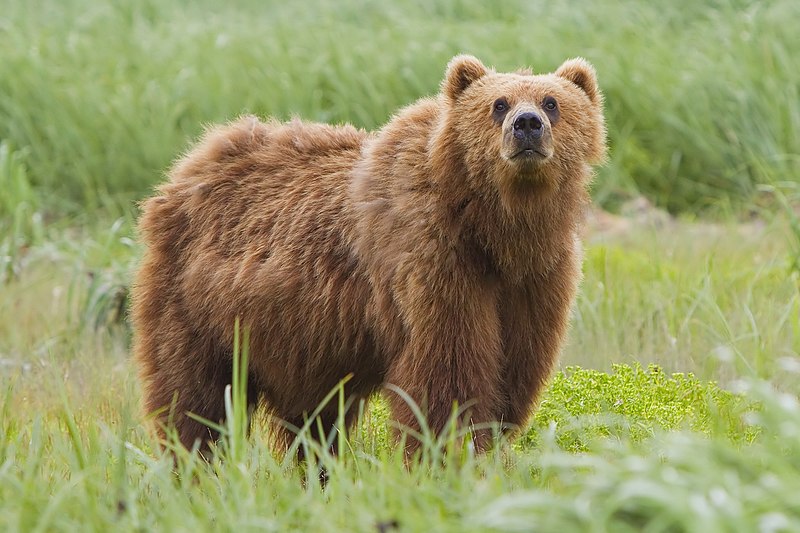
File:2010-kodiak-bear-1.jpg · Wikimedia Commons · See Wikimedia Commons
OverviewAI-generated
Ursus arctos, commonly known as the brown bear or grizzly bear, is a species in the family Ursidae. It belongs to the genus Ursus and was first described by Linnaeus in 1758. The taxon is classified within the kingdom Animalia, phylum Chordata, class Mammalia, and order Carnivora. Its scientific name is Ursus arctos.
The species inhabits shrubland, forest, and taiga environments. It has been recorded in the United States, Canada, and the United Kingdom. According to the IUCN Red List, the conservation status is Least Concern. The species is listed in Appendix I of CITES.
Individuals can reach a mass of 500 and have a longest observed lifespan of 40. The gestation period is 7, with an average litter size of 2.5. The bite force quotient is 78. The taxon is a source of bile bear.
Synthesized by Vinony from 48 facts across 8 sources: Wikidata, GBIF, Gbif Occ, Encyclopedia of Life, IUCN Red List, WoRMS, iDigBio, Vinony graph. Generated from structured data (not the Wikipedia text) and checked against those facts — may still contain errors.
Species
Least ConcernUrsus arctos
SPECIES
- KingdomAnimalia
- PhylumChordata
- ClassMammalia
- OrderCarnivora
- FamilyUrsidae
棕熊(学名:Ursus arctos)是一种极为庞大的熊,古称羆,体重可达130–700公斤(300–1500磅)。
via GBIF · IUCN
Museum specimens
- Specimen records
- 6,229
- With media
- 459
- Family
- Ursidae
- Collections
- USNM, UWBM, AMNH, NHMUK, CM, ROM
- Recorded in
- United States, Canada, United Kingdom
Bird sounds
- alarm call· Estonia· quality A
- alarm call· Estonia· quality A
- call, social call· Finland· quality B
- call· Russian Federation· quality C
via Xeno-canto
Wikidata facts
Show 23 more facts
- taxon rank
- species
- IUCN conservation status
- Least Concern
- Commons category
- Ursus arctos
- topic's main category
- Category:Ursus arctos
- Commons gallery
- Ursus arctos
- taxon common name
- 棕熊
- gestation period
- 7
- this taxon is source of
- bile bear
- bite force quotient
- 78
- litter size
- 2.5
- longest observed lifespan
- 40
- taxon name
- Ursus arctos
- start time
- 500000-00-
- CITES Appendix
- Appendix I of CITES
- sequenced genome URL
- www.dnazoo.org/assemblies/Ursus_arctos
- habitat
- taiga
- on focus list of Wikimedia project
- Wikipedia:Vital articles/Level/4
- short name
- U. arctos
- Digital Atlas of Idaho URL
- digitalatlas.cose.isu.edu/bio/mammal/Carn/bears/grbe/grbefrm.htm
- foods traditionally associated
- Salmo
- main food source
- fish
- regional conservation status
- Near Threatened
- temporal range start
- Pleistocene
Sources (10)
via Wikidata · CC0
~40 min read
Encyclopedic overview
The brown bear (Ursus arctos) is a large bear native to Eurasia and North America. Of the land carnivorans, it is rivaled in size only by its closest relative, the polar bear, which is much less variable in size and slightly bigger on average. The brown bear is a sexually dimorphic species, as adult males are larger and more compactly built than females. The fur ranges in color from cream to reddish to dark brown. It has evolved large hump muscles, unique among bears, and paws up to 21 cm (8.3 in) wide and 36 cm (14 in) long, to effectively dig through dirt. Its teeth are similar to those of other bears and reflect its dietary plasticity.
Throughout the brown bear's range, it inhabits mainly forested habitats in elevations of up to 5,000 m (16,000 ft). It is omnivorous, and consumes a variety of plant and animal species. Contrary to popular belief, the brown bear derives 90% of its diet from plants. When hunting, it will target animals as small as insects and rodents to those as large as moose or muskoxen. In parts of coastal Alaska, brown bears predominantly feed on spawning salmon that come near shore to lay their eggs. For most of the year, it is a usually solitary animal that associates only when mating or raising cubs. Females give birth to an average of one to three cubs that remain with their mother for 1.5 to 4.5 years. It is a long-lived animal, with an average lifespan of 25 years in the wild. Attacks on humans, though widely reported, are generally rare.
Excerpted from Wikipedia’s “Ursus arctos” article, available under the CC BY-SA 4.0 licence.
Gallery (16)
Available in 131 languages
- Español
- Français
- Deutsch
- 中文
- 日本語
- Русский
- Português
- Italiano
- العربية
- हिन्दी
- Afrikaans
- Albanian
- Amharic
- Aragonese
- Armenian
- Arpitan
- Asturian
- azb
Show 112 more
- Azerbaijani
- Bahasa Indonesia
- Balinese
- Bangla
- Bashkir
- Basque
- bat_smg
- be_x_old
- Belarusian
- Bosnian
- Breton
- Bulgarian
- Burmese
- Catalan
- Cebuano
- Central Kurdish
- Chechen
- Cheyenne
- Chuvash
- Croatian
- Czech
- Danish
- Egyptian Arabic
- Erzya
- Esperanto
- Estonian
- Faroese
- Filipino
- Finnish
- fiu_vro
- Galician
- Georgian
- Gilaki
- Greek
- Hebrew
- Hungarian
- Icelandic
- Inari Sami
- Inupiaq
- Irish
- Javanese
- Kabyle
- Kashmiri
- Kashubian
- Kazakh
- Komi-Permyak
- Kotava
- Kyrgyz
- Latin
- Latvian
- lbe
- Limburgish
- Lithuanian
- Lower Sorbian
- Luxembourgish
- Macedonian
- Maithili
- Malagasy
- Malay
- Malayalam
- Mari
- Mongolian
- Navajo
- Nederlands
- Nepali
- Northern Sami
- Norwegian
- Norwegian Nynorsk
- Occitan
- Old English
- olo
- Ossetic
- Pashto
- Polski
- Quechua
- Romanian
- Rusyn
- Scots
- Serbian
- Serbian (Latin)
- simple
- Sindhi
- Slovak
- Slovenian
- Svenska
- Tajik
- Tatar
- Tibetan
- Tiếng Việt
- Türkçe
- Udmurt
- Ukrainian
- Upper Sorbian
- Urdu
- Uyghur
- Uzbek
- Veps
- Waray
- Welsh
- West Flemish
- Western Frisian
- Western Mari
- Western Panjabi
- Wu Chinese
- Yakut
- Yoruba
- Zaza
- zh_min_nan
- zh_yue
- فارسی
- ไทย
- 한국어
via Wikidata sitelinks · CC0