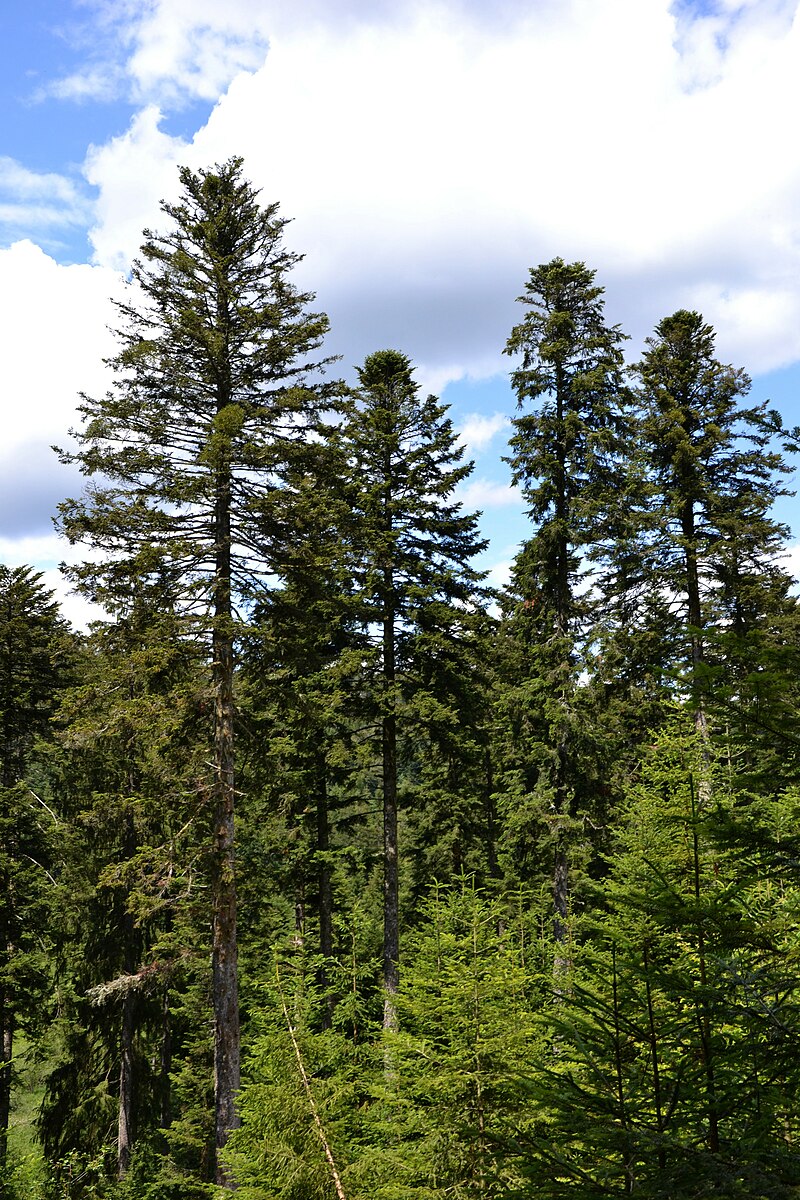
File:Sapins_pectinés.jpg · Wikimedia Commons · See Wikimedia Commons
Pinophyta
Sign in to saveAlso known as Coniferophyta, Coniferae, conifers, evergreen, coniferous plant, coniferous tree, evergreen tree
Conifers () are a group of vascular plants and a subset of gymnosperms. They are primarily perennial, woody trees and shrubs, mostly evergreen with a regular branching pattern, reproducing with male and female cones, usually on the same tree. They are wind-pollinated and the seeds are usually dispersed by the wind. Taxonomically, they make up the division Pinophyta, also known as Coniferae. All extant conifers, except for the gnetophytes, are perennial woody plants with secondary growth. There are over 600 living species.
Conifers are a large group of over 600 species of woody plants, mostly evergreen trees and shrubs like pines and firs, that reproduce using male and female cones and disperse their seeds through the wind. They matter because they are among the most common and structurally important plants in many ecosystems, and they provide valuable timber, food sources, and other resources that humans depend on.
AI-generated from the Wikipedia summary — may contain errors.
Wikidata facts
- Instance of
- taxon
- Image
- Conifer forest.jpg
Show 7 more facts
- taxon common name
- 松柏门
- Commons category
- Pinophyta
- taxon name
- Pinophyta
- taxon rank
- division
- topic's main category
- Category:Pinophyta
- different from
- Gymnospermae
- Digital Atlas of Idaho URL
- digitalatlas.cose.isu.edu/bio/plants/coniphyt/coniphyt.htm
Sources (2)
via Wikidata · CC0
Article · Italiano
La divisione Pinophyta Reveal, 1996 include la grande maggioranza delle piante chiamate comunemente conifere (che significa "portatrici di coni", cioè di strobili) perciò possono essere considerati sinonimi. Sono piante vascolari (Tracheobionta), con semi (Spermatophyta) contenuti in un cono, legnose, perlopiù alberi e solo pochi arbusti. Sono spesso dominanti nel loro ambiente al punto che varie specie di conifere possono essere trovate allo stato naturale in quasi tutte le parti del mondo. Rivestono una grande importanza economica, specialmente per la lavorazione del legno strutturale e la produzione di carta.
Abstract from DBpedia / Wikipedia · CC BY-SA
Gallery (34)
Available in 90 languages
- Español
- Français
- 中文
- 日本語
- Русский
- Português
- Italiano
- العربية
- हिन्दी
- Afrikaans
- Armenian
- Asturian
- Atikamekw
- Azerbaijani
- Bahasa Indonesia
- Balinese
- Basque
- bat_smg
Show 71 more
- be_x_old
- Belarusian
- Bosnian
- Bulgarian
- Catalan
- Cebuano
- Croatian
- Czech
- Danish
- Egyptian Arabic
- Esperanto
- Estonian
- Filipino
- Finnish
- fiu_vro
- Galician
- Georgian
- Greek
- Gujarati
- Hebrew
- Hungarian
- Icelandic
- Irish
- Javanese
- Kabyle
- Kazakh
- Latin
- Latvian
- lbe
- Limburgish
- Lingua Franca Nova
- Lithuanian
- Lombard
- Macedonian
- Malagasy
- Malay
- Malayalam
- Manx
- Mari
- Mongolian
- Nederlands
- Nepali
- Norwegian Nynorsk
- Occitan
- Ossetic
- Piedmontese
- Polski
- Quechua
- Romanian
- Scots
- Serbian
- Serbian (Latin)
- simple
- Sindhi
- Slovak
- Slovenian
- Svenska
- Tajik
- Tatar
- Tiếng Việt
- Türkçe
- Ukrainian
- Waray
- West Flemish
- Western Frisian
- Western Panjabi
- Wu Chinese
- zh_yue
- فارسی
- ไทย
- 한국어
via Wikidata sitelinks · CC0