File:RiemannCriticalLine.svg · Wikimedia Commons · See Wikimedia Commons
conjecture
Sign in to saveAlso known as mathematical conjecture, open problem in mathematics
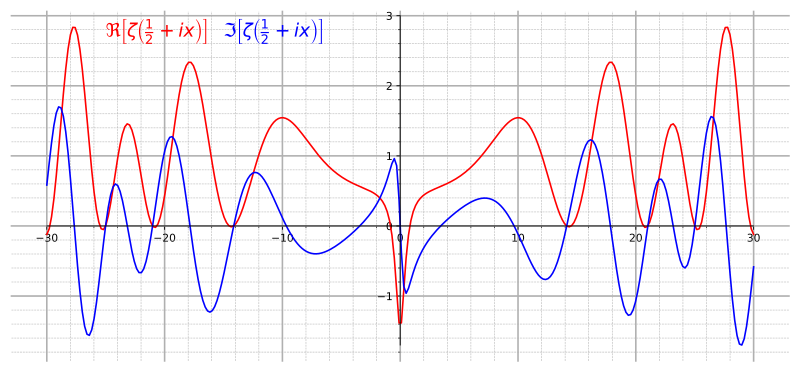
thumb|350px|The real part (red) and imaginary part (blue) of the Riemann zeta function along the critical line Re(s) = 1/2. The first non-trivial zeros can be seen at Im(s) = ±14.135, ±21.022 and ±25.011. The Riemann hypothesis, a famous conjecture, says that all non-trivial zeros of the zeta function lie along the critical line.
Wikidata facts
- Subclass of
- proposition
Show 6 more facts
- topic's main category
- Category:Conjectures
- different from
- mathematical problem
- on focus list of Wikimedia project
- Wikipedia:Vital articles/Level/4
- maintained by WikiProject
- WikiProject Mathematics
- studied by
- mathematics
Sources (3)
via Wikidata · CC0
~15 min read
Encyclopedic overview
19 sectionsContents
- Resolution of conjectures
- Proof
- Disproof
- Independent conjectures
- Conditional proofs
- Important examples
- Fermat's Last Theorem
- Four color theorem
- Hauptvermutung
- Weil conjectures
- Poincaré conjecture
- Riemann hypothesis
- P versus NP problem
- Other conjectures
- In other sciences
- See also
- References
- Works cited
- External links
thumb|350px|The real part (red) and imaginary part (blue) of the Riemann zeta function along the critical line Re(s) = 1/2. The first non-trivial zeros can be seen at Im(s) = ±14.135, ±21.022 and ±25.011. The Riemann hypothesis, a famous conjecture, says that all non-trivial zeros of the zeta function lie along the critical line.
In mathematics, a conjecture is a proposition that is proffered on a tentative basis without proof. Some conjectures, such as the Riemann hypothesis or Fermat's conjecture (now a theorem, proven in 1995 by Andrew Wiles), have shaped much of mathematical history as new areas of mathematics are developed in order to prove them.
Excerpted from Wikipedia’s “conjecture” article, available under the CC BY-SA 4.0 licence.