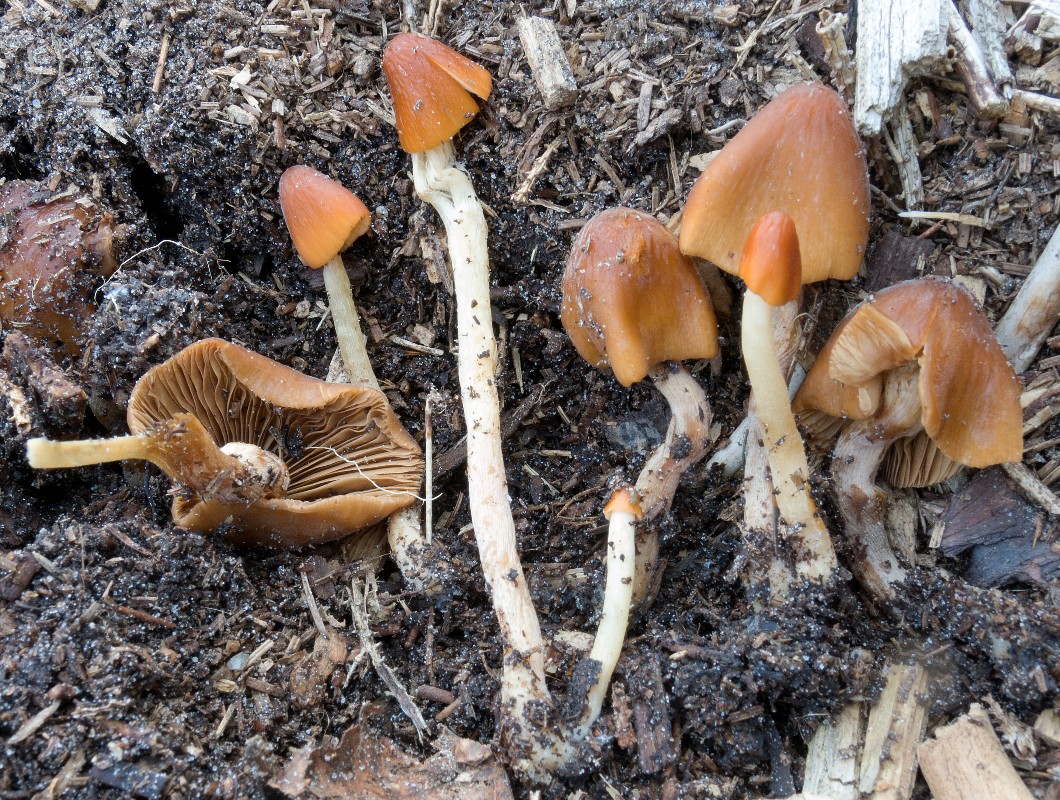
Thomas Læssøe · https://creativecommons.org/licenses/by-nc/4.0/
Conocybe
Sign in to saveConocybe is a genus of mushrooms with Conocybe tenera as the type species and at least 243 other species. There are at least 50 different species in North America.
Species
kjeglesopp
GENUS
- KingdomFungi
- PhylumBasidiomycota
- ClassAgaricomycetes
- OrderAgaricales
- FamilyBolbitiaceae
Especies de Sudamerica Austral
via GBIF
Museum specimens
- Specimen records
- 1,694
- With media
- 1,707
- Family
- Bolbitiaceae
- Collections
- ECOSUR, UFRGS, INSTITUTO NACIONAL DE PESQUISAS DA AMAZÔNIA (INPA), DBG, UFPB, UJAT
- Recorded in
- Mexico, Uruguai, Brasil, United States, Australia
Wikidata facts
- Instance of
- taxon
- Parent taxon
- Bolbitiaceae
- Image
- 2008-12-23 Conocybe tenera (Schaeff.) Fayod 33118 crop.jpg
Show 7 more facts
- taxon rank
- genus
- taxon name
- Conocybe
- Commons category
- Conocybe
- topic's main category
- Category:Conocybe
- taxonomic type
- Conocybe tenera
- Commons gallery
- Conocybe
- taxon author citation
- Fayod
Sources (2)
via Wikidata · CC0
~3 min read
Encyclopedic overview
7 sectionsContents
- Selected species
- Legal status
- United States
- Louisiana
- See also
- References
- External links
Conocybe is a genus of mushrooms with Conocybe tenera as the type species and at least 243 other species. There are at least 50 different species in North America.
Most have a long, thin fragile stipe and are delicate, growing in grasslands on dead moss, dead grass, sand dunes, decayed wood, and dung. Conocybe species generally prefer fertile soils in lawns and pastures and are found worldwide. Conocybe species are sometimes called dunce caps or cone heads due to their conical or bell-shaped caps. Former species of Conocybe that have a well-developed partial veil and/or lack lecythiform cheilocystidia have been transferred to the genus Pholiotina, which was formerly a subgenus of Conocybe. However, Pholiotina as it is currently defined is polyphyletic, although none of the three clades that make it up belong in Conocybe. Similar to Galerina, a Conocybe species can be distinguished microscopically by its cellular cap cuticle, which is filamentous (thread-like) in Galerina. It is easy to confuse Conocybe species for Galerina species unless the microscopic nature of the cap cuticle is examined. Conocybe species have cap cuticles resembling cobblestones. Conocybe species can also be mistaken for species of Bolbitius.
Excerpted from Wikipedia’s “Conocybe” article, available under the CC BY-SA 4.0 licence.