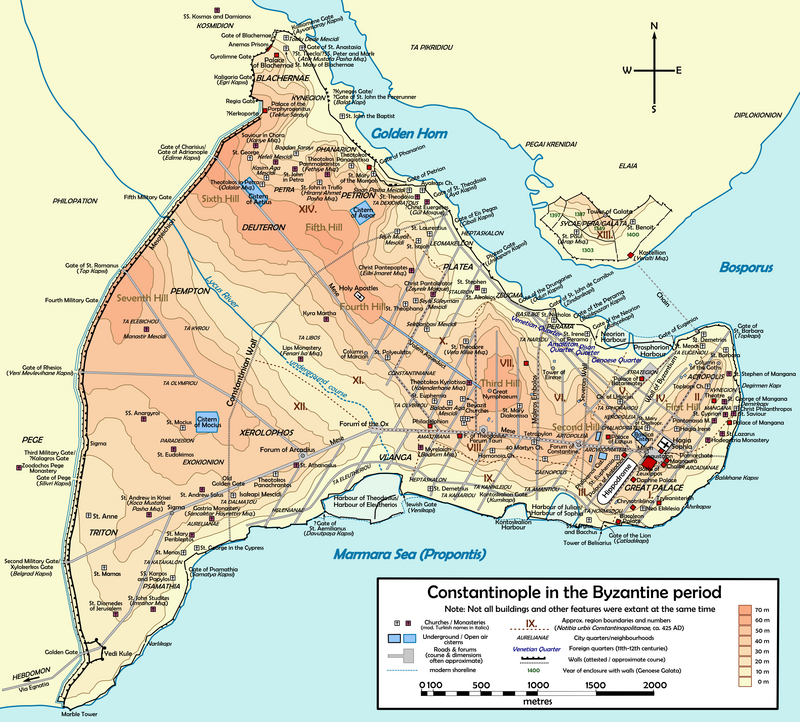
File:Byzantine_Constantinople-en.png · Wikimedia Commons · See Wikimedia Commons
Constantinople
Sign in to saveAlso known as Constantinopolis, The City of the World's Desire, Tsarigrad, Tsargorod, Czargrad, Tzargrad
Constantinople (see other names) was a historical city located on the Bosporus, which served as the capital of the Roman, Byzantine, Latin, and Ottoman empires between its consecration in 330 and the formal abolition of the Ottoman sultanate in 1922. Constantinople was founded in 324, initially as New Rome, during the reign of Constantine the Great on the site of the existing settlement of Byzantium and in 330 became the capital of the Roman Empire. Following the collapse of the Western Roman Empire in the late 5th century, Constantinople remained the capital of the Eastern Roman Empire (also
OverviewAI-generated
Constantinople is a city and administrative territorial entity located on the continents of Europe and Asia. It was named after Constantine the Great and follows the earlier settlement of Byzantium. The city serves as the capital of the Byzantine Empire, Latin Empire, Roman Empire, and Ottoman Empire. It is partially coincident with Istanbul, which replaced it.
The subject is associated with significant events including the Fall of Constantinople and the Siege of Constantinople. It has been described by sources such as the Brockhaus and Efron Encyclopedic Dictionary and the Jewish Encyclopedia of Brockhaus and Efron. The native label for the city is Κωνσταντινούπολις. Official names include Βυζάντιον, Константинопол, Цариград, and Истанбул.
Synthesized by Vinony from 44 facts across 6 sources: Wikidata, Open Meteo, Openweathermap, OpenStreetMap, Vinony graph, Geo. Generated from structured data (not the Wikipedia text) and checked against those facts — may still contain errors.
Weather now
7-day forecast
via Open-Meteo
Air quality
- PM2.5
- 77.5 µg/m³
- PM10
- 84.7 µg/m³
Key facts
- Ancient site.name
- Constantinople
- Ancient site.image
- Byzantine Constantinople-en.png
- Ancient site.caption
- Map of Constantinople in the Byzantine period, corresponding to the modern-day Fatih and Beyoğlu district of Istanbul
- Ancient site.map_type
- Istanbul#Turkey Marmara#Turkey
- Ancient site.map_alt
- A map of Byzantine Istanbul
- Ancient site.map_size
- 275
- Ancient site.map_caption
- Constantinople was founded on the former site of the Greek colony of Byzantium, which today is known as Istanbul in Turkey.
- Ancient site.location
- Fatih and Beyoğlu, Istanbul, Turkey
- Ancient site.region
- Marmara Region
- Ancient site.type
- Imperial city
- Ancient site.area
- enclosed within Constantinian Walls enclosed within Theodosian Walls
- Ancient site.builder
- Constantine the Great
- Ancient site.built
- 11 May 330
- Ancient site.epochs
- Late antiquity to Interwar period
- Ancient site.event
- Sieges of Constantinople, including fall of the city (1204 and 1453)
- Ancient site.designation1
- WHS
- Ancient site.designation1_offname
- Historic Areas of Istanbul
- Ancient site.designation1_type
- Cultural
via Wikipedia infobox
Wikidata facts
- Named after
- Constantine the Great
- Official name
- Стамбул
- Country
- Turkey
- Continent
- Asia
- Capital of
- Ottoman Empire
- Followed by
- Istanbul
- Follows
- Byzantium
- Image
- Byzantine Constantinople-en.png
- Significant event
- Siege of Constantinople
- Said to be same as
- Miklagard
Show 16 more facts
- Commons category
- Constantinople
- topic's main category
- Category:Constantinople
- category for people born here
- Category:Births in Istanbul
- category of associated people
- Category:People from Constantinople
- category for people who died here
- Category:Deaths in Constantinople
- described by source
- Wikitólica
- category for people buried here
- Category:Burials in Istanbul by place
- WordLift URL
- data.thenextweb.com/tnw/entity/constantinople
- replaces
- Byzantium
- P8168
- Ellen Brockhöft
- native label
- Κωνσταντινούπολις
- P12749
- Riga
- partially coincident with
- Istanbul
- replaced by
- Istanbul
- inception
- 0330-00-00
- dissolved, abolished or demolished date
- 1922-00-00
Sources (9)
via Wikidata · CC0
Travel guide
Get in
See Turkey#Get in for visa requirements. From 2020, most EU, UK, CIS and South American visitors do not need a visa. Those from many other countries including Australia, Canada and US can get an e-visa online, valid for 90 days.
Get around
thumb|upright=2.5|Rapid transit map of Istanbul (urban rail and metrobüs systems) İETT (or just toplu taşıma) is the municipality's public transportation company. Istanbul's public transit system can be difficult to figure out. However, if you put some effort into it, you can avoid taxis and not walk too much.
Unless you use the Istanbulkart, each time you use a tram, metro, bus, or boat on the public transport system, you will need to use a ticket or pass. They can be bought at various vending machines at bus, railway and metro stations or authorized ticket/Istanbulkart sellers (usually newspaper kiosks). Ticket fares across buses, trams and metros differ. Only cash in Turkish lira is accepted at ticket kiosks of public transport, no credit cards or foreign currency. The Istanbul subway system does not offer transfer tickets: each change to a new line requires a new fare.
When travelling to Istanbul by air, it is much cheaper (and more fun) to use the bus (or metro system once it is extended) to get as close to your accommodation as possible before walking and/or taking a taxi to where you are staying. Although the public transport may be slightly confusing, taxis/charter buses from the airport are notoriously overpriced.
If public transport is your choice of getting around, consider using smartphone public transportation applications so that you can easily see stops, stations and terminals nearby or see alternate routes for your planned destination. İETT has an official …
See
thumb|Istanbul Archaeological Museums thumb|Topkapı Palace from the Galata Tower thumb|Basilica cistern, built by the Romans
Do
thumb|Interior of a hamam Hamam – Sultanahmet has many historical hamams. Some are very extravagant and cater mainly to tourists. Waterpipe – Most of the places where you can smoke a nargile are in Yeniçeriler Caddesi, near the Kapalı Çarşı (Grand Bazaar). Çorlulu Ali Paşa and Koca Sinan Paşa Türbesi are both in secluded internal courts, just around the corner from some tomb yards, while Rumeli Kahvesi is actually inside the cemetery of an old medrese, though it’s not as spooky as you might think. In the south of Sultanahmet, near the sea, is Yeni Marmara (Çayıroğlu Sokak), where you can also sit in the terrace and enjoy the view. In Beyoğlu, at the Ortakahve (Büyükparmakkapı), there’s even the choice of a wide range of flavors. Another area with few big good looking places is the Rıhtım Caddesi, between Galata bridge and Istanbul Modern Museum.
Eat
For a full-on culinary experience, one should look for esnaf lokantası restaurants. They are essentially old-school canteens with a variety of traditional selections from soups to main courses to desserts.
Drink
thumb|A street in [[Istanbul/Kadikoy|Kadıköy]]
Meyhanes are taverns which originated in Ottoman times. They come in both 'traditional' and 'modern' accents, some even with some belly dancing. One could find them mostly on the seaside districts of both sides.
Bebek is a small town on the European Bosphorus, 10 km north of downtown, with fancy restaurants and bars. Great place to have a walk on the seaside after a nice dinner. Bağdat Caddesi is a very long avenue full of good restaurants, boutiques and high-end stores on the south Anatolia side of Istanbul. Beyoğlu has lively night life, with cafes and bars with live music. Kadıköy also has a compact nightlife scene, serving mostly locals of this part of the city. It's easy-going, with local pubs and wine houses. Karaköy is the rising star of the city, with its underground parties with views over the Marmara Sea. Nişantaşı is the place for young entrepreneurs and artists, but prices are higher than in Taksim.
Nightclubs are found all over the city, but most popular ones are in Pera and Ortaköy.
Sleep
thumb|Taksim Square In general, it is possible to find some kind of accommodation in any part of Istanbul. Here is a quick list of the areas where they are concentrated most:
Harbiye is a popular place to stay; it's close to the main centre of the new city on the European side, and contains a variety of international standard apartments, hotels, and moderate hotels for budget travelers. Nişantaşı and Taksim are quite close so you can stay in Harbiye and benefit from all activities in those areas. Taksim is the main centre of the city on the European side. Locals and tourists go to Taksim for shopping and entertainment, and it has moderate hotels for budget travelers. There are also hostels in this area. Sultanahmet the main centre for the old city on the European side. It has a selection of quality, reasonably priced hotels, many with terraces overlooking the Golden Horn, or with views of the Marmara Sea and the Blue Mosque. Most hostel-type accommodation frequented by independent travellers are located in this district, although it is possible to find a few upmarket hotels. Upscale hotels can be found in the western suburbs, especially around the former airport, as well as on or near the banks of the European Bosphorus. Caravan parks exist in Ahırkapı south of Sultanahmet, in Maltepe in the Maltepe and in the outlying villages on both sides of the Bosphorus.
Stay safe
thumb|Don't try to outrun them... In Istanbul, most drivers won't abide any rules. Even if you have priority on a road junction, crosswalk, or even during green light, always be aware of your surroundings. Even if you are in a one way road, check both sides before crossing the road. It is common for Turkish drivers to use shortcuts.
A major earthquake with epicenter in the nearby Sea of Marmara is expected within the next few decades, so read the earthquake safety article before you arrive.
If prices are not on display, always ask beforehand (even for a tea) instead of just ordering something like in Europe. This can be fatal in Istanbul because tourists are constantly overcharged. Unfortunately, often prices are not on display, like in sweet shops or even restaurants. Skip these places or ask for a price knowing what the approximate or fair price is.
Istanbul is home to three of the biggest clubs in Turkey and maybe European football: Beşiktaş, Fenerbahçe, and Galatasaray. It is advisable not to wear your jersey on the days of matches between the sides due to the fearsome rivalry they share. If you are supporting the away team whenever the Turkish national team plays in Istanbul, be very careful as violent attacks on fans and players of the opposing team have been known to occur.
Stay healthy
thumb|Tophane Fountain Tap water may not be safe depending on where you drink it. Although the tap water itself is clean, many local water tanks are not maintained properly, and one should try to avoid tap water if possible. Locals widely prefer bottled water and the same applies for the restaurants. Expect to pay for water in restaurants. Although there are fountains nearly everywhere.
Food and drinks are mostly of international standards. Some Turkish foods are known to use a variety of spices which may affect international tourists who may not be accustomed to such ingredients, although most of it is edible for any tongue.
Use common sense when buying certain foods, particularly from street vendors. Delicacies such as "Firin Sutlac" (a kind of rice pudding) can go bad rapidly on a hot day, as can the oysters occasionally for sale on the streets.
Connect
thumb|Çamlıca TV Tower For general information on SIM cards, Wi-Fi and Internet see the country article.
Travel guide from Wikivoyage (CC BY-SA 4.0)
~64 min read
Encyclopedic overview
36 sectionsContents
- Names
- Before Constantinople
- Names of Constantinople
- Modern names of the city
- History
- Foundation of Byzantium
- 324–337: The refoundation as Constantinople
- 337–529: Constantinople during the Barbarian Invasions and the fall of the West
- 527–565: Constantinople in the Age of Justinian
- Survival, 565–717: Constantinople during the Byzantine Dark Ages
- 717–1025: Constantinople during the Macedonian Renaissance
- Iconoclast controversy in Constantinople
- 1025–1081: Constantinople after Basil II
- 1081–1185: Constantinople under the Komneni
- 1185–1261: Constantinople during the Imperial Exile
- 1261–1453: Palaiologan Era and the Fall of Constantinople
- 1453–1930: Ottoman and Republican Kostantiniyye
- Culture
- Women in literature
- Markets
- Architecture and coinage
- Religion
- Education
- Media
- Film
- Newspaper
- International status
- See also
- People from Constantinople
- Secular buildings and monuments
- Churches, monasteries and mosques
- Miscellaneous
- Notes
- References
- Bibliography
- External links
Constantinople (see other names) was a historical city located on the Bosporus, which served as the capital of the Roman, Byzantine, Latin, and Ottoman empires between its consecration in 330 and the formal abolition of the Ottoman sultanate in 1922. Constantinople was founded in 324, initially as New Rome, during the reign of Constantine the Great on the site of the existing settlement of Byzantium and in 330 became the capital of the Roman Empire. Following the collapse of the Western Roman Empire in the late 5th century, Constantinople remained the capital of the Eastern Roman Empire (also known as the Byzantine Empire; 330–1204 and 1261–1453), the Latin Empire (1204–1261), and the Ottoman Empire (1453–1922). In the aftermath of the Turkish War of Independence, the Turkish capital moved to Ankara. The city was officially renamed Istanbul on 28 March 1930. As of December 2025, it is the most populous city in Europe, with a population of more than 16 million residents, straddling the Bosporus Strait and lying in both Europe and Asia, and is the financial beneficiary of Turkey.
In 324, following the reunification of the Eastern and Western Roman Empires, the ancient city of Byzantium was selected to serve as the new capital of the Roman Empire, and the city was renamed Nova Roma, or 'New Rome', by Emperor Constantine the Great. On 11 May 330, it was renamed Constantinople and dedicated to Constantine. Later, in 474 AD, the Great Fire of Constantinople erupted and consequently devastated the region. Constantinople is generally considered to be the center and the "cradle of Orthodox Christian civilization." From the mid-5th century to the early 13th century, Constantinople was the largest and wealthiest city in Europe. The city became famous for its architectural masterpieces, such as Hagia Sophia, the cathedral of the Eastern Orthodox Church, which served as the seat of the Ecumenical Patriarchate; the sacred Imperial Palace, where the emperors lived; the Hippodrome; the Golden Gate of the Land Walls; and opulent aristocratic palaces. The University of Constantinople was founded in the 5th century and contained artistic and literary treasures before it was sacked in 1204 and 1453, including its vast Imperial Library. which contained more than 100,000 volumes. The city was the home of the Ecumenical Patriarch of Constantinople and guardian of Christendom's holiest relics, such as the Crown of Thorns and the True Cross.
Excerpted from Wikipedia’s “Constantinople” article, available under the CC BY-SA 4.0 licence.
Gallery (52)
On the map
31 mapped locations
Available in 121 languages
- Español
- Français
- Deutsch
- 中文
- 日本語
- Русский
- Português
- Italiano
- العربية
- हिन्दी
- Abkhazian
- Achinese
- Afrikaans
- Albanian
- Aramaic
- Armenian
- Arpitan
- Asturian
Show 102 more
- azb
- Azerbaijani
- Bahasa Indonesia
- Bangla
- Basque
- be_x_old
- Belarusian
- Bosnian
- Breton
- Bulgarian
- Burmese
- Catalan
- Cebuano
- Central Kurdish
- Chechen
- Chuvash
- Croatian
- Czech
- Danish
- Divehi
- Egyptian Arabic
- Esperanto
- Estonian
- Faroese
- Filipino
- Finnish
- Friulian
- Galician
- Georgian
- Greek
- Guarani
- Gujarati
- Haitian Creole
- Hebrew
- Hungarian
- hyw
- Ido
- Interlingua
- Irish
- Kabyle
- Kannada
- Kurdish
- Ladino
- Latin
- Latvian
- Ligurian
- Limburgish
- Lingua Franca Nova
- Lojban
- Lombard
- Low German
- Macedonian
- Malagasy
- Malay
- Maltese
- Minangkabau
- Mingrelian
- Neapolitan
- Nederlands
- Norwegian
- Norwegian Nynorsk
- Occitan
- Pashto
- Picard
- Polski
- Punjabi
- Quechua
- Romanian
- Rusyn
- Sardinian
- Scots
- Serbian
- Serbian (Latin)
- Sicilian
- simple
- Sindhi
- Sinhala
- Slovenian
- Svenska
- Swahili
- Tajik
- Tamil
- Tiếng Việt
- Türkçe
- Ukrainian
- Urdu
- Uyghur
- Uzbek
- Venetian
- Walloon
- Waray
- Welsh
- Western Frisian
- Western Panjabi
- Wu Chinese
- Zaza
- zh_classical
- zh_min_nan
- zh_yue
- فارسی
- ไทย
- 한국어
via Wikidata sitelinks · CC0