Encyclopedia of Life · EOL (see source)
Corynebacterium diphtheriae
Sign in to savespecies of bacterium
OverviewAI-generated
Corynebacterium diphtheriae is a species of gram-positive bacteria belonging to the genus Corynebacterium. It is classified within the kingdom Bacteria, phylum Actinobacteriota, class Actinomycetia, order Mycobacteriales, and family Mycobacteriaceae. The organism is the causative agent of the disease diphtheria.
Records of this species are held by institutions including the NHMUK. Database entries indicate 212 occurrences, 4 records, and 3,313 associated publications. The taxon is referenced by 221 other encyclopedia articles.
Synthesized by Vinony from 24 facts across 6 sources: Wikidata, GBIF, PubMed, Gbif Occ, iDigBio, Vinony graph. Generated from structured data (not the Wikipedia text) and checked against those facts — may still contain errors.
Species
SPECIES
- KingdomBacteria
- PhylumActinobacteriota
- ClassActinomycetia
- OrderMycobacteriales
- FamilyMycobacteriaceae
Das Bakterium Corynebacterium diphtheriae ist der Erreger der Diphtherie. Er ist auch als Klebs-Loeffler-Bazillus bekannt, weil es 1884 von Edwin Klebs (1834–1913) und Friedrich Loeffler (1852–1915) entdeckt wurde. Das Bakterium bildet ein Toxin (Diphtherietoxin), was seine Gefährlichkeit ausmacht.
via GBIF
Research
3,313 papers- Corynebacterium diphtheriae and its relatives.Bacteriological reviews · 1970
- Corynebacterium diphtheriae Infections, South Africa, 2015-2023.Emerging infectious diseases · 2025
- Toxigenic Corynebacterium diphtheriae-Associated Genital Ulceration.Emerging infectious diseases · 2020
- Toxigenic Corynebacterium diphtheriae Infection in Cat, Texas, USA.Emerging infectious diseases · 2022
- Corynebacterium rouxii sp. nov., a novel member of the diphtheriae species complex.Research in microbiology · 2020
via PubMed
Wikidata facts
- Instance of
- taxon
- Parent taxon
- Corynebacterium
- Image
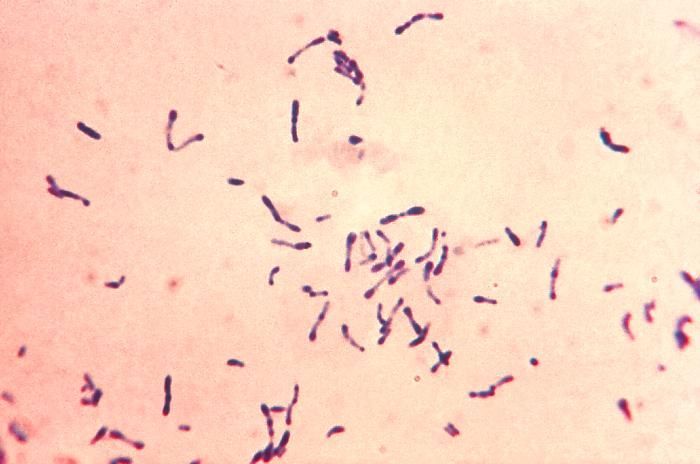
- Corynebacterium diphtheriae Gram stain.jpg
Show 6 more facts
- taxon name
- Corynebacterium diphtheriae
- taxon rank
- species
- Commons category
- Diphtheria
- Gram staining
- gram-positive bacteria
- short name
- C. diphtheriae
via Wikidata · CC0
~14 min read
Encyclopedic overview
Corynebacterium diphtheriae is a Gram-positive pathogenic bacterium that causes diphtheria. It is also known as the Klebs–Löffler bacillus because it was discovered in 1884 by German bacteriologists Edwin Klebs (1834–1913) and Friedrich Löffler (1852–1915). While nontoxigenic C. diphtheriae may rarely produce systemic disease by invading tissues, virulence is enhanced when the bacteria are infected by a bacteriophage carrying a gene which gives rise to a toxin. This toxin causes the disease.
Diphtheria is caused by the adhesion and infiltration of the bacteria into the mucosal layers of the body, primarily affecting the respiratory tract and causing the subsequent release of an exotoxin. The toxin has a localized effect on skin lesions, as well as a metastatic, proteolytic effects on other organ systems in severe infections. Originally a major cause of childhood mortality, respiratory diphtheria has become rare in the United States by the vigorous administration of diphtheria vaccines starting in 1914.
Excerpted from Wikipedia’s “Corynebacterium diphtheriae” article, available under the CC BY-SA 4.0 licence.