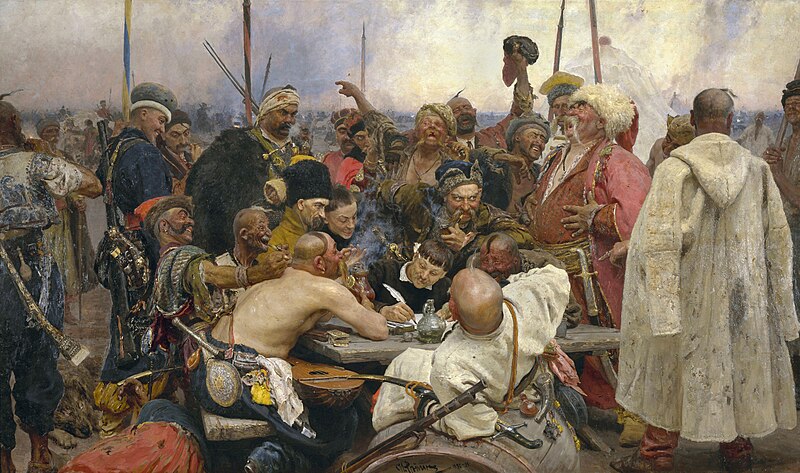
File:Ilja_Jefimowitsch_Repin_-_Reply_of_the_Zaporozhian_Cossacks_-_Yorck.jpg · Wikimedia Commons · See Wikimedia Commons
Kozakken
Sign in to saveoverwegend Oost-Slavisch orthodox-christelijk ruitervolk afkomstig van de Pontische steppe
Cossacks are a historically distinct group of people from Eastern Europe and Russia, particularly known for their traditional military and frontier communities. They remain culturally significant today, as evidenced by their continued presence in parades and family communities across Russia and among diaspora populations.
AI-generated from the Wikipedia summary — may contain errors.
Wikidata facts
- Instance of
- occupation
- Subclass of
- military
- Image
- Repin Cossacks.jpg
Show 6 more facts
- commanded by
- hetman
- Commons category
- Cossacks
- topic's main category
- Category:Cossacks
- described by source
- Granat Encyclopedic Dictionary
- different from
- Kazakhs
- on focus list of Wikimedia project
- Wikipedia:Vital articles/Level/4
Sources (1)
via Wikidata · CC0
Article · Nederlands
De Kozakken (Oekraïens: enkv. козак; Kozak; meerv. козаки; Kozaky, Russisch: enkv. казак; Kazak; meerv. казаки; Kazaki, Pools: Kozak; meerv. Kozacy) zijn een traditionele gemeenschap van mensen die leven in het zuidelijke steppegebied van Oost-Europa en Aziatisch Rusland. Ze staan bekend om hun onafhankelijke levenswijze en militaire vaardigheden, vooral wat betreft hun rijkunsten. De (symbolische) hoofdstad van de Kozakken is sinds 1993 het historische Don-Kozakkencentrum Novotsjerkassk in het zuidwesten van Rusland.
Abstract from DBpedia / Wikipedia · CC BY-SA
Gallery (52)
Available in 92 languages
- Español
- Français
- Deutsch
- 中文
- 日本語
- Русский
- Português
- Italiano
- العربية
- हिन्दी
- Afrikaans
- Armenian
- Asturian
- Azerbaijani
- Bahasa Indonesia
- Bashkir
- Basque
- be_x_old
Show 73 more
- Belarusian
- Bosnian
- Breton
- Bulgarian
- Catalan
- Chechen
- Church Slavic
- Chuvash
- Crimean Tatar
- Croatian
- Czech
- Danish
- Egyptian Arabic
- Esperanto
- Estonian
- Finnish
- Friulian
- Galician
- Georgian
- Greek
- Hebrew
- Hungarian
- Icelandic
- Ido
- Irish
- Kannada
- Karachay-Balkar
- Kazakh
- Kurdish
- Kyrgyz
- Latin
- Latvian
- Lithuanian
- Macedonian
- Malagasy
- Malay
- Malayalam
- Mari
- Mingrelian
- Moksha
- Mongolian
- Nederlands
- Norwegian
- Norwegian Nynorsk
- Occitan
- Ossetic
- Polski
- Punjabi
- Romanian
- Scottish Gaelic
- Serbian
- Serbian (Latin)
- simple
- Slovak
- Slovenian
- Svenska
- Tajik
- Tamil
- Tatar
- Tiếng Việt
- Türkçe
- Ukrainian
- Urdu
- Uzbek
- Veps
- Walloon
- Welsh
- Western Panjabi
- Wu Chinese
- zh_yue
- فارسی
- ไทย
- 한국어
via Wikidata sitelinks · CC0