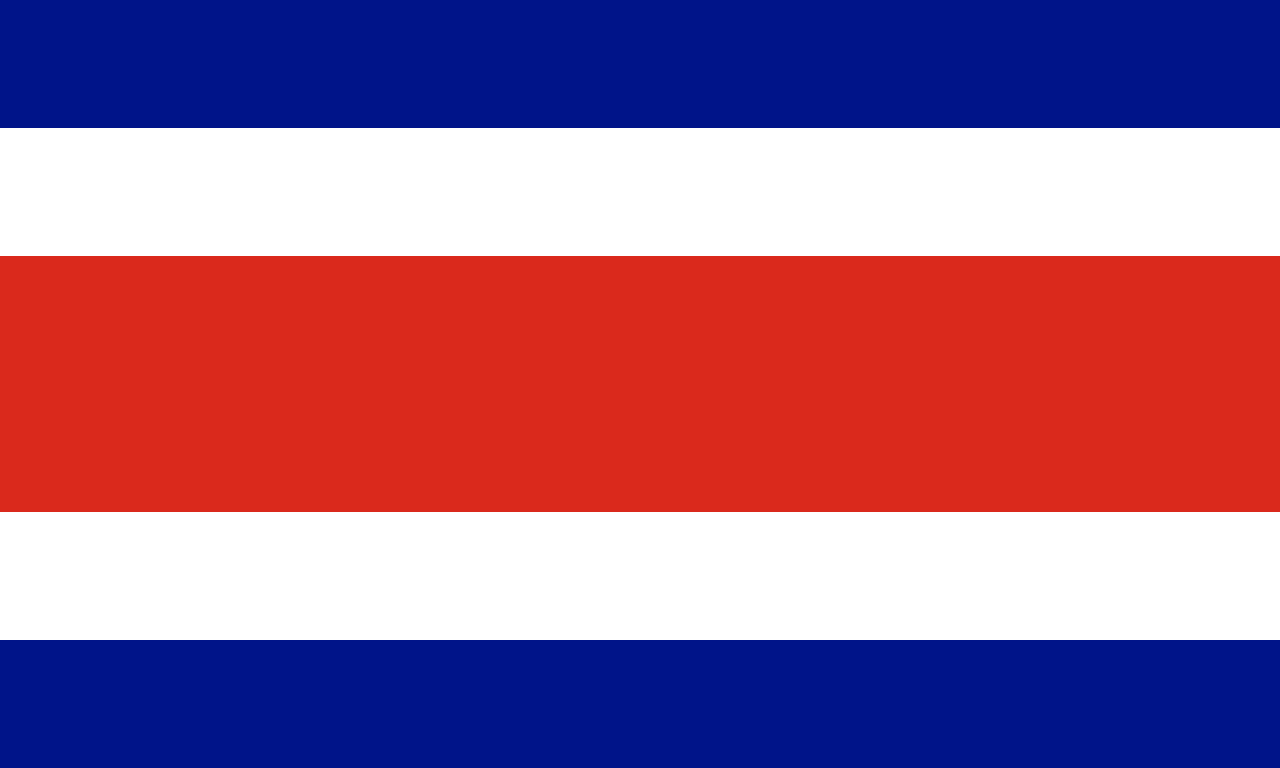
Costa Rica
Sign in to saveAlso known as Republic of Costa Rica, cr, CRI, CRC
Costa Rica, officially the Republic of Costa Rica, is a country in Central America. It borders Nicaragua to the north, the Caribbean Sea to the northeast, Panama to the southeast, and the Pacific Ocean to the southwest, sharing a maritime border with Ecuador to the south of Cocos Island. It has a population of around five million in a land area of nearly 51,180 km2 (19,760 sq mi); the capital and largest city is San José, home to around 350,000 residents and two million people in the surrounding metropolitan area.
OverviewAI-generated
Costa Rica, officially the Republic of Costa Rica, is a country in Central America, part of the Americas region and the continent of North America. Its capital is San José. The nation has a population of 5309625 and covers an area of 51100. It is characterized as a free country. The official currency is the Costa Rican colón, with the Costa Rican peso also listed. The country uses the license plate code CR and the top-level domain .cr.
The head of state and head of government holds the office of President of Costa Rica, and the legislative body is the Legislative Assembly of Costa Rica. Costa Rica has diplomatic relations with Brazil, Germany, Australia, and Chile. Its patron saint is the Virgin of the Angels. The country’s inception is dated to 1821-01-01. Emergency services are reached via the number 911. The flag is represented by the Unicode character 🇨🇷.
Synthesized by Vinony from 71 facts across 10 sources: Wikidata, Openweathermap, Open Meteo, World Bank, OpenStreetMap, Firecrawl, REST Countries, PubMed, Vinony graph, Geo. Generated from structured data (not the Wikipedia text) and checked against those facts — may still contain errors.
Weather now
7-day forecast
via Open-Meteo
Country
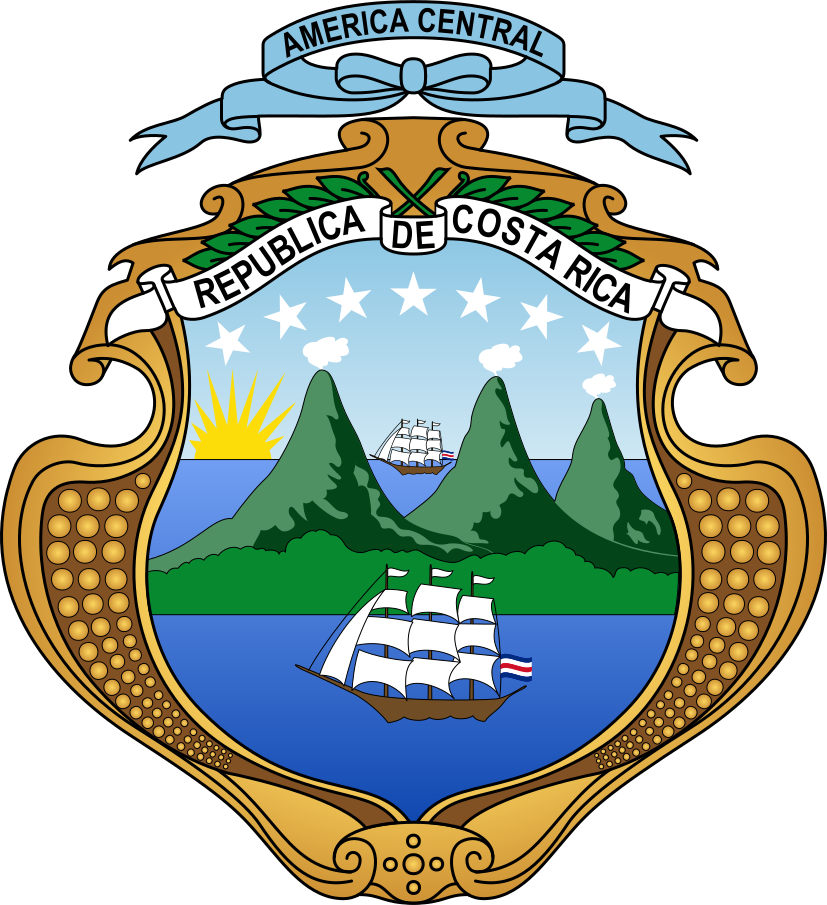

- Capital
- San José
- Population
- 5,309,625
- Region
- Americas · Central America
- Demonym
- Costa Rican
- Currencies
- CRC (₡)
- Languages
- Spanish
- Calling code
- +506
- Drives on
- Right
- Gini
- 48.2 (2019)
- FIFA code
- CRC
- TLD
- .cr
- Timezones
- UTC-06:00
- Borders
- NIC, PAN
via REST Countries
Indicators · World Bank
- GDP
- $95.4B(2024)
- Population
- 5,129,910(2024)
- Life expectancy
- 81 yrs(2024)
- Unemployment
- 6.8 %(2025)
- Urban population
- 79.3 %(2024)
- Internet users
- 87.2 %(2024)
- Forest area
- 60.4 %(2023)
- Renewable energy
- 34.2 %(2021)
via World Bank Open Data · CC BY 4.0
Place details
- Locality
- Dulce Nombre de Jesús
- Country
- Costa Rica
- Population
- 4,999,441
- Timezone
- America/Costa_Rica
via OpenStreetMap · GeoNames
Wikipedia views (30d)
112,407 totalvia Wikimedia Pageviews API
Research
15,717 papers- IVF in Costa Rica.ReviewJBRA assisted reproduction · 2017Valerio C, Vargas K, Raventós HDOI: 10.5935/1518-0557.20170060
- Implementing sustainable primary healthcare reforms: strategies from Costa Rica.ReviewBMJ global health · 2020Spigel L, Pesec M, Villegas Del Carpio O et al.DOI: 10.1136/bmjgh-2020-002674
- Severe Rickettsia typhi Infections, Costa Rica.Emerging infectious diseases · 2023Chinchilla D, Sánchez I, Chung I et al.DOI: 10.3201/eid2911.221561
- Costa Rica.Department of State publication. Background notes series · 1986United States. Department of State. Bureau of Public Affairs
- Chronic kidney disease in Costa Rica.ReviewKidney international. Supplement · 2005Cerdas MDOI: 10.1111/j.1523-1755.2005.09705.x
- Costa Rica.Department of State publication. Background notes series · 1989United States. Department of State. Bureau of Public Affairs
- Genome-Based Characterization of Listeria monocytogenes, Costa Rica.Emerging infectious diseases · 2023Giralt-Zúñiga M, Redondo-Solano M, Moura A et al.DOI: 10.3201/eid2912.230774
- Costa Rica's Marine Protected Areas: status and perspectives.ReviewRevista de biologia tropical · 2012Alvarado JJ, Cortés J, Esquivel MF et al.DOI: 10.15517/rbt.v60i1.2657
via PubMed
Official website
Gobierno de Costa Rica | Presidencia de la República de Costa Rica
presidencia.go.cr →Link to the official site · 27,648 chars · not written by Vinony
Wikidata facts
- Instance of
- country
- Official name
- Republic of Costa Rica
- Demonym
- Cósta Ríceach
- Country
- Costa Rica
- Contains
- Heredia Province
- Continent
- North America
- Capital
- San José
- Official language
- Spanish
- Currency
- Costa Rican peso
- Population
- 5265575
- Area
- 51179.92
- Body of water
- Pacific Ocean
- Head of government
- Miguel Ángel Rodríguez Echeverría
- Head of state
- Rodrigo Chaves
- Legislature
- Legislative Assembly of Costa Rica
- Shares border with
- Nicaragua
- Highest point
- Cerro Chirripó
- Official website
- www.presidencia.go.cr
- Life expectancy
- 77
- Nominal GDP
- 68380838316
- Unemployment rate
- 8
- Calling code
- +506
Show 67 more facts
- Licence plate code
- CR
- Mains voltage
- 120
- Motto
- Essential Costa Rica
- Coat of arms
- coat of arms of Costa Rica
- Patron saint
- Virgin of the Angels
- coordinates of easternmost point
- 5.51879,-87.09442
- topic's main Wikimedia portal
- Portal:Costa Rica
- Unicode character
- 🇨🇷
- category of associated people
- Category:Costa Rican people
- emergency phone number
- 112
- geography of topic
- Geography of Costa Rica
- office held by head of government
- President of Costa Rica
- has characteristic
- free country
- number of out-of-school children
- 56289
- diplomatic relation
- China
- inception
- 1821-01-01
- office held by head of state
- President of Costa Rica
- Commons gallery
- Costa Rica
- history of topic
- history of Costa Rica
- mobile country code
- 712
- total fertility rate
- 1.819
- maritime identification digits
- 321
- marriageable age
- 18
- topic's main category
- Category:Costa Rica
- central bank
- Central Bank of Costa Rica
- category for films shot at this location
- Category:Films shot in Costa Rica
- category for people who died here
- Category:Deaths in Costa Rica
- Commons category
- Costa Rica
- top-level Internet domain
- .cr
- category for people born here
- Category:Births in Costa Rica
- driving side
- right
- lowest point
- Caribbean Sea
- described by source
- The Nuttall Encyclopædia
- language used
- Boruca
- native label
- República de Costa Rica
- suicide rate
- 7.6
- GS1 country code
- 744
- culture
- culture of Costa Rica
- VAT rate
- 13
- literacy rate
- 97.41
- P6413
- Costa Rica
- BTI Status Index
- 8.37
- BTI Governance Index
- 7.13
- economy of topic
- economy of Costa Rica
- demographics of topic
- Demographics of Costa Rica
- Democracy Index
- 8.16
- topic has template
- Template:Provinces of Costa Rica
- Human Development Index
- 0.809
- P11012
- Ecuador
- hashtag
- CostaRica
- on focus list of Wikimedia project
- Wikipedia:Vital articles/Level/4
- Gini coefficient
- 49.3
- Happy Planet Index score
- 62.1
- Inequality-adjusted Human Development Index
- 0.664
- social media followers
- 58337
- P12749
- Montana
- P8168
- Rezhet
- birth rate
- 11.686
- male population
- 2590709
- death rate
- 7.113
- rural population
- 930373
- female population
- 2590119
- urban population
- 4250456
- located in/on physical feature
- Central America
- most populous urban area
- San José
Sources (15)
via Wikidata · CC0
Travel guide
Understand
thumb|A path in the rainforest Since the late 1980s, Costa Rica has been a popular nature travel destination, and its main competitive advantage is its well-established system of national parks and protected areas, covering almost 28% of the country's land area, the largest in the world as a percentage of the country's territory, and home to a rich variety of flora and fauna, in a country covering only 0.03% of the world's landmass, but containing about 5% of the world's biodiversity. The country also has plenty of world renowned beaches, in the Pacific Ocean and in the Caribbean Sea, within short travel distances between the coasts, and also several active volcanoes that can be visited safely.
Costa Rica has managed to avoid the political turmoil and violence plaguing the region. President Figueres constitutionally abolished the Costa Rican army permanently in 1948 after winning the 44-day civil war, the last significant political violence in the country. Costa Rica is Latin America's oldest democracy (since the Chilean coup d'etat in 1973) and one of only a handful of presidential republics in the world to last more than five decades. Costa Rica placed 5th among 21 Latin American countries (68th overall) in the 2018 Human Development Index. It frequently performs better than countries with higher GDP per capita in this measure and while still plagued with stark income and wealth inequality, it has these problems to a lesser extent than many other Latin American countries. …
Get in
thumb|375px|A map showing the visa requirements of Costa Rica, with countries in blue having visa-free access; and countries in khaki having restricted visa
Get around
thumb|250px|Cocos Island coastline
Eat
thumb|Casado, which includes gallo pinto, salad, meat and fried plantains Costa Rican cuisine can be described as simple but wholesome. The spiciness often associated with Latin America has typically originated in Mexico; Costa Rican food is generally subtle, but, as the ingredients simmer in a large pot, the flavors are blended. If you don't like cilantro (coriander), learn to ask for it to be left out. The locals are unaware that it is a divisive issue to some foreigners!
Gallo pinto is a mixture of rice and beans with a little cilantro or onion thrown in. While more common at breakfast, it can also be served at lunch or dinner.
Casado, which means married, is the typical lunch in Costa Rica, containing rice and beans with meat, chicken or fish, always served with salad and fried plantain.
Plato del dia, is the 'Plate of the Day' and is often a casado, but has the meat or fish selection of the day. Usually around US$5 and includes a natural juice.
Sopa negra, literally "black soup", is a type of soup made with black beans, thus giving it its color, and often paired with some rice.
Tres leches, literally "three milks", is a cake that serves as the quintessential Costa Rican dessert. The "three milks" refer to condensed milk, evaporated milk and cream, all of which are used to make the dish. As the name suggests, it is rather rich, so beware if you are lactose intolerant.
Chicharrones refers to fried pork rinds. Unlike its better-known Mexican counterpart, which largel…
Drink
Most places have potable water, so don't worry about drinking tap water, although some beach towns such as Puerto Viejo are said to be an exception. Bottled water is also available at low prices.
Ready-to-drink coffee is excellent and considered to be among the best in the world.
Refrescos are beverages made from fresh fruit (cas, guanabana, sandia/watermelon, mora/blackberry, fresa/strawberry, granadilla/passion fruit), sugar, and either water or milk. All small, cheap diners – known locally as sodas – serve these. You can also easily buy the standard international soft drinks. Fresca, Canada Dry, and the local Fanta Kolita (fruit punch) are recommended.
The national drink is called guaro, which is made from fermented sugar cane. It tastes similar to vodka, and is usually drunk with water and lemon. The state-owned brand is called Cacique and is the national drink. As in other places, do not drink home-distilled spirits, which may contain poisonous methanol.
There are around eight national beers available (and most international), which are sold in cans, bottles and even kegs. The most common beers are Pilsen and Imperial: all bars and restaurants serve both. Bavaria, "Bavaria Negra" (dark) and Bavaria Light are considered higher quality but more expensive, Rock Ice and Rock Ice Limón (lemon flavor) has a higher alcohol percentage and is less common in rural areas. Heineken is locally made under license and is more expensive as well.
Selling and serving alcoholic bevera…
Sleep
You can find many places to stay all over Costa Rica, including hotels, aparthotels, condos, vacation rentals, and cabinas. Vacation homes, cabinas, and condos can be less expensive than hotels and provide more flexibility in your adventure to Costa Rica. Costa Rica is known as a world leader for eco and sustainable travel and accommodations are often listed as 'eco-lodges'. They do tend to be more expensive though the government does have a well functioning certification program. Be careful of so-called "motels", see below.
Apart from the big reservation websites, also checkout Google Maps, which has many home stays, guesthouses and such including location, rating and phone number (for WhatsApp). This is generally cheaper than booking online, but always compare.
The share of local oriented businesses without a website and where the owner only speaks Spanish is notably lower than in Nicaragua, but those also exist, especially off the beaten tourist path. They can be cheaper sometimes, but unless you know their phone number it can be difficult to book ahead.
There are backpackers' hostels are all over Costa Rica with dorm beds from as low as US$8 a night (March 2022).
Stay healthy
Costa Rica has one of the highest levels of social care in the world. Its doctors are known worldwide as some of the best. Many people from the U.S., Canada, and Europe go there to be treated, not only because of quality but also cost. First class hospitals can be found in the capital. There are public and private hospital systems that provide excellent care. The public system has much longer waits, while the private system has shorter waits. If you have a very sick child requiring hospitalization, the child will be transferred to the only children's hospital in Costa Rica, in San José. This children's hospital is public.
For information on the current COVID-19 situation in Costa Rica, see Costa Rica's COVID-19 webpage.
Generally, no vaccinations are needed to get into Costa Rica, but you should bring bug-repellent to keep away mosquitoes and other biting insects and prevent malaria and other similar diseases. In 2019, the U.S. Centers for Disease Control reported local transmission of malaria in the Distritos of Cutris and Pocosol in San Carlos Canton of Alajuela Province, and rare local cases in other parts of Alajuela, Heredia, Limón, and Puntarenas Provinces. Protection against mosquito bites is very important, wearing lightweight long pants, long-sleeved shirts, a hat and using insect repellents with high concentrations of DEET is recommended by the CSC. If you are going to be in very rural areas known to be malaria-infested, you might want to consider an anti-malari…
Stay safe
thumb|Mounted police officers Travel to Costa Rica is common, with 2.6 million people visiting annually, more than any other Latin American country. Costa Rica is generally regarded to be one of the less crime-ridden countries in Latin America and is the most politically stable, with no successful coups or wars since the current republic was established in 1948. However, stable does not equal rich, and high wealth inequality in urban areas has fueled crime.
Costa Rica is often considered one of the safest countries in Central America. The 2024 Global Peace Index ranked Costa Rica as the safest country in the region, with its ranking at 58 nearly twice as high as that of the United States. Still, travellers to Costa Rica should exercise caution as they would in any foreign country or tourist area. The emergency number in Costa Rica is 911.
Travelling alone is fine and generally safe in Costa Rica, but carefully consider what kind of risks (if any) you are willing to take. Always hike with other people and try to explore a new city with other people. On solo forays, if you feel uncomfortable, seek out a group of other people (both women and men). A well-lit place with people you can trust is always a plus. A busy restaurant or hostel is a great source of local info as well as a great place to relax and recharge.
Respect
In general, Ticos are very hospitable and laidback people, happy to assist visitors in any manner necessary. Being bien educado (well-mannered) is emphasised heavily in Costa Rica. You will typically be greeted with “buenos días”, “buenas” or other iterations upon entering stores and other establishments, and it is polite to reciprocate this gesture. Other niceties go a long way, such as saying “disculpe” (pardon me) when bumping into another person or prefacing a question. Avoid using straight-out “give me…” commands and instead be gentle when asking for something, saying “¿me podria dar…, por favor?” (could you give me…, please?) or “quisiera…” (I would like…). Even though many people can speak some English, learning at least a few basic greetings in Spanish goes a long way.
As in other Latin American countries, Costa Ricans have a relaxed sense of time compared to North Americans and Europeans. Don’t fight it, simply go along with it and embrace the slower pace of life and pura vida philosophy. Becoming frustrated is likely to generate amusement and will seldom achieve results for you. However, arriving late in professional settings (i.e. work) is ill-advised, as it would be anywhere else in the world.
Keep in mind that a few U.S. dollars, when converted to Colones, can go a long way for locals. While tipping is not the norm in restaurants and other food and drink establishments, leaving even a small tip can be worth it for some services, especially if you don't feel lik…
Connect
thumb|Post office in Heredia The international calling code/country code for Costa Rica is +506.
Sending a postcard to US, Europe or Asia is ₡385, ₡435, or ₡545, respectively. Other mail is becomes more expensive the more it weights.
The primary means of outside contact are through e-mail, SIM cards for unlocked phones, or public pay telephones.
Internet cafes are fairly easy to find in tourist areas, with variation in prices. Some of these offer long distance calls over the internet.
Travel guide from Wikivoyage (CC BY-SA 4.0)
~40 min read
Encyclopedic overview
Costa Rica, officially the Republic of Costa Rica, is a country in Central America. It borders Nicaragua to the north, the Caribbean Sea to the northeast, Panama to the southeast, and the Pacific Ocean to the southwest, sharing a maritime border with Ecuador to the south of Cocos Island. It has a population of around five million in a land area of nearly 51,180 km (19,760 sq mi); the capital and largest city is San José, home to around 350,000 residents and two million people in the surrounding metropolitan area.
Humans have been present in Costa Rica since between 7,000 and 10,000 BC. Various indigenous peoples lived in the territory before it was colonized by Spain in the 16th century. Costa Rica was a peripheral colony of the Spanish Empire until independence in 1821 as part of the First Mexican Empire, followed by membership in the Federal Republic of Central America in 1823, from which it formally declared independence in 1847. The country underwent gradual modernization under relatively stable authoritarian rule until the late 19th century, when it promulgated a liberal constitution and held the first free and fair national election in Central America.
Excerpted from Wikipedia’s “Costa Rica” article, available under the CC BY-SA 4.0 licence.
Gallery (16)
On the map
2 mapped locations
Available in 244 languages
- Español
- Français
- Deutsch
- 中文
- 日本語
- Русский
- Português
- Italiano
- العربية
- हिन्दी
- Abkhazian
- abstract
- Achinese
- Adyghe
- Afrikaans
- Albanian
- Albanian
- Amharic
Show 225 more
- ami
- Angika
- Aragonese
- Armenian
- Arpitan
- Asturian
- Aymara
- azb
- Azerbaijani
- Bahasa Indonesia
- Balinese
- Bambara
- Bangla
- Bashkir
- Basque
- bat_smg
- Batak Toba
- Bavarian
- be_x_old
- Belarusian
- Betawi
- Bhojpuri
- Bikol
- Bishnupriya
- Bislama
- Bosnian
- Breton
- Bulgarian
- Buriat
- Burmese
- Catalan
- cbk_zam
- cdo
- Cebuano
- Central Kurdish
- Chechen
- Cherokee
- Cornish
- Corsican
- Crimean Tatar
- Croatian
- Czech
- dag
- Danish
- Divehi
- dty
- Egyptian Arabic
- Erzya
- Esperanto
- Estonian
- Ewe
- Extremaduran
- Faroese
- Fiji Hindi
- Filipino
- Finnish
- fiu_vro
- Fula
- Gagauz
- Galician
- gcr
- Georgian
- Gilaki
- Goan Konkani
- Greek
- Guarani
- Gujarati
- Haitian Creole
- Hakka Chinese
- Hausa
- Hebrew
- Hungarian
- hyw
- Icelandic
- Ido
- Iloko
- Inari Sami
- Interlingua
- Interlingue
- Irish
- Jamaican Creole English
- Javanese
- Kabyle
- Kannada
- Kara-Kalpak
- Karachay-Balkar
- Kashmiri
- Kazakh
- kbp
- Kinyarwanda
- Komi
- Kotava
- Kurdish
- Kyrgyz
- Ladino
- Lao
- Latin
- Latvian
- Ligurian
- Limburgish
- Lingala
- Lingua Franca Nova
- Lithuanian
- lld
- Lojban
- Lombard
- Low German
- Lower Sorbian
- Luxembourgish
- Macedonian
- Madurese
- Malagasy
- Malay
- Malayalam
- Maltese
- Manipuri
- Manx
- Māori
- map_bms
- Marathi
- Mari
- Mazanderani
- Minangkabau
- Mingrelian
- Mirandese
- Moksha
- Mongolian
- Moroccan Arabic
- nds_nl
- Nederlands
- Nepali
- Newari
- Northern Frisian
- Northern Sami
- Norwegian
- Norwegian Nynorsk
- Novial
- Occitan
- Odia
- Old English
- olo
- Oromo
- Ossetic
- Pampanga
- Papiamento
- Pashto
- Picard
- Piedmontese
- Polski
- Punjabi
- Quechua
- rki
- roa_rup
- Romanian
- Romansh
- Samoan
- Sanskrit
- Santali
- Sardinian
- Saterland Frisian
- Scots
- Scottish Gaelic
- Serbian
- Serbian (Latin)
- Shan
- Shona
- Sicilian
- Silesian
- simple
- Sindhi
- Sinhala
- skr
- Slovak
- Slovenian
- Somali
- Standard Moroccan Tamazight
- Sundanese
- Svenska
- Swahili
- Swati
- szy
- Tajik
- Tamil
- Taroko
- Tatar
- tay
- Telugu
- Tetum
- Tibetan
- Tiếng Việt
- Toki Pona
- Tongan
- Türkçe
- Turkmen
- Udmurt
- Ukrainian
- Upper Sorbian
- Urdu
- Uyghur
- Uzbek
- Venetian
- Veps
- Volapük
- Walloon
- Waray
- Welsh
- West Flemish
- Western Frisian
- Western Mari
- Western Panjabi
- Wolof
- Wu Chinese
- Yakut
- Yiddish
- Yoruba
- Zaza
- Zeelandic
- zh_classical
- zh_min_nan
- zh_yue
- Zhuang
- Zulu
- فارسی
- ไทย
- 한국어
via Wikidata sitelinks · CC0