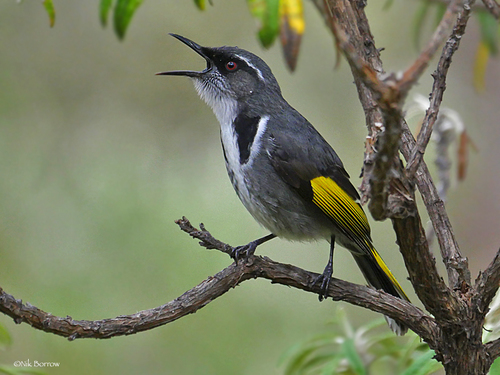
(c) Nik Borrow, some rights reserved (CC BY-NC) · cc-by-nc
Crescent Honeyeater
Sign in to saveAlso known as Phylidonyris pyrrhopterus, Certhia pyrrhoptera, Certhia australasiana, Melithreptus melanoleucus, Meliphaga inornata, Phylidonyris pyrrhoptera, Phylidonyris (Phylidonyris) pyrrhopterus
species of bird
Species
Least ConcernCrescent Honeyeater
species
via IUCN
Wikidata facts
- Instance of
- taxon
- Parent taxon
- Phylidonyris
- Image
- Phylidonyris pyrrhopterus male.jpg
Show 8 more facts
- taxon rank
- species
- IUCN conservation status
- Least Concern
- Commons category
- Phylidonyris pyrrhopterus
- taxon name
- Phylidonyris pyrrhopterus
- taxon common name
- olovastotrbi medojed
- endemic to
- Australia
- egg incubation period
- 13
- short name
- P. pyrrhopterus
Sources (2)
via Wikidata · CC0
~15 min read
Encyclopedic overview
The crescent honeyeater (Phylidonyris pyrrhopterus) is a passerine bird of the honeyeater family Meliphagidae native to southeastern Australia. A member of the genus Phylidonyris, it is most closely related to the common New Holland honeyeater (P. novaehollandiae) and the white-cheeked honeyeater (P. niger). Two subspecies are recognized, with P. p. halmaturinus restricted in range to Kangaroo Island and the Mount Lofty Ranges in South Australia.
It has dark grey plumage and paler underparts, highlighted by yellow wing-patches and a broad, black crescent, outlined in white, down the sides of its breast. The species exhibits slight sexual dimorphism, with the female being duller in colour than the male. Juvenile birds are similar to the female, though the yellow wing-patches of male nestlings can be easily distinguished.
Excerpted from Wikipedia’s “Crescent Honeyeater” article, available under the CC BY-SA 4.0 licence.