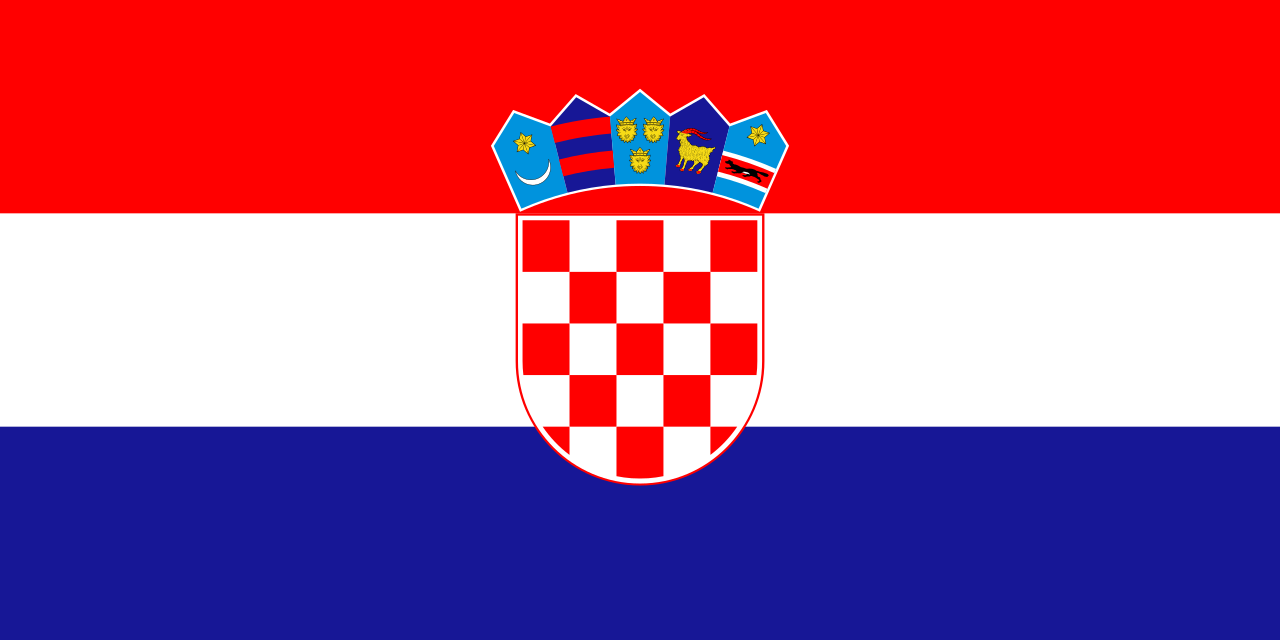
Croacia
Also known as Republic of Croatia, HR, HRV, CRO, RH
país de Europa del sudeste
AI overview
Croatia is a country located in Central and Southeast Europe along the Adriatic Sea coast, bordered by Slovenia, Hungary, Serbia, Bosnia and Herzegovina, Montenegro, and Italy. With a capital in Zagreb, a population of nearly 3.9 million, and major cities including Split, Rijeka, and Osijek, it serves as an important geographic and cultural hub in the region.
AI-generated from the Wikipedia summary — may contain errors.
Weather now
20°clear sky
62% 0.8 m/s OpenWeatherMap
7-day forecast
via Open-Meteo
Country

- Capital
- Zagreb
- Population
- 3,866,233
- Region
- Europe · Southeast Europe
Travel guide
Understand
300px|thumb|right|Croatia has 1244 islands thumb|right|Ban Jelačić Square in Zagreb
Get in
thumb|450px| Visa policy of Schengen states
See
thumb|300px|right|Croatian National Theatre in [[Zagreb]] Croatia is dense with places that are well worthy of a visit, owing to its diverse regions, each with its own layered past. Towns and cities generally have a historical urban core that exhibits the architectural heritage of a specific era. To a get a sense of Croatia as a whole—how it was shaped by different influences, and the resulting contrasts—it is important to visit both the coastal and the inland part of the country. Dubrovnik being such a world renowned destination, it is often taken as the exemplar of the former style. However it is more of an enclosed world with its admirably individual aesthetic (having been an independent city-state for the most of its history). Other similarly gratifying places, like Šibenik, carry the true spirit of Dalmatia, but going further north along the coast, there is Rijeka, which again has quite a different kind of charm.
Dominating continental Crotia lies its capital of Zagreb, a home to nearly 1 million. It is a modern city with all the modern features, yet it mostly has an easy-going atmosphere. In the east, in the region of Slavonia with its regional capital Osijek and the war torn Vukovar are awe inspiring. Scattered throughout the region are vineyards and wine cellars, most of which give tours and tastings.
Throughout the country there are numerous cultural venues that are worth seeing. Croatia has 10 UNESCO World Heritage Sites, 8 national parks and 10 nature parks. In t…
Do
300px|thumb|right|City of [[Hvar has average of 2726 hours of sunshine per year, as do many other Croatian towns on Adriatic coast. Croatia is a land of urban culture which numbers more cities than any other part of the Mediterranean]]
Eat
thumb|Croatian cheese
Croatian cuisine is quite diverse so it is hard to say what meal is most typically Croatian. In the eastern continental regions (Slavonija and Baranja) spicy sausage such as kulen or kulenova seka is a must try. Čobanac ("shepherd's stew") is a mixture of several kinds of meat with a lot of red spicy paprika. In Hrvatsko Zagorje and Central Croatia pasta filled with cheese called štrukli is a famous delicacy (it is said that the best štrukli in Croatia is served in the Esplanade Hotel restaurant in Zagreb), as is purica s mlincima, which is baked turkey cooked in a special kind of pastry. Sir i vrhnje (sour cream with cottage cheese) can be bought fresh on the Zagreb main market Dolac. Croats love a bit of oil and you will find plenty of it in piroška. In the mountainous regions of Lika and Gorski Kotar meals containing mushrooms, wild berries and game meat are very popular. One of typical dishes in Lika is police (oven-baked potatoes covered with bacon) and several kinds of cheese (smoked cheese and škripavac).
Article · Español
Croacia (en croata, Hrvatska, AFI: [xř̩.ʋaː.ʦkaː]), oficialmente República de Croacia (Republika Hrvatska (?·i)), es uno de los veintisiete estados soberanos que integran la Unión Europea, ubicado entre Europa Central, Europa meridional y el mar Adriático; limita al noreste con Hungría, al este con Serbia, al sureste con Bosnia-Herzegovina y Montenegro, al noroeste con Eslovenia y al suroeste con el mar Adriático; donde comparte una frontera marítima con Italia. Su capital y ciudad más poblada es Zagreb. Tiene 56 594 km² de extensión territorial —esta cifra incluye las más de mil islas (1185) que se ubican frente a la costa del mar Adriático— y cuenta con un clima variado, en su mayor parte continental y mediterráneo. En cuanto a la administración política, el país está dividido en veinte condados y la ciudad de Zagreb. Su población, según el censo de 2021, es de 3 888 529 habitantes. La mayor parte de ellos son croatas de religión católica. A principios del siglo VII los croatas llegaron a la zona y dos siglos más tarde se organizaron en dos ducados. En el año 925 Tomislav se convirtió en el primer rey, elevando el estatus del estado a un reino. El Reino de Croacia mantuvo su soberanía por casi dos siglos, y alcanzó su apogeo durante el reinado de Pedro Krešimir IV y Demetrio Zvonimir. Croacia formó una unión personal con Hungría en 1102. En 1527, amenazado por la expansión otomana, el parlamento croata eligió a Fernando I de Habsburgo como sucesor del trono croata. En 1918, tras la Primera Guerra Mundial, formó parte del efímero Reino de los Serbios, Croatas y Eslovenos, el cual se había separado de Austria–Hungría, y que posteriormente se transformó en el Reino de Yugoslavia. Durante la Segunda Guerra Mundial se fundó un Estado títere de la Alemania nazi. Luego de la guerra, Croacia fue un miembro fundador y elemento federal de la Segunda Yugoslavia, un Estado socialista. En junio de 1991 Croacia declaró su independencia, la cual fue reconocida el 8 de octubre de ese año. La guerra croata de Independencia tuvo lugar en los cuatro años sucesivos a la declaración. En 2012 Croacia mantenía un Índice de Desarrollo Humano muy alto. El Fondo Monetario Internacional la clasificó como una economía emergente y en desarrollo, mientras que el Banco Mundial la identificó como una economía de altos ingresos. Croacia es miembro de la ONU, el Consejo de Europa, la OTAN, la Organización Mundial de Comercio y es un miembro fundador de la Unión por el Mediterráneo. Además, en julio de 2013 Croacia accedió a la Unión Europea. Como un miembro activo de las Fuerzas de paz de las Naciones Unidas, ha contribuido con tropas a la misión de seguridad de la OTAN en Afganistán y durante el periodo de 2008 a 2009 ocupó un asiento del Consejo de Seguridad de la ONU. La economía croata está dominada por el sector servicios, seguido por la industria y la agricultura. El turismo es una fuente de ingresos importante durante el verano, ya que el país se encuentra dentro de los veinte destinos turísticos más visitados en el mundo. El Estado controla una parte de la economía, con un gasto gubernamental importante y su principal socio comercial es la Unión Europea. Desde el 2000 el país invirtió en infraestructura, especialmente en caminos y medios de transporte, así como en los corredores Pan-Europeos. El Estado croata provee de un sistema de salud universal y educación primaria y secundaria gratuita, al mismo tiempo que apoya la cultura por medio de diversas instituciones públicas e inversiones en los medios de comunicación y la literatura.
Gallery (59)
On the map
60 mapped locations
Connections
Categories
Countries and territories where Croatian is an official languageCountries in EuropeCountries in the BalkansCroatiaMember states of NATOMember states of the European UnionMember states of the Three Seas InitiativeMember states of the Union for the MediterraneanMember states of the United NationsRepublicsStates and territories established in 1991