File:Crocodilia_montage.jpg · Wikimedia Commons · See Wikimedia Commons
Crocodilia
Sign in to saveAlso known as Crocodylia
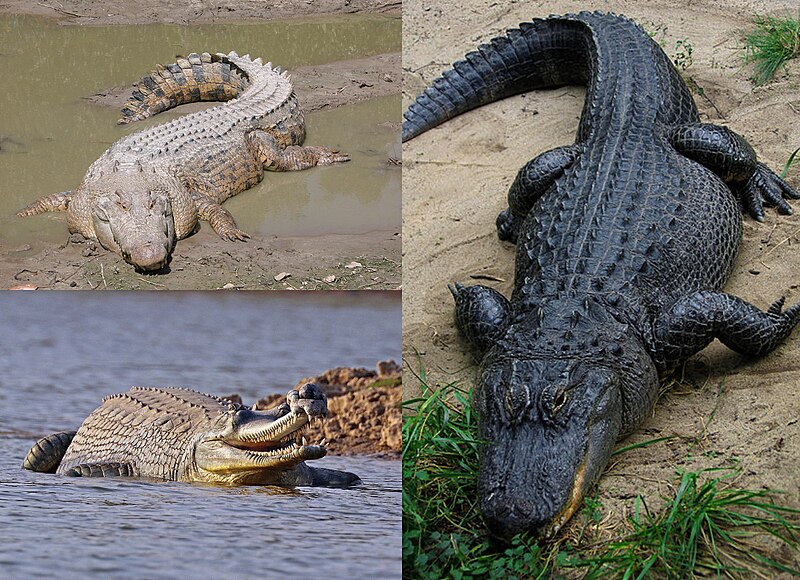
Crocodilia () is an order of semiaquatic, predatory reptiles that are known as crocodilians. They appeared 83.5 million years ago in the Late Cretaceous period (Campanian stage) and are the closest living relatives of birds, as the two groups are the only known survivors of the Archosauria. Members of the crocodilian total group, the clade Pseudosuchia, appeared about 250 million years ago in the Early Triassic period, and diversified during the Mesozoic era. The order includes the true crocodiles (family Crocodylidae), the alligators and caimans (family Alligatoridae), and the gharial and fal
OverviewAI-generated
Crocodilia is a taxon classified as a Class within the phylum Chordata. It was established by Deraniyagala in 1939 and is recognized as an accepted group. The organisms inhabit marine, brackish, and freshwater environments.
The group originated approximately 84 million years ago. Records indicate its presence in the United States, with specimens held by institutions including ALMNH, NMMNHS, and UCM. There are 85 records associated with this subject, though no media files are currently listed.
The taxon is referenced by 1,479 other encyclopedia articles. It is categorized under the Commons category "Crocodilia," which also hosts a corresponding gallery.
Synthesized by Vinony from 15 facts across 4 sources: Wikidata, WoRMS, iDigBio, Vinony graph. Generated from structured data (not the Wikipedia text) and checked against those facts — may still contain errors.
Species
Class
- PhylumChordata
- ClassCrocodylia
Crocodilians are members of the taxon Crocodilia and include the crocodiles, alligators, gavials, and caimans. With some possible exceptions, crocodilians are more closely related to birds than to any other living reptile. Crocodilians are large reptiles with powerful limbs and tails and heavy plates of bone (osteoderms) beneath the skin. All crocodilian species have webbed feet, a transparent membrane drawn across the eye underwater, nostrils at the top of the snout, and other adaptations for an aquatic lifestyle. Crocodilians also have well-developed senses of smell, sight, and hearing. Of the 23 crocodilian species that exist in the world, the American crocodile and the American alligator are native to the United States. A third species, the common caiman, is an introduced species in Florida.
via
Wikidata facts
Show 10 more facts
- taxon rank
- order
- Commons category
- Crocodilia
- taxon name
- Crocodilia
- Code of nomenclature
- International Code of Zoological Nomenclature
- topic's main category
- Category:Crocodilia
- Commons gallery
- Crocodilia
- this taxon is source of
- crocodile skin
- start time
- 83500000-0
- topic has template
- Template:Crocodilia
- taxon common name
- crocodilios
via Wikidata · CC0
~57 min read
Encyclopedic overview
34 sectionsContents
- Spelling and etymology
- Phylogeny and evolution
- Origins from pseudosuchians
- Early crocodyliform diversity
- Diversification of modern crocodilians
- Relationships
- Anatomy and physiology
- Locomotion
- Jaws and teeth
- Sense organs
- Skin and scales
- Circulation
- Respiration
- Digestion
- Thermoregulation
- Osmoregulation
- Distribution and habitat
- Behaviour and life history
- Feeding
- Reproduction and parenting
- Communication
- Growth and mortality
- Cognition
- Interactions with humans
- Attacks
- Uses
- Conservation
- Cultural depictions
- In mythology and folklore
- In literature and media
- References
- Citations
- Bibliography
- External links
Crocodilia () is an order of semiaquatic, predatory reptiles that are known as crocodilians. They appeared 83.5 million years ago in the Late Cretaceous period (Campanian stage) and are the closest living relatives of birds, as the two groups are the only known survivors of the Archosauria. Members of the crocodilian total group, the clade Pseudosuchia, appeared about 250 million years ago in the Early Triassic period, and diversified during the Mesozoic era. The order includes the true crocodiles (family Crocodylidae), the alligators and caimans (family Alligatoridae), and the gharial and false gharial (family Gavialidae). Although the term "crocodiles" is sometimes used to refer to all of these families, the term "crocodilians" is less ambiguous.
Extant crocodilians have flat heads with long snouts and tails that are compressed on the sides, with their eyes, ears, and nostrils at the top of the head. Alligators and caimans tend to have broader U-shaped jaws that, when closed, show only the upper teeth, whereas crocodiles usually have narrower V-shaped jaws with both rows of teeth visible when closed. Gharials have extremely slender, elongated jaws. The teeth are conical and peg-like, and the bite is powerful. All crocodilians are good swimmers and can move on land in a "high walk" position, traveling with their legs erect rather than sprawling. Crocodilians have thick skin covered in non-overlapping scales and, like birds, have a four-chambered heart and lungs with unidirectional airflow.
Excerpted from Wikipedia’s “Crocodilia” article, available under the CC BY-SA 4.0 licence.
Gallery (53)
Available in 104 languages
- Español
- Français
- Deutsch
- 中文
- 日本語
- Русский
- Português
- Italiano
- العربية
- हिन्दी
- Albanian
- Aragonese
- Armenian
- Asturian
- Azerbaijani
- Bahasa Indonesia
- Balinese
- Basque
Show 85 more
- bdr
- be_x_old
- Belarusian
- Bosnian
- Breton
- Bulgarian
- Catalan
- cdo
- Cebuano
- Chechen
- Cheyenne
- Chuvash
- Croatian
- Czech
- Danish
- Egyptian Arabic
- Esperanto
- Estonian
- Faroese
- Filipino
- Finnish
- Galician
- Gan Chinese
- Georgian
- Hausa
- Hebrew
- Hungarian
- hyw
- Icelandic
- Interlingua
- Kabyle
- Kazakh
- kbp
- Komi
- Kyrgyz
- Latin
- Latvian
- Lezghian
- Limburgish
- Lingala
- Lingua Franca Nova
- Lithuanian
- Macedonian
- Malagasy
- Malay
- Malayalam
- Mingrelian
- Navajo
- Nederlands
- Northern Frisian
- Norwegian
- Norwegian Nynorsk
- Occitan
- Ossetic
- Polski
- Quechua
- Romanian
- Samoan
- Scots
- Serbian
- Serbian (Latin)
- simple
- Slovak
- Slovenian
- Sundanese
- Svenska
- Swahili
- Tiếng Việt
- Tok Pisin
- Türkçe
- Ukrainian
- Uzbek
- Waray
- West Flemish
- Western Frisian
- Western Mari
- Western Panjabi
- Wu Chinese
- Yoruba
- zh_classical
- zh_min_nan
- zh_yue
- فارسی
- ไทย
- 한국어
via Wikidata sitelinks · CC0