Described at
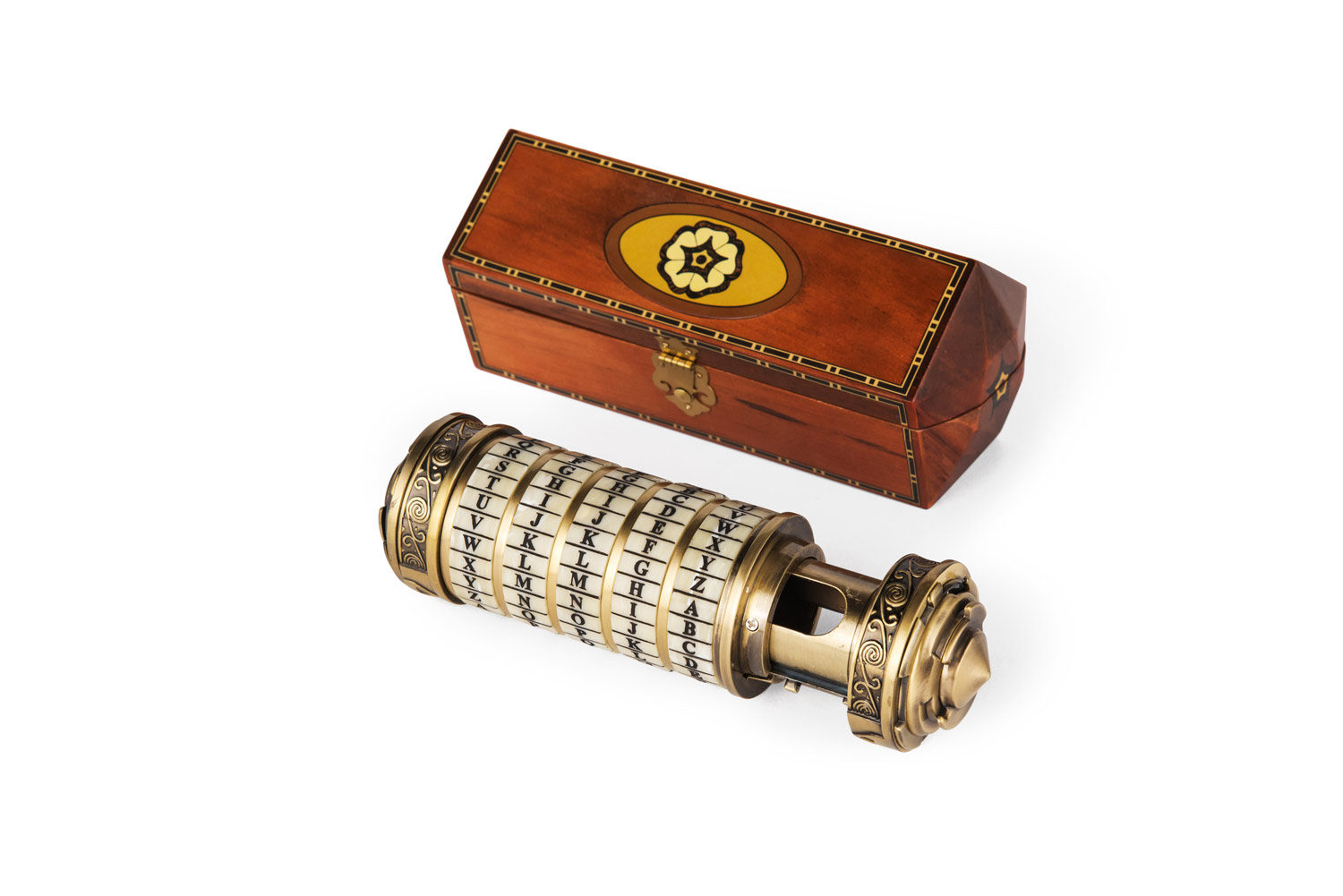
The Cryptex | German Spy Museum Berlin
The Cryptex device is somewhere between truth, fiction and conspiracy theories. Read more information here on the Cryptex and it's origin.
deutsches-spionagemuseum.de →The Cryptex tells a slightly different story to the majority of the exhibits at the German Spy museum. The well-secured and entirely secret vault was in reality a figment in the imagination of the author Dan Brown. Writing in the novel The Da Vinci Code published in 2003, he came up with the idea of a vault containing a scroll, secured by a combination lock. Whilst the novel names Leonardo da Vinci as the inventor, the author was probably inspired by other sources. Dan Brown’s idea was realized in 2004 by the artisan Justin Kirk Nevins. As the story goes, Mary Magdalena was “actually” the wife of Jesus of Nazareth, who bore him a child. As such, the Holy Grail was not a vessel, but Mary Magdalena herself. Secret societies such as the Prieuré de Sion and later the Knights Templar knew of this lineage and protected its descendants over the centuries. Himself moving in well-informed circles and thus aware of this secret, Leonardo left references to this secret in many of his works of art, in particular the painting “The Last Supper”. All this only comes to light following the discovery of a small mysterious device said to be invented by da Vinci. Access requires the investigators to enter the correct password; forcing the mechanism would only result in the destruction of its contents. In the film of the novel, this presents Tom Hanks, Audrey Tautou and Sir Ian McKellen with a number of serious challenges. The principle of rotating discs inscribed with numbers or figures also serves the encryption of secret messages. Thomas Jefferson invented what became known as the “Jefferson Disc” in 1790 to encode and decode secret messages. This principle was also applied to the M-94 encryption cylinder used by the US military in the 1920s and attained fame at the start of the twentieth century with the German Enigma . Developed in 1915, the device used rotors and discs to scramble and unscramble messages and bears a striking resemblance to Cryptex and co.
Excerpt from a page describing this subject · 5,164 chars · not written by Vinony
Wikidata facts
- Instance of
- appliance
- Image
- Davincicryptex01wiki1.jpg
Show 2 more facts
- described at URL
- www.deutsches-spionagemuseum.de/en/sammlung/the-cryptex
- present in work
- The Da Vinci Code
Sources (2)
via Wikidata · CC0
Article · Português
Criptex é uma palavra-valise criada por Dan Brown das palavras criptologia e códice (codex). No livro e filme O Código Da Vinci ele é um cofre no formato de cilindro supostamente criado por Leonardo da Vinci. Hoje ele está sendo fabricado para usos comerciais. O Criptex tem a forma cilíndrica, sua tranca é feita por um conjunto de anéis com todas as letras do alfabeto gravadas para efetuar a senha e abri-lo.O objetivo de um críptex é esconder uma mensagem (ou informação) de tal forma que somente a entrada correta (a senha) é capaz de revelá-la, abrindo o criptex.Qualquer tentativa de abri-lo à força bruta, resulta na destruição imediata de seu conteúdo. O criptex foi supostamente desenhado por Da Vinci, em muitos de seus esboços ele a descrevia como "caixa do mistério" ou "santo graal", pouco se sabe da veracidade do criptex, porém uma cópia fiel se encontra no museu do louvre.O imaginário popular cresce cada vez que algo mais é encontrado.Em 1986 no túmulo de Da Vinci foi encontrada uma combinação de 5 letras que diziam "Domus" que em latim significa casa grande (o que possivelmente seria a senha do criptex).
Abstract from DBpedia / Wikipedia · CC BY-SA