Described at
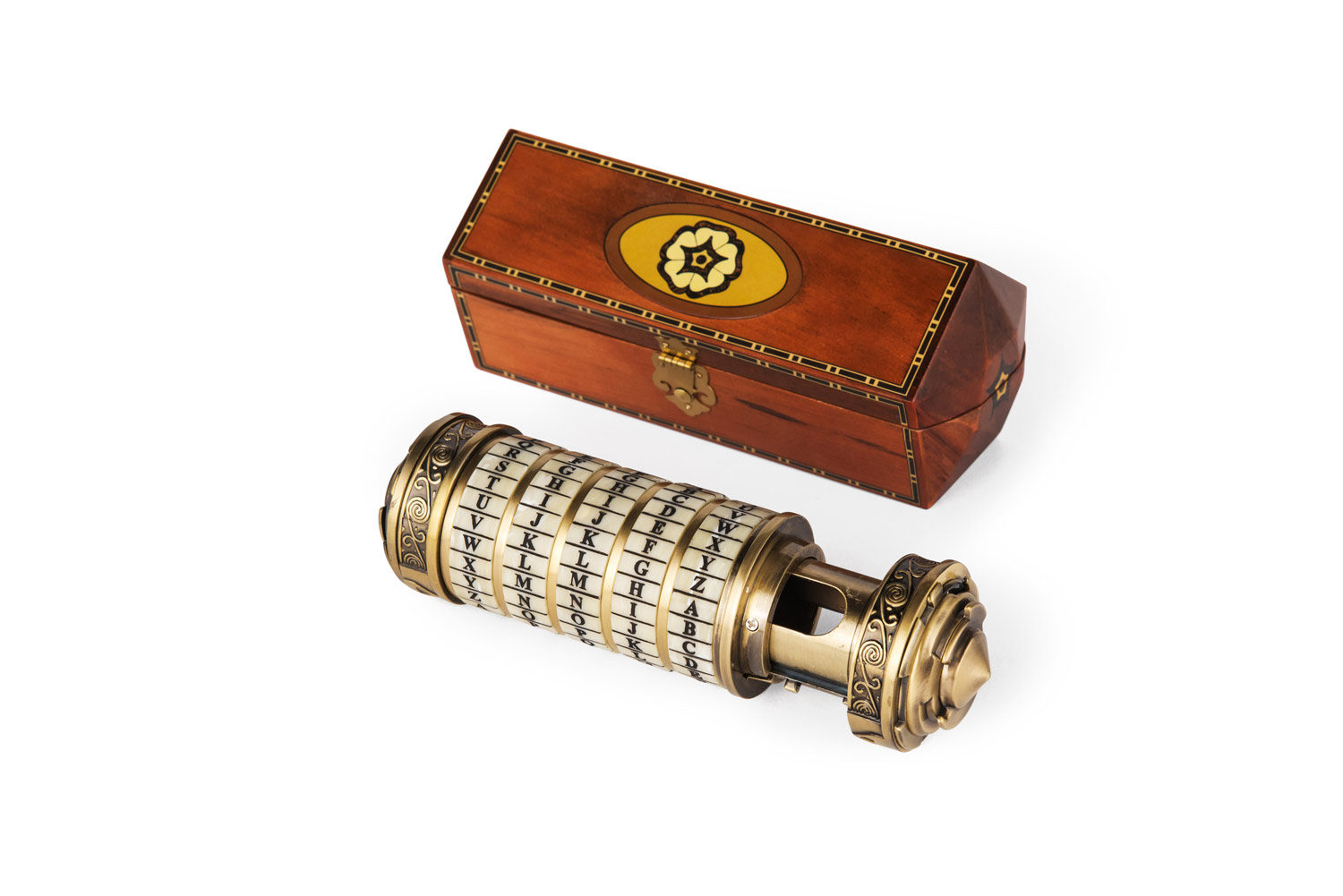
The Cryptex | German Spy Museum Berlin
The Cryptex device is somewhere between truth, fiction and conspiracy theories. Read more information here on the Cryptex and it's origin.
deutsches-spionagemuseum.de →The Cryptex tells a slightly different story to the majority of the exhibits at the German Spy museum. The well-secured and entirely secret vault was in reality a figment in the imagination of the author Dan Brown. Writing in the novel The Da Vinci Code published in 2003, he came up with the idea of a vault containing a scroll, secured by a combination lock. Whilst the novel names Leonardo da Vinci as the inventor, the author was probably inspired by other sources. Dan Brown’s idea was realized in 2004 by the artisan Justin Kirk Nevins. As the story goes, Mary Magdalena was “actually” the wife of Jesus of Nazareth, who bore him a child. As such, the Holy Grail was not a vessel, but Mary Magdalena herself. Secret societies such as the Prieuré de Sion and later the Knights Templar knew of this lineage and protected its descendants over the centuries. Himself moving in well-informed circles and thus aware of this secret, Leonardo left references to this secret in many of his works of art, in particular the painting “The Last Supper”. All this only comes to light following the discovery of a small mysterious device said to be invented by da Vinci. Access requires the investigators to enter the correct password; forcing the mechanism would only result in the destruction of its contents. In the film of the novel, this presents Tom Hanks, Audrey Tautou and Sir Ian McKellen with a number of serious challenges. The principle of rotating discs inscribed with numbers or figures also serves the encryption of secret messages. Thomas Jefferson invented what became known as the “Jefferson Disc” in 1790 to encode and decode secret messages. This principle was also applied to the M-94 encryption cylinder used by the US military in the 1920s and attained fame at the start of the twentieth century with the German Enigma . Developed in 1915, the device used rotors and discs to scramble and unscramble messages and bears a striking resemblance to Cryptex and co.
Excerpt from a page describing this subject · 5,164 chars · not written by Vinony
Wikidata facts
- Instance of
- appliance
- Image
- Davincicryptex01wiki1.jpg
Show 2 more facts
- described at URL
- www.deutsches-spionagemuseum.de/en/sammlung/the-cryptex
- present in work
- The Da Vinci Code
Sources (2)
via Wikidata · CC0
Article · 中文
藏密筒(cryptex,又称密码筒)是美国作家丹·布朗在其2003年的小说《达芬奇密码》中创造的一个新词,指一种可携带的用来保存秘密信息的拱顶。这是一个由和组合而成的混成词;“一个很贴切的名称,这个装置就是运用来保存那些写在卷轴或codex上的信息的。”(小说第47章)-尽管事实上与卷起的“卷轴”相对,“codex”是现在称之为“书”一词的早期形态。小说中称最初的设计来自列奥纳多·达芬奇的秘密日记。事实上,并没有任何关于他设计了这种装置的记录。 遵循"codex"的复数形态为"codices"的模式,"cryptex"的复数形态应为"cryptices"。但布朗在小说中使用了"cryptexes"这个形态。 在小说中,主人公们试图通过算出密码打开藏密筒来获得寻找圣杯的线索。藏密筒共有两个,一个藏在另一个中以提供额外的安全保障。(在2006年根据小说改编的同名电影中,只出现了一个藏密筒。密码是小说中黑色藏密筒的密码)
Abstract from DBpedia / Wikipedia · CC BY-SA