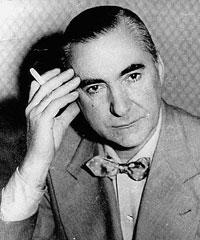
Curzio Malaparte
Also known as Ḳurts'yo Malaparṭeh, Kurt Erich Suckert, Curzio Suckert
Italian writer (1898-1957)
AI overview
Curzio Malaparte was an Italian writer, journalist, and filmmaker from 1898 to 1957 who lived through and documented some of the most dramatic events of twentieth-century Europe. His works, which often mixed vivid storytelling with sharp political observation, made him an important voice in Italian literature during the Fascist era and its aftermath.
AI-generated from the Wikipedia summary — may contain errors.
Person · Open Library
- Born
- 1898-06-09
- Died
- 1957-07-19
- Works
- 154
Top works
- Kaputt
- Tecnica del colpo di stato
- I custodi del disordine
- L'Europa vivente e altri saggi politici, 1921-1931
- Maledetti Toscani
via Open Library + Wikidata
Listeners · Last.fm
- Listeners
- 3
- Total plays
- 4
<a href="https://www.last.fm/music/Curzio+Malaparte">Read more on Last.fm</a>
Recent publications · Crossref
5 total works indexed
Article
Curzio Malaparte ( Italian: [ˈkurtsjo malaˈparte]; born Kurt Erich Suckert; 9 June 1898 – 19 July 1957) was an Italian writer, filmmaker, war correspondent and diplomat. Malaparte is best known outside Italy for his works Kaputt (1944) and The Skin (1949). The former is a semi-fictionalised account of the Eastern Front during the Second World War and the latter is an account focusing on morality in the immediate post-war period of Naples (it was placed on the Index Librorum Prohibitorum).
During the 1920s, Malaparte was one of the intellectuals who supported the rise of Italian fascism and Benito Mussolini, through the magazine 900. Despite this, Malaparte had a complex relationship with the National Fascist Party and was stripped of membership in 1933 for his independent streak. Arrested numerous times, he had Casa Malaparte created in Capri where he lived under house arrest. After the Second World War, he became a filmmaker and moved closer to both Togliatti's Italian Communist Party and the Catholic Church (though once a staunch atheist), reputedly becoming a member of both before his death.
Gallery (2)
Connections
Categories
1898 births1957 deaths20th-century Italian dramatists and playwrights20th-century Italian essayists20th-century Italian male writers20th-century Italian novelists20th-century Italian short story writersCapri, CampaniaCurzio MalaparteDiplomats for ItalyItalian communistsItalian dramatists and playwrights