Cynomorium · Kew POWO · Kew Plants of the World Online
Cynomorium
Sign in to saveCynomorium is a genus of parasitic perennial flowering plants in the family Cynomoriaceae. The genus consists of only one species, Cynomorium coccineum (although one of its subspecies is sometimes treated as a separate species). Its placement in the Saxifragales was resolved in 2016 with the help of nuclear, plastid, and mitochondrial sequences obtained from next-generation sequencing. Common names include the misleading Maltese fungus or Maltese mushroom; also desert thumb, red thumb, tarthuth (Bedouin) and suoyang (Chinese). A rare or local species, it grows in dry, rocky or sandy soils, oft
Species
GENUS
- KingdomPlantae
- PhylumTracheophyta
- ClassMagnoliopsida
- OrderSaxifragales
- FamilyCynomoriaceae
via GBIF · Kew POWO
Museum specimens
- Specimen records
- 15
- With media
- 7
- Family
- Cynomoriaceae
- Collections
- MO, MEL, VT
- Recorded in
- United States, Algeria, Tunisia, Morocco, Egypt, Italy, Mongolia, France
Research
151 papersvia PubMed
Wikidata facts
- Instance of
- taxon
- Parent taxon
- Cynomoriaceae
- Image
- Cynomorium coccineum 2.jpg
Show 7 more facts
- taxon rank
- genus
- taxon name
- Cynomorium
- Commons category
- Cynomorium
- has fruit type
- nut
- taxonomic type
- Cynomorium coccineum
- taxon common name
- 锁阳属
Sources (2)
via Wikidata · CC0
~8 min read
Encyclopedic overview
8 sectionsContents
- Description
- Taxonomy
- Distribution
- History and historical uses
- Active ingredients
- References
- Bibliography
- External links
Cynomorium is a genus of parasitic perennial flowering plants in the family Cynomoriaceae. The genus consists of only one species, Cynomorium coccineum (although one of its subspecies is sometimes treated as a separate species). Its placement in the Saxifragales was resolved in 2016 with the help of nuclear, plastid, and mitochondrial sequences obtained from next-generation sequencing. Common names include the misleading Maltese fungus or Maltese mushroom; also desert thumb, red thumb, tarthuth (Bedouin) and suoyang (Chinese). A rare or local species, it grows in dry, rocky or sandy soils, often in salt marshes or other saline habitats close to the coast. It has had a wide variety of uses in European, Arabian and Chinese herbal medicine.
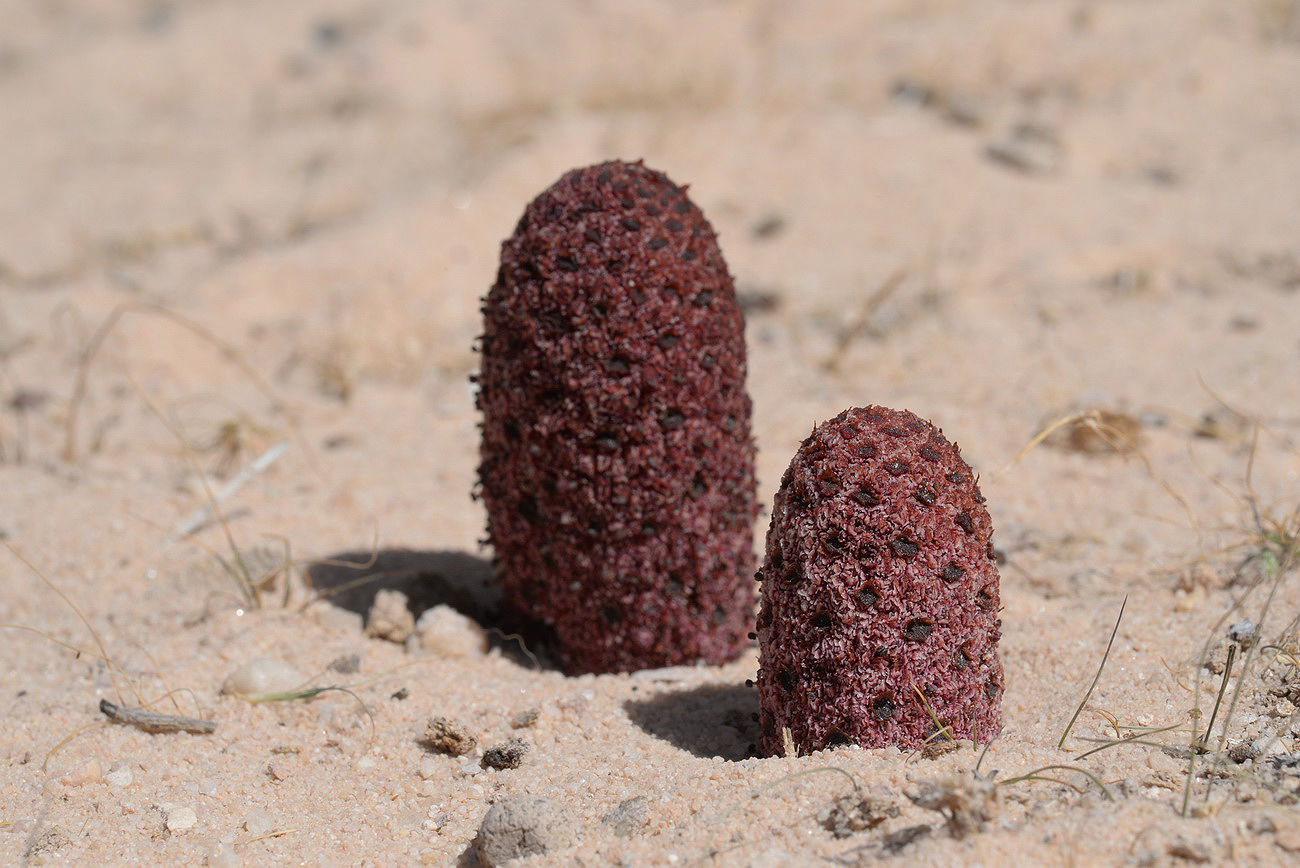
==Description== This plant has no chlorophyll and is unable to photosynthesise. It is a geophyte, spending most of its life underground in the form of a rhizome, which is attached to the roots of its host plant; it is a holoparasite, i.e. totally dependent on its host. The low-growing inflorescence emerges (in spring, following winter rain), on a fleshy, unbranched stem (most of which is underground) with scale-like, membranous leaves. Dark-red or purplish, the inflorescence consists of a dense, erect, club-shaped mass, some long, of minute scarlet flowers, which may be male, female or hermaphrodite. It is pollinated by flies, attracted to the plant by its sweet, slightly cabbage-like odour. Once pollinated, the spike turns black. The fruit is a small, indehiscent nut.
Excerpted from Wikipedia’s “Cynomorium” article, available under the CC BY-SA 4.0 licence.
Gallery (2)
Available in 11 languages
via Wikidata sitelinks · CC0