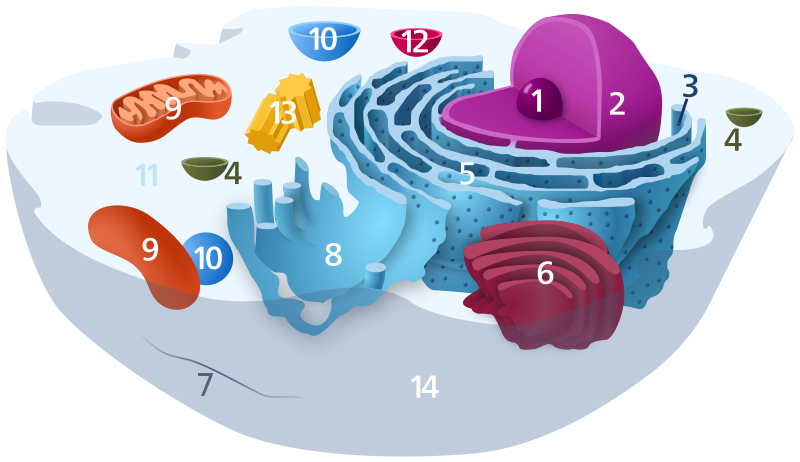
File:Animal_Cell.svg · Wikimedia Commons · See Wikimedia Commons
cytoplasm
Sign in to saveAlso known as GO:0005737, cytoplasma
The cytoplasm is all the material within a eukaryotic or prokaryotic cell, enclosed by the cell membrane, including the organelles and excluding the nucleus in eukaryotic cells. The material inside the nucleus of a eukaryotic cell and contained within the nuclear membrane is termed the nucleoplasm. The main components of the cytoplasm are the cytosol (a gel-like substance), the cell's internal sub-structures, and various cytoplasmic inclusions. The cytoplasm is about 80% water and is usually colorless.
Cytoplasm is the gel-like material that fills cells, located between the cell membrane and the nucleus (in eukaryotic cells), and contains the cell's internal structures and various substances. It matters because it is where most of the cell's vital activities and processes take place, making it essential for the cell to function.
AI-generated from the Wikipedia summary — may contain errors.
Research
984,083 papers- Inheritance through the cytoplasm.ReviewHeredity · 2022Camus MF, Alexander-Lawrie B, Sharbrough J et al.DOI: 10.1038/s41437-022-00540-2
- The periplastidal compartment: a naturally minimized eukaryotic cytoplasm.ReviewCurrent opinion in microbiology · 2014Grosche C, Hempel F, Bolte K et al.DOI: 10.1016/j.mib.2014.09.017
- Mechanisms linking cytoplasmic decay of translation-defective mRNA to transcriptional adaptation.Science (New York, N.Y.) · 2026El-Brolosy MA, Oak A, Hoang AT et al.DOI: 10.1126/science.aea1272
- Cytoplasm effects on rancidity related traits in pearl millet (Pennisetum glaucum (L.) R. Br.) hybrids.BMC plant biology · 2025Reddy PS, Sravani D, Venkateswarlu R et al.DOI: 10.1186/s12870-025-07926-4
- Threshold estimation based on local minima for nucleus and cytoplasm segmentation.BMC medical imaging · 2022Mayala S, Haugsøen JBDOI: 10.1186/s12880-022-00801-w
- Cytoplasm mediates both development and oxidation-induced apoptotic cell death in mouse zygotes.Biology of reproduction · 2000Liu L, Keefe DLDOI: 10.1095/biolreprod62.6.1828
- Biochemical evidence that the whole compartment activity behavior of GAPDH differs between the cytoplasm and nucleus.PloS one · 2023Tang HS, Gates CR, Schultz MCDOI: 10.1371/journal.pone.0290892
- Two-Step Identification of N-, S-, R- and T-Cytoplasm Types in Onion Breeding Lines Using High-Resolution Melting (HRM)-Based Markers.International journal of molecular sciences · 2023Khrustaleva L, Nzeha M, Ermolaev A et al.DOI: 10.3390/ijms24021605
via PubMed
Wikidata facts
- Image
- Animal cell structure en.svg
Show 6 more facts
- Commons category
- Cytoplasm
- topic's main category
- Category:Cytoplasm
- exact match
- purl.obolibrary.org/obo/GO_0005737
- NCI Thesaurus ID
- C13226
- has characteristic
- cytoplasmic streaming
- depicted by
- animal cell
via Wikidata · CC0
~10 min read
Encyclopedic overview
13 sectionsContents
- History
- Physical nature
- As a sol-gel
- As a glass
- Other perspectives
- Constituents
- Cytosol
- Organelles
- Cytoplasmic inclusions
- Controversy and research
- See also
- References
- External links
The cytoplasm is all the material within a eukaryotic or prokaryotic cell, enclosed by the cell membrane, including the organelles and excluding the nucleus in eukaryotic cells. The material inside the nucleus of a eukaryotic cell and contained within the nuclear membrane is termed the nucleoplasm. The main components of the cytoplasm are the cytosol (a gel-like substance), the cell's internal sub-structures, and various cytoplasmic inclusions. The cytoplasm is about 80% water and is usually colorless.
The cytosol or cytoplasmic matrix or groundplasm, remains after the exclusion of the cell organelles and cytoplasmic inclusions. Microscopically it is a highly complex, polyphasic system in which all resolvable cytoplasmic elements are suspended, including the larger organelles such as the ribosomes, mitochondria, plant plastids, lipid droplets, and vacuoles.
Excerpted from Wikipedia’s “cytoplasm” article, available under the CC BY-SA 4.0 licence.
Gallery (33)
Available in 89 languages
- Español
- Français
- Deutsch
- 中文
- 日本語
- Русский
- Português
- Italiano
- العربية
- हिन्दी
- Albanian
- Aragonese
- Armenian
- Asturian
- Azerbaijani
- Bahasa Indonesia
- Bangla
- Basque
Show 70 more
- Belarusian
- Bosnian
- Bulgarian
- Catalan
- Central Kurdish
- Croatian
- Czech
- Danish
- Esperanto
- Estonian
- Filipino
- Finnish
- Galician
- Georgian
- Gilaki
- Greek
- Haitian Creole
- Hebrew
- Hungarian
- Ido
- Irish
- Javanese
- Kannada
- Kashmiri
- Kazakh
- Kurdish
- Kyrgyz
- Latin
- Latvian
- Lithuanian
- Low German
- Luxembourgish
- Macedonian
- Malay
- Malayalam
- Manx
- Mingrelian
- Mongolian
- Moroccan Arabic
- Nederlands
- Northern Frisian
- Norwegian
- Occitan
- Oromo
- Polski
- Punjabi
- Romanian
- Rusyn
- Serbian
- Serbian (Latin)
- simple
- Slovak
- Slovenian
- Sundanese
- Svenska
- Tajik
- Tamil
- Tatar
- Tiếng Việt
- Türkçe
- Ukrainian
- Urdu
- Uzbek
- Western Panjabi
- Wu Chinese
- zh_yue
- Zulu
- فارسی
- ไทย
- 한국어
via Wikidata sitelinks · CC0