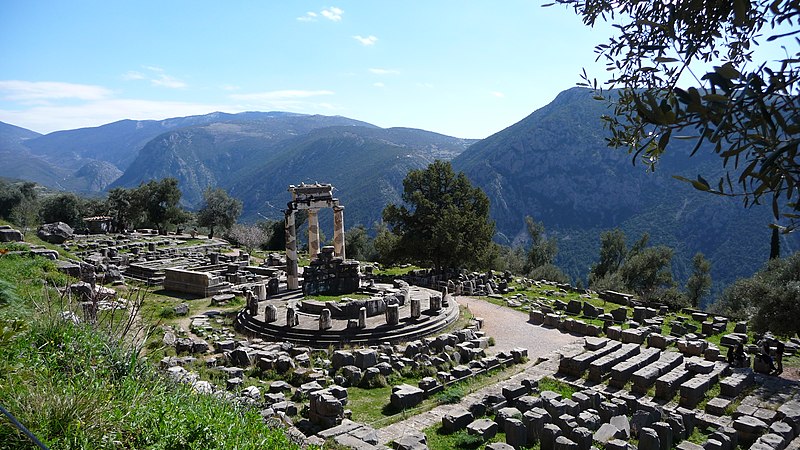
File:Delphi,_Greece_-_panoramio.jpg · Wikimedia Commons · See Wikimedia Commons
Delphes
Sign in to saveAlso known as Delphi (Samian Ware Discovery Site), Ancient Delphi, ancient Delphi
site archéologique et commune de Grèce
Delphi was an ancient sacred site in central Greece that housed Pythia, a famous oracle whom people throughout the classical world consulted for guidance on important decisions. The ancient Greeks believed Delphi marked the center of the world, symbolized by a stone monument called the Omphalos (meaning "navel" in Greek).
AI-generated from the Wikipedia summary — may contain errors.
Key facts
- Ancient site.name
- Delphi
- Ancient site.relief
- yes
- Ancient site.image
- Delphi, Greece - panoramio.jpg
- Ancient site.alt
- Delphic Tholos
- Ancient site.caption
- The Athena temple complex, including the Delphic Tholos. The background is the Pleistos River Valley.
- Ancient site.image_upright
- 1.3
- Ancient site.map_type
- Greece
- Ancient site.map_size
- 290px
- Ancient site.location
- Phocis, Greece
- Ancient site.map_dot_label
- Delphi
- Ancient site.type
- Ruins of an ancient sacred precinct
- Ancient site.height
- Top of a scarp maximum off the valley floor
- Ancient site.archaeologists
- French School at Athens
- Ancient site.cultures
- Ancient Greece
- Ancient site.ownership
- Hellenic Republic
- Ancient site.management
- Ministry of Culture and Sports
- Ancient site.public_access
- Accessible for a fee
- Ancient site.designation1
- WHS
via Wikipedia infobox
Wikidata facts
- Official name
- Δελφοί
- Country
- Greece
- Located in
- Delfi Municipality
- Elevation
- 570
- Image
- Delphi Temple of Apollo.jpg
Show 6 more facts
- Commons gallery
- Delphi
- Commons category
- Ancient Delphi
- native label
- Δελφοί
- culture
- Ancient Greece
- time period
- Ancient Greece
via Wikidata · CC0
Article · Français
Delphes (en grec ancien et grec moderne Δελφοί, Delphoí) est le site d'un sanctuaire panhellénique, situé au pied du mont Parnasse, en Phocide, où parle l'oracle d'Apollon à travers sa prophétesse, la Pythie qui était assise dans une salle du temple d’Apollon et parlait au nom du dieu. Elle répondait aux questions qui lui étaient posées ; ces réponses étaient aussitôt traduites en phrases par des prêtres. Delphes abrite également l'Omphalos ou « nombril du monde ». Investie d'une signification sacrée, le sanctuaire est, du VIe au IVe siècle av. J.-C., le véritable centre et le symbole de l'unité du monde grec. Les sanctuaires panhelléniques sont des complexes architecturaux extérieurs aux cités. Ils constituent les seuls lieux où tous les anciens Grecs, et certains barbares (Lydiens et Étrusques) prennent part à des célébrations religieuses communes. Les ruines de Delphes ont été rendues au jour grâce aux fouilles de l’École française d’Athènes à partir de 1892 sous la direction de Théophile Homolle.
Abstract from DBpedia / Wikipedia · CC BY-SA
Gallery (52)
On the map
6 mapped locations
Available in 80 languages
- Español
- Français
- Deutsch
- 中文
- 日本語
- Русский
- Português
- Italiano
- العربية
- हिन्दी
- Afrikaans
- Albanian
- Armenian
- Asturian
- Azerbaijani
- Bahasa Indonesia
- Basque
- Belarusian
Show 61 more
- Bosnian
- Breton
- Bulgarian
- Catalan
- Cebuano
- Croatian
- Czech
- Danish
- Esperanto
- Estonian
- Filipino
- Finnish
- Galician
- Georgian
- Greek
- Gujarati
- Hebrew
- Hungarian
- hyw
- Icelandic
- Ido
- Irish
- Kazakh
- Kurdish
- Latin
- Latvian
- Lithuanian
- Macedonian
- Malay
- Malayalam
- Maltese
- Marathi
- Nederlands
- Norwegian
- Norwegian Nynorsk
- Occitan
- Polski
- Romanian
- Serbian
- Serbian (Latin)
- Sicilian
- simple
- Sindhi
- Slovak
- Slovenian
- Svenska
- Tamil
- Tiếng Việt
- Türkçe
- Ukrainian
- Urdu
- Uzbek
- Waray
- Welsh
- Western Panjabi
- Wu Chinese
- Yiddish
- zh_yue
- فارسی
- ไทย
- 한국어
via Wikidata sitelinks · CC0