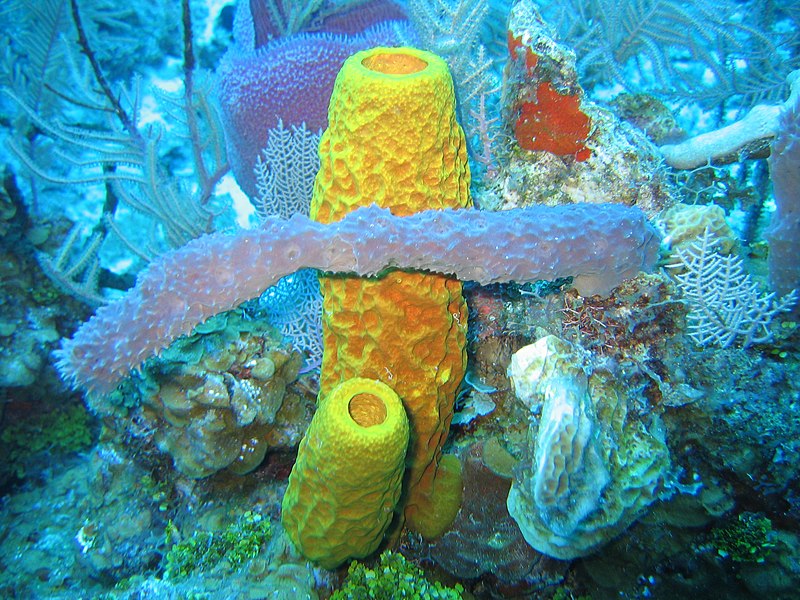
File:Sponges_in_Caribbean_Sea,_Cayman_Islands.jpg · Wikimedia Commons · See Wikimedia Commons
Demospongiae
Sign in to savethumb| The carnivorous ping-pong tree sponge, Chondrocladia|Chondrocladia lampadiglobus thumb|Monanchora arbuscula ([[Poecilosclerida)]] thumb|Geodia barretti ([[Tetractinellida)]] thumb|Chondrosia reniformis ([[Chondrosiida)]] thumb|Spongia officinalis ([[Dictyoceratida)]] thumb|Spongilla lacustris ([[Spongillida)]]
OverviewAI-generated
Demospongiae, also known as demosponges, is a class within the phylum Porifera and the kingdom Animalia. The taxon was established by Sollas in 1885 and is currently accepted. It is also referred to by the synonym Tetractinomorpha. Common names for this group include horn- og kiselsvamper, 普通海綿綱, and 普通海绵纲.
Demosponges inhabit marine, brackish, and freshwater environments. The class has been documented in the United States, United Kingdom, Mexico, and Canada. Specimens are held by institutions such as SDNHM, YPM, NHMUK, UCMP, and ICML-UNAM.
Records for this taxon include 1,681,940 occurrences and 8,369 records, with 7,659 associated media files. The subject is referenced by 883 other encyclopedia articles.
Synthesized by Vinony from 26 facts across 6 sources: Wikidata, GBIF, Gbif Occ, WoRMS, iDigBio, Vinony graph. Generated from structured data (not the Wikipedia text) and checked against those facts — may still contain errors.
Species
demosponges
CLASS
- KingdomAnimalia
- PhylumPorifera
- ClassDemospongiae
亞綱 同骨海绵亚纲 Homoscleromorpha 四放海綿亞綱 Tetractinomorpha 蠟質海綿亞綱 Ceractinomorpha 寻常海绵纲(学名:Demospongiae)是多孔动物门中最大的一綱,全世界大約有7000種以上;多数海产,僅少部分屬於淡水種,大約150種;有些種類體型可以長到2公尺長。都是群体;呈块状。 特征 有些种类有骨针,骨针为硅质,针与针之间借助海绵质互相粘着,海绵质是一种类似蚕丝的物质;某些种类的骨针包裹在海绵质内部,而另外一些的骨针则完全消失,只有海绵质的纤维错综交互构成骨胳网。 著名海绵 浴用海绵 马海绵 查 论 编 后鞭毛生物:动物现存门分类表 域 古菌 细菌 真核生物 (界 植物 Hacrobia(英语:Template:Hacrobia) 不等鞭毛类(英语:Template:Heterokont) 囊泡虫 有孔虫(英语:Template:Rhizaria) 古虫 变形虫(英语:Template:Amoebozoa) 动物 真菌) 侧生动物 多孔动物门 钙质海绵纲 寻常海绵纲 六放海绵纲 扁盘动物门 丝盘虫 中生动物 直泳动物门 菱形动物门 单胚动物门 真后生动物辐射对称动物 栉水母动物门 刺胞动物门 珊瑚纲 水螅纲 钵水母纲 立方水母纲 十字水母纲(英语:Stauromedusae) 多足动物纲(英语:Polypodiozoa) 黏体动物 两侧对称动物 异无腔动物 无腔动物门 异涡动物门 肾管动物(英语:Nephrozoa) 原口动物 未命名基群 毛颚动物门 蜕皮动物 环神经动物(英语:Cycloneuralia) 有棘动物(英语:Scalidophora) 动吻动物门 铠甲动物门 鳃曳动物门 线虫动物 线虫动物门 线形动物门 泛节肢动物 有爪动物门 缓步动物门 节肢动物门 螺旋動物 有颚动物(英语:Gnathifera (clade)) 合皮动物(英语:Syndermata) 轮形动物门 棘头动物门 地位未定 尾盘动物门? 摇轮虫 颚胃动物门 微颚动物门 环口动物门 扁轮动物(英语:Platytrochozoa) 吮食动物(英语:Rouphozoa) 扁形动物门 腹毛动物门 冠轮动物 担轮动物 纽形动物门 软体动物门 环节动物门 星虫动物门? 触手冠动物 苔藓动物门 内肛动物门 腕足动物门 帚虫动物门 后口动物 步带动物 棘皮动物门 半索动物门 脊索动物门 有头动物 脊椎动物亚门 盲鳗纲 头索动物亚门 尾索动物亚门 (?)为地位未定 取自“https://zh.wikipedia.org/w/index.php?title=寻常海绵纲&oldid=53076589” 分类:寻常海绵纲 隐藏分类:本地相关图片与维基数据不同
via GBIF
Museum specimens
- Specimen records
- 8,369
- With media
- 7,659
- Collections
- SDNHM, YPM, NHMUK, UCMP, ICML-UNAM
- Recorded in
- United States, United Kingdom, Mexico, Canada
Wikidata facts
Show 6 more facts
- taxon rank
- class
- taxon name
- Demospongiae
- Commons category
- Demospongiae
- topic's main category
- Category:Demospongiae
- taxon synonym
- Tetractinomorpha
- taxon common name
- 普通海绵纲
Sources (1)
via Wikidata · CC0
~11 min read
Encyclopedic overview
8 sectionsContents
- Classification and systematics
- Sclerosponges
- Chaetetids
- Reproduction
- Meiosis and recombination
- Economic importance
- Citations
- General references
thumb| The carnivorous ping-pong tree sponge, Chondrocladia|Chondrocladia lampadiglobus thumb|Monanchora arbuscula ([[Poecilosclerida)]] thumb|Geodia barretti ([[Tetractinellida)]] thumb|Chondrosia reniformis ([[Chondrosiida)]] thumb|Spongia officinalis ([[Dictyoceratida)]] thumb|Spongilla lacustris ([[Spongillida)]]
Demosponges or common sponges are sponges of the class Demospongiae (from + ), the most diverse group in the phylum Porifera which include greater than 90% of all extant sponges with nearly 8,800 species worldwide (according to the World Porifera Database). Being siliceous sponges, they are predominantly leuconoid in structure with an endoskeleton made of a meshwork of spicules consisting of fibers of the protein spongin, the mineral silica, or both. Where spicules of silica are present, they have a different shape from those in the otherwise similar glass sponges. Some species, in particular from the Antarctic, obtain the silica for spicule-building from the ingestion of diatoms.
Excerpted from Wikipedia’s “Demospongiae” article, available under the CC BY-SA 4.0 licence.