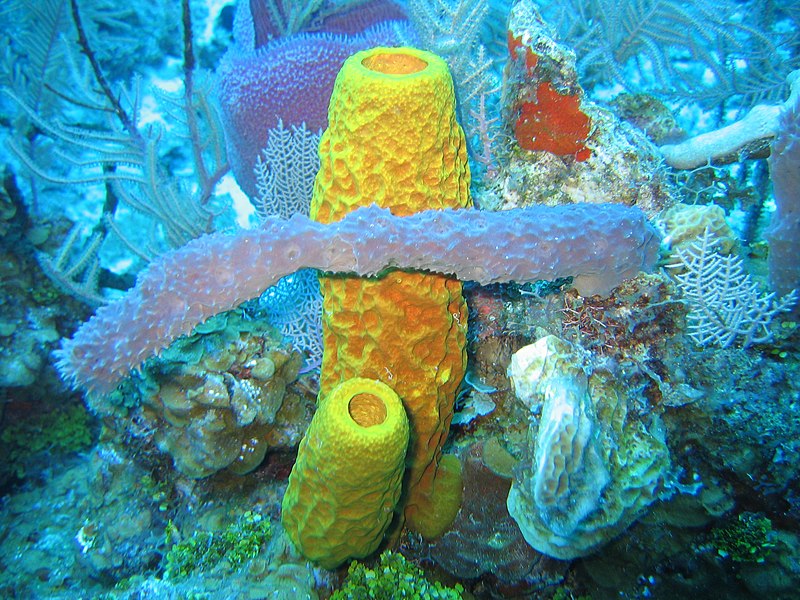
File:Sponges_in_Caribbean_Sea,_Cayman_Islands.jpg · Wikimedia Commons · See Wikimedia Commons
Porifera
Sign in to saveAlso known as sponges, sea sponges
Sponges or sea sponges are primarily marine invertebrates of the animal phylum Porifera (; meaning 'pore bearer'). They are sessile filter feeders that are bound to the seabed, and are one of the most ancient members of macrobenthos, with many historical species being important reef-building organisms.
OverviewAI-generated
Porifera is a phylum within the kingdom Animalia and the parent taxon Parazoa. Commonly known as sponges or poriferans, this group is classified as invertebrates. The taxon was established by Grant in 1836 and is currently recognized as an accepted name. It reproduces through both asexual and sexual methods.
These organisms inhabit marine, brackish, and freshwater environments. Their temporal range extends back to the Ediacaran period. Scientific literature regarding Porifera includes 9,092 records in PubMed. Biological occurrence data lists 2,563,650 entries, while specimen records number 43,577, supported by 7,570 media files. Collections are held by institutions such as FMNH, LACM, PRI, NHMUK, and USNM in countries including the United States, United Kingdom, France, and Germany. The subject is referenced by 3,006 other encyclopedia articles.
Synthesized by Vinony from 33 facts across 7 sources: Wikidata, GBIF, PubMed, Gbif Occ, WoRMS, iDigBio, Vinony graph. Generated from structured data (not the Wikipedia text) and checked against those facts — may still contain errors.
Species
sponges
Porifera
PHYLUM
- KingdomAnimalia
- PhylumPorifera
「海绵」重定向至此。關於与此名称相似的其他条目,詳見「海绵 (消歧义)」。 多孔动物门(學名:Porifera)为原始的多细胞生物,也称海绵动物门(Spongiatia或Spongia),一般称为海绵。海绵没有神经元/神经系统、消化和循环系统,相反,牠們大多依靠海水流過自己的身體来獲得食物和氧氣並消除廢物,就像海底中的濾水器。 由於形状像植物,而且根植在海底中,所以海綿千百年來都被認為是植物,但後來發現牠們幾乎具備所有最基本的動物特徵,所以到十九世纪中期才被歸入動物界。但近期基於基因組資訊與系統發生學的更多證據,應否把它們保留在動物界還是獨立出來自成一個界別的論點在生物學界仍在不斷討論中。 特征 海绵动物體壁上有很多小孔(入水孔),游離的一端有大孔開口。 海绵的体型多种多样,小的不过几克,大的却有45公斤,最大的海绵跨度能有4.2米。海绵的颜色同样是丰富多彩。 细胞雖已开始分化,但未形成组织和器官,也没有形成真正的胚层(见内胚层、中胚层或外胚层); 体壁由内、外两层细胞构成。外层细胞扁平,称皮层(扁细胞层);内层细胞称胃层(襟细胞层),生有鞭毛,多数具有原生质领,称“领细胞”(choanocytes),主要行摄食和细胞内消化的作用;入水孔通入体内的沟道,与领细胞组成鞭毛室和出水口组成复杂的沟道系统。含有食饵的海水,由于内层细胞鞭毛的不断振动,从入水孔流入体内,不消化的东西随着海水从顶端的出水口排出体外。 在内、外两层细胞之间,还有一层中胶层,其中有像变形虫的游离细胞、生殖细胞、造骨细胞、海绵丝细胞等。 海绵动物体壁内多具有支持的针状骨骼,称內骨骼(Endoskeleton),由膠原蛋白(collagen)、碳酸鈣(CaCO3)和二氧化硅(SiO2)組成。 海绵没有神经系统,但海绵细胞共同捕食、分工消化,所以被认为是动物界器官形成的开始。 大多為雌雄同體(Hermaphroditic) 層孔蟲常聚集成群,有造礁作用。常和珊瑚、苔蘚蟲及藻類等一起形成生物礁。 分类 钙质海绵纲 (Calcispongea) 六放海绵纲 (Hexactinellida) 寻常海绵纲 (Demospongiae) 層孔蟲綱 (Stromatoporata)†? 旧分类中,多孔动物门可分为下面一些纲: 普通海绵纲 (Demospongea) 玻璃海绵纲 (Hyalospongea) 钙质海绵纲 (Calcispongea) 硬海绵纲 (Sclerospongea) 查 论 编 后鞭毛生物:动物现存门分类表 域 古菌 细菌 真核生物 (界 植物 Hacrobia(英语:Template:Hacrobia) 不等鞭毛类(英语:Template:Heterokont) 囊泡虫 有孔虫(英语:Template:Rhizaria) 古虫 变形虫(英语:Template:Amoebozoa) 动物
via GBIF
Museum specimens
- Specimen records
- 43,577
- With media
- 7,570
- Collections
- FMNH, LACM, PRI, NHMUK, USNM, UWBM
- Recorded in
- United States, United Kingdom, France, Germany
Research
9,092 papers- Global diversity of sponges (Porifera).ReviewPloS one · 2012Van Soest RW, Boury-Esnault N, Vacelet J et al.DOI: 10.1371/journal.pone.0035105
- Triterpene and Steroid Glycosides from Marine Sponges (Porifera, Demospongiae): Structures, Taxonomical Distribution, Biological Activities.ReviewMolecules (Basel, Switzerland) · 2023Ivanchina NV, Kalinin VIDOI: 10.3390/molecules28062503
- Porifera a reference phylum for evolution and bioprospecting: the power of marine genomics.ReviewThe Keio journal of medicine · 2004Müller WE, Schwertner H, Müller IMDOI: 10.2302/kjm.53.159
- Natural products from porifera.ReviewFortschritte der Chemie organischer Naturstoffe = Progress in the chemistry of organic natural products. Progres dans la chimie des substances organiques naturelles · 1976Minale L, Cimino G, De Stefano S et al.DOI: 10.1007/978-3-7091-3262-3_1
- Deep phylogeny and evolution of sponges (phylum Porifera).ReviewAdvances in marine biology · 2012Wörheide G, Dohrmann M, Erpenbeck D et al.DOI: 10.1016/B978-0-12-387787-1.00007-6
- Zootaxa 20 years: Phylum Porifera.Zootaxa · 2021Hooper JNA, Wörheide G, Hajdu E et al.DOI: 10.11646/zootaxa.4979.1.8
- The order Axinellida (Porifera: Demospongiae) in California.Zootaxa · 2023Turner TL, Pankey MSDOI: 10.11646/zootaxa.5230.5.1
- Sponges.ReviewCurrent biology : CB · 2005Leys SP, Rohksar DS, Degnan BMDOI: 10.1016/j.cub.2005.02.005
via PubMed
Wikidata facts
- Instance of
- taxon
- Subclass of
- invertebrate
- Parent taxon
- Animalia
- Image
- Vaasspons2.jpg
Show 9 more facts
- taxon name
- Porifera
- taxon rank
- phylum
- Commons category
- Porifera
- topic's main category
- Category:Porifera
- Commons gallery
- Sponge
- taxon common name
- 海綿動物門
- different from
- sponge
- mode of reproduction
- sexual reproduction
- temporal range start
- Ediacaran
Sources (10)
via Wikidata · CC0
~57 min read
Encyclopedic overview
46 sectionsContents
- Etymology
- Overview
- Distinguishing features
- Basic structure
- Cell types
- Water flow and body structures
- Skeleton
- Vital functions
- Movement
- Respiration, feeding and excretion
- Carnivorous sponges
- Endosymbionts
- "Immune" system
- Reproduction
- Asexual
- Sexual
- Meiosis
- Life cycle
- Coordination of activities
- Ecology
- Habitats
- As primary producers
- Defenses
- Predation
- Bioerosion
- Diseases
- Collaboration with other organisms
- Sponge loop
- Sponge microbiome
- Systematics
- Taxonomy
- Classes
- Phylogeny
- Evolutionary history
- Fossil record
- Relationships to other animal groups
- Notable spongiologists
- Use
- By dolphins
- By humans
- Skeleton
- Medicinal compounds
- See also
- References
- Further reading
- External links
Sponges or sea sponges are primarily marine invertebrates of the animal phylum Porifera (; meaning 'pore bearer'). They are sessile filter feeders that are bound to the seabed, and are one of the most ancient members of macrobenthos, with many historical species being important reef-building organisms.
Sponges are multicellular organisms consisting of jelly-like mesohyl sandwiched between two thin layers of cells, and usually have tube-like bodies full of pores and channels that allow water to circulate through them. They have unspecialized cells that can transform into other types and that often migrate between the main cell layers and the mesohyl in the process. They do not have complex nervous, digestive or circulatory systems. Instead, most rely on maintaining a constant water flow through their bodies to obtain food and oxygen and to remove wastes, usually via flagella movements of the so-called "collar cells".
Excerpted from Wikipedia’s “Porifera” article, available under the CC BY-SA 4.0 licence.
Gallery (54)
Available in 104 languages
- Español
- Français
- Deutsch
- 中文
- 日本語
- Русский
- Português
- Italiano
- العربية
- हिन्दी
- Afrikaans
- Albanian
- Amharic
- Armenian
- Assamese
- Asturian
- Azerbaijani
- Bahasa Indonesia
Show 85 more
- Bangla
- Bashkir
- Basque
- be_x_old
- Belarusian
- Betawi
- Bosnian
- Breton
- Bulgarian
- Burmese
- Catalan
- Cebuano
- Chuvash
- Croatian
- Czech
- Danish
- Egyptian Arabic
- Erzya
- Esperanto
- Estonian
- Filipino
- Finnish
- Galician
- Georgian
- Greek
- Hebrew
- Hungarian
- Icelandic
- Ido
- Irish
- Javanese
- Kannada
- Kazakh
- Khmer
- Kyrgyz
- Latin
- Latvian
- Limburgish
- Lingua Franca Nova
- Lithuanian
- lld
- Low German
- Luxembourgish
- Macedonian
- Malay
- Malayalam
- Manx
- Navajo
- Nederlands
- Northern Frisian
- Norwegian
- Norwegian Nynorsk
- Occitan
- Oromo
- Ossetic
- Polski
- Quechua
- Romanian
- Scots
- Serbian
- Serbian (Latin)
- simple
- Sindhi
- Slovak
- Slovenian
- Svenska
- Swahili
- Tamil
- Tatar
- Telugu
- Tiếng Việt
- Türkçe
- Ukrainian
- Urdu
- Waray
- Welsh
- West Flemish
- Western Mari
- Western Panjabi
- Wu Chinese
- zh_min_nan
- zh_yue
- فارسی
- ไทย
- 한국어
via Wikidata sitelinks · CC0