File:Heart_diasystole.svg · Wikimedia Commons · See Wikimedia Commons
diastole
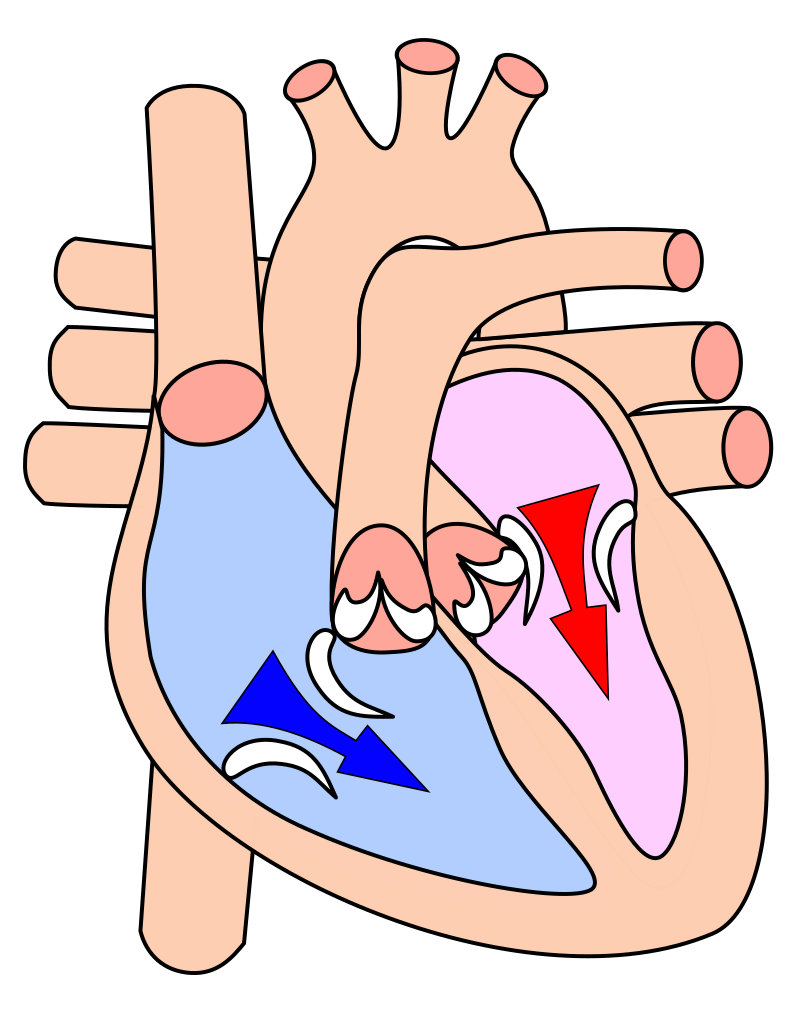
Sign in to savethumb|upright=1.5|Early ventricular diastole is the filling of blood from the atria (from the left atrium shown in pink, and from the right atrium shown in blue) that weakly contract letting blood fill into the ventricles; in late ventricular diastole, the two atria begin to contract (atrial systole), forcing additional blood flow into the ventricles.
Research
169,386 papers- Left Ventricular Diastolic Function: Understanding Pathophysiology, Diagnosis, and Prognosis With Echocardiography.JACC. Cardiovascular imaging · 2020
- Heart failure with preserved ejection fraction: refocusing on diastole.International journal of cardiology · 2015
- Role of diastole in left ventricular function, I: Biochemical and biomechanical events.American journal of critical care : an official publication, American Association of Critical-Care Nurses · 2004
- The deconvolution of diastole.Journal of the American College of Cardiology · 2009
- The dilemma of diastole.Cardiology · 2010
via PubMed
Wikidata facts
- Instance of
- part
- Part of
- cardiac cycle
Show 2 more facts
- opposite of
- systole
- NCI Thesaurus ID
- C62109
Sources (2)
via Wikidata · CC0
~8 min read
Encyclopedic overview
9 sectionsContents
- Role in cardiac cycle
- Early ventricular diastole
- Late ventricular diastole
- Atrial diastole
- Clinical notation
- Diagnostic value
- Effects of impaired diastolic function
- References
- External links
thumb|upright=1.5|Early ventricular diastole is the filling of blood from the atria (from the left atrium shown in pink, and from the right atrium shown in blue) that weakly contract letting blood fill into the ventricles; in late ventricular diastole, the two atria begin to contract (atrial systole), forcing additional blood flow into the ventricles.
Diastole ( ) is the relaxed phase of the cardiac cycle when the chambers of the heart are refilling with blood. The contrasting phase is systole when the heart chambers are contracting. Atrial diastole is the relaxing of the atria, and ventricular diastole the relaxing of the ventricles.
Excerpted from Wikipedia’s “diastole” article, available under the CC BY-SA 4.0 licence.