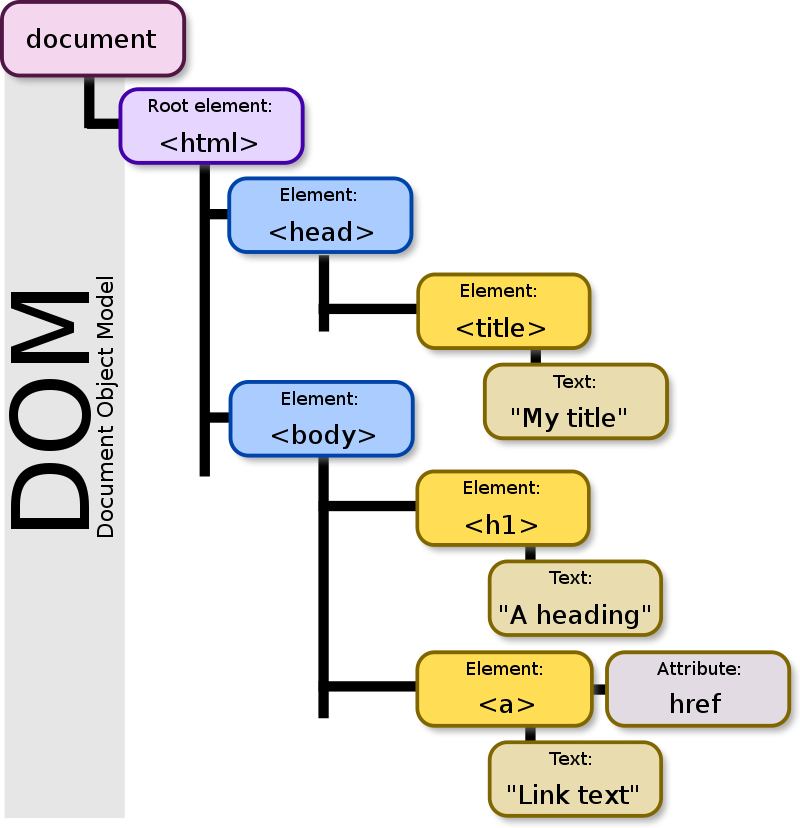
File:DOM-model.svg · Wikimedia Commons · See Wikimedia Commons
Key facts
- Abbreviation
- DOM
- Latest version
- DOM4 , November 19, 2015 ; 10 years ago ( 2015-11-19 )
- Organization
- World Wide Web Consortium , WHATWG
- Base standards
- WHATWG DOM Living Standard , W3C DOM4
via Wikipedia infobox
Source code
We are committed to providing a friendly, safe, and welcoming environment for all. Please read and respect the Code of Conduct. Folks notice minor and larger issues with the DOM Standard all the time and we'd love your help fixing those. Pull requests for typographical and grammar errors are also most welcome. Issues labeled "good first issue" are a good place to get a taste for editing the DOM Standard. Note that we don't assign issues and there's no reason to ask for availability either, just provide a pull request. If you are thinking of suggesting a new feature, read through the FAQ and Working Mode documents to get yourself familiarized with the process. In short, change dom.bs and submit your patch, with a good commit message. Please add your name to the Acknowledgments section in your first pull request, even for trivial fixes. The names are sorted lexicographically. To ensure your patch meets all the necessary requirements, please also see the Contributor Guidelines. Editors of the DOM Standard are expected to follow the Maintainer Guidelines. A dashboard showing the tests running against browser engines can be seen at wpt.fyi/results/dom. For quick local iteration, run make ; this will use a web service to build the standard, so that you don't have to install anything. See more in the Contributor Guidelines. Do not use newlines inside "inline" elements, even if that means exceeding the column width requirement. Using newlines between "inline" element tag names and their content is also forbidden. (This actually alters the content, by adding spaces.) That is Do not indent for anything except a new "block" element. For instance End tags may be included (if done consistently) and attributes may be quoted (using double quotes), though the prevalent theme is to omit end tags and not quote attributes (unless they contain a space). Place one newline between paragraphs (including list elements). Place three newlines before , and two newlines before other headings. This does not apply when a nested heading follows the parent heading. Use camel-case for variable names and "spaced" names for definitions, algorithms, etc.
Excerpt from the source-code README · 4,674 chars · not written by Vinony
Wikidata facts
- Instance of
- application programming interface
- Official website
- dom.spec.whatwg.org
- Image
- DOM-model.svg
Show 8 more facts
- standards body
- World Wide Web Consortium
- Stack Exchange tag
- stackoverflow.com/tags/dom
- Commons category
- Document object models
- work available at URL
- dom.spec.whatwg.org
- source code repository URL
- github.com/whatwg/dom
- uses
- web browser
- short name
- DOM
- different from
- DOM
Sources (6)
via Wikidata · CC0
Article · 日本語
Document Object Model(DOM、日: ドキュメントオブジェクトモデル)は、マークアップがなされたリソース(Document)をリソース要素(Object)の木構造(Model)で表現し操作可能にする仕組み、またそのモデルである。 DOMは、HTML文書やXML文書(あるいはより単純なマークアップされた文章など)をオブジェクトの木構造モデルで表現することで、ドキュメントをプログラムから操作・利用することを可能にする仕組みである。Documentの種類、操作に用いるプログラミング言語の種類に依存しない仕様である。 WHATWGがLiving Standardとして定義している。WHATWG以前はW3Cが仕様を策定しており、Level 1からLevel 4まで勧告している。 XMLを読み込むAPIであるSAXと異なり、XMLデータをツリー構造として扱う事ができる。ただし、通常の場合対象のXML文書を全て読み込んでからの扱いを前提とするため、動作速度が遅かったり、メモリーの使用量が大きくなるといった欠点もある。 DOMの実装は各メーカーに委ねられており、DOMを実装したが各メーカーから提供されている。
Abstract from DBpedia / Wikipedia · CC BY-SA