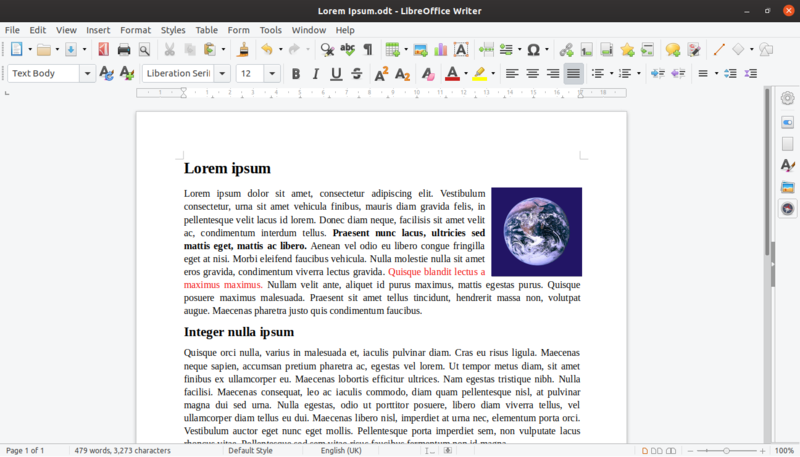
File:LibreOffice_Writer_6.3.png · Wikimedia Commons · See Wikimedia Commons
document
Sign in to saveAlso known as doc, record
A document is a written, drawn, presented, or memorialized representation of thought, often the manifestation of non-fictional, as well as fictional, content. The etymology of the word "document" derives from the Latin ', which denotes a "teaching" or "lesson": the verb ' denotes "to teach". Historically, the term "document" was usually used to indicate written proof useful as evidence of a truth or fact.
A document is a written, drawn, or recorded representation of thoughts and ideas, which can convey both factual and fictional content. Historically, documents have been especially valued as written proof that can serve as evidence of facts or truths.
AI-generated from the Wikipedia summary — may contain errors.
Wikidata facts
- Has part
- heading
- Image
- Sales contract Shuruppak Louvre AO3766.jpg
Show 9 more facts
- entry in abbreviations table
- док.
- P13411
- Ingemar Stenmark
- Unicode character
- 🗎
- Commons category
- Documents
- topic's main category
- Category:Documents
- topic has template
- Template:Infobox document
- equivalent class
- www.w3.org/ns/activitystreams#Document
- has cause
- writing
- studied by
- library science
via Wikidata · CC0
~9 min read
Encyclopedic overview
8 sectionsContents
- Abstract definitions
- Kinds
- Drafting
- Media
- In law
- See also
- References
- Further reading
A document is a written, drawn, presented, or memorialized representation of thought, often the manifestation of non-fictional, as well as fictional, content. The etymology of the word "document" derives from the Latin ', which denotes a "teaching" or "lesson": the verb ' denotes "to teach". Historically, the term "document" was usually used to indicate written proof useful as evidence of a truth or fact.
In the Computer Age, the term "document" typically refers to a primarily textual computer file, encompassing its structural and format elements, such as fonts, colors, and images. In the contemporary era, the definition of "document" has expanded beyond its traditional medium, such as paper, to encompass electronic documents as well. History, events, examples, opinions, stories, and creativity can all be expressed in documents.
Excerpted from Wikipedia’s “document” article, available under the CC BY-SA 4.0 licence.
Gallery (8)
Available in 81 languages
- Español
- Français
- Deutsch
- 中文
- 日本語
- Русский
- Português
- Italiano
- العربية
- हिन्दी
- Albanian
- Angika
- Aragonese
- Armenian
- Asturian
- Azerbaijani
- Bahasa Indonesia
- Basque
Show 62 more
- be_x_old
- Belarusian
- Bikol
- Bosnian
- Breton
- Bulgarian
- Catalan
- Central Kurdish
- Croatian
- Czech
- Danish
- Esperanto
- Estonian
- Filipino
- Finnish
- Galician
- Hebrew
- Hungarian
- Icelandic
- Ido
- Irish
- Javanese
- Kazakh
- Kikuyu
- Latvian
- Lithuanian
- Macedonian
- Malay
- Mari
- Mongolian
- Nederlands
- Norwegian
- Norwegian Nynorsk
- Polski
- Punjabi
- Romanian
- Scots
- Serbian
- Serbian (Latin)
- Shona
- Sicilian
- simple
- Sindhi
- Svenska
- Swahili
- Tajik
- Tamil
- Telugu
- Tiếng Việt
- Türkçe
- Ukrainian
- Urdu
- Uzbek
- Venetian
- Western Frisian
- Western Panjabi
- Wu Chinese
- zh_min_nan
- zh_yue
- فارسی
- ไทย
- 한국어
via Wikidata sitelinks · CC0