
Dominica
Sign in to saveAlso known as Commonwealth of Dominica, The Commonwealth of Dominica, dm, DOM, DMA, Wai‘tu kubuli, Wai'tu kubuli, Island of Dominica
Dominica, officially the Commonwealth of Dominica, is an island country in the Caribbean. It is part of the Windward Islands chain in the Lesser Antilles archipelago in the Caribbean Sea. The capital, Roseau, is located on the western side of the island. Dominica's closest neighbours are two constituent territories of the European Union, both overseas departments of France: Guadeloupe to the northwest and Martinique to the south-southeast. Dominica comprises a land area of , and the highest point is Morne Diablotins, at in elevation. The population was 71,293 at the 2011 census.
OverviewAI-generated
Dominica, officially the Commonwealth of Dominica, is a sovereign island country located in the Caribbean subregion of the Americas. Its capital is Roseau, and English is the official language. The nation is a member of the United Nations, the Commonwealth of Nations, the World Trade Organization, and the Caribbean Community. It has a population of 67,408 and covers an area of 751 square kilometers. The highest point in the country is Morne Diablotins.
The country is divided into administrative territorial entities including Saint Andrew Parish, Saint David Parish, Saint George Parish, and Saint John Parish. The Eastern Caribbean dollar serves as its currency, and its top-level Internet domain is .dm. The national anthem is titled "Isle of Beauty, Isle of Splendour." Dominica is situated in the UTC−04:00 time zone. The name of the country is derived from the word for Sunday.
Synthesized by Vinony from 67 facts across 9 sources: Wikidata, REST Countries, Openweathermap, Open Meteo, World Bank, OpenStreetMap, PubMed, Vinony graph, Geo. Generated from structured data (not the Wikipedia text) and checked against those facts — may still contain errors.
Weather now
7-day forecast
via Open-Meteo
Country
- Capital
- Roseau
- Population
- 67,408
- Region
- Americas · Caribbean
- Demonym
- Dominican
- Currencies
- XCD ($)
- Languages
- English
- Calling code
- +1767
- Drives on
- Left
- FIFA code
- DMA
- TLD
- .dm
- Timezones
- UTC-04:00
via REST Countries
Indicators · World Bank
- GDP
- $688.9M(2024)
- Population
- 66,205(2024)
- Life expectancy
- 71.3 yrs(2024)
- Urban population
- 73.5 %(2024)
- Internet users
- 82 %(2024)
- Forest area
- 63.8 %(2023)
- Renewable energy
- 8.9 %(2022)
via World Bank Open Data · CC BY 4.0
Place details
- Locality
- Belles
- Region
- Saint Joseph Parish
- Country
- Dominica
- Population
- 71,625
- Timezone
- America/Dominica
via OpenStreetMap · GeoNames
Wikipedia views (30d)
70,683 totalvia Wikimedia Pageviews API
Key facts
- Country.conventional_long_name
- Commonwealth of Dominica
- Country.common_name
- Dominica
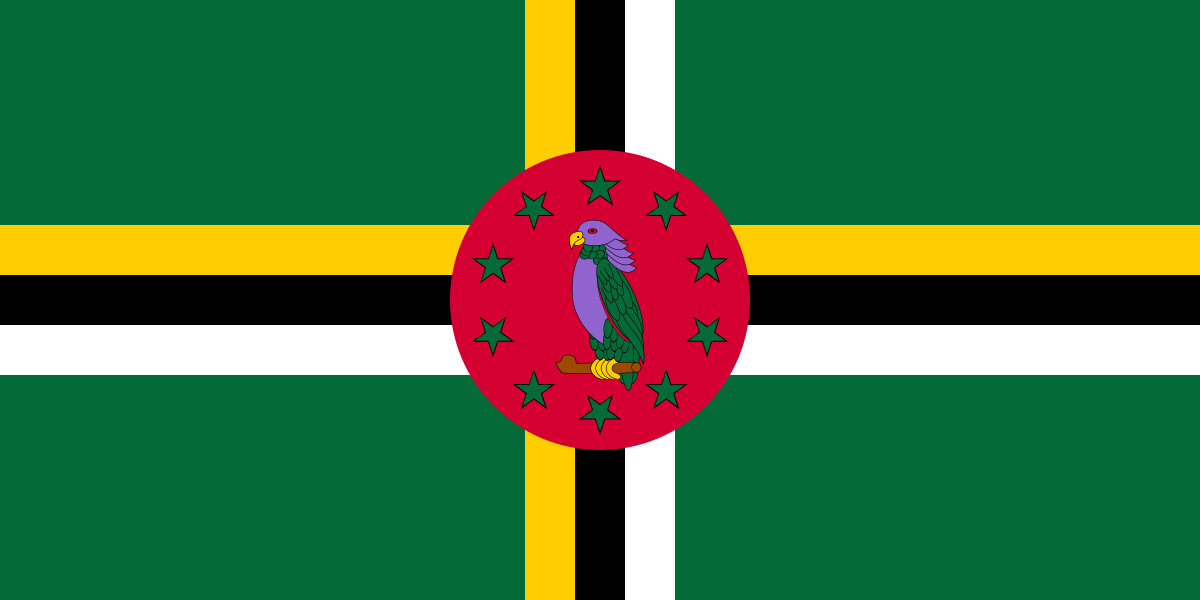
- Country.image_flag
- Flag of Dominica.svg
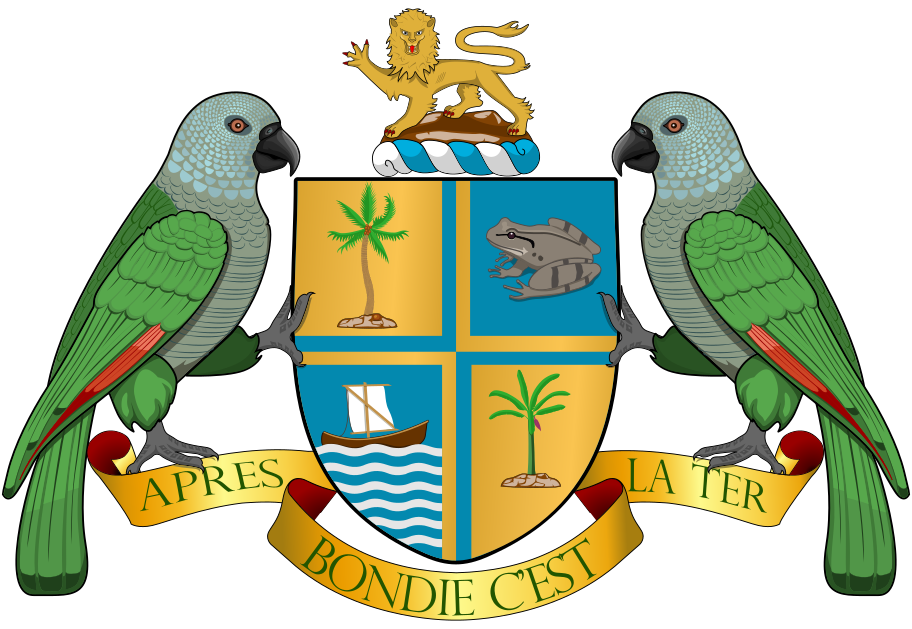
- Country.image_coat
- Coat of Arms of the Commonwealth of Dominica.svg
- Country.coa_size
- 95
- Country.national_motto
- "Apres Bondie, C'est La Ter" (Dominican Creole French) "Post Deum terra est" (Latin) "After God is the earth"
- Country.national_anthem
- "Isle of Beauty"
- Country.image_map
- Caribbean location map highlighting Dominica.svg
- Country.map2_width
- 250px
- Country.capital
- Roseau
- Country.largest_city
- capital
- Country.official_languages
- English
- Country.languages_type
- Vernacularlanguages
- Country.languages
- Dominican Creole French, Kokoy
- Country.ethnic_groups_year
- 2014
- Country.demonym
- Dominican(pronounced )
- Country.government_type
- Unitary parliamentary republic
- Country.leader_title1
- President
via Wikipedia infobox
Research
992 papers- Dominica.Department of State publication. Background notes series · 1987United States. Department of State. Bureau of Public Affairs
- A Conversation with Sister Frances Dominica.Death studies · 2020Balk DEDOI: 10.1080/07481187.2019.1641997
- The Genome of Rhyzopertha dominica (Fab.) (Coleoptera: Bostrichidae): Adaptation for Success.Genes · 2022Oppert B, Muszewska A, Steczkiewicz K et al.DOI: 10.3390/genes13030446
- Muscular dystrophies.Pediatric annals · 2005Shulman STDOI: 10.3928/0090-4481-20050701-03
- Diagnostic et prise en charge de la maladie cœliaque.ReviewCMAJ : Canadian Medical Association journal = journal de l'Association medicale canadienne · 2026Blom JJ, Gidrewicz D, Turner J et al.DOI: 10.1503/cmaj.230091-f
- Genetic ancestry, admixture, and population structure in rural Dominica.PloS one · 2021Keith MH, Flinn MV, Durbin HJ et al.DOI: 10.1371/journal.pone.0258735
- Dominica's Hurricane David.Nursing times · 1980Ifill DC
- Competition of Rhyzopertha dominica and Sitophilus oryzae on six sorghum varieties.Environmental science and pollution research international · 2023Agrafioti P, Arthur FH, Athanassiou CGDOI: 10.1007/s11356-023-29807-9
via PubMed
Wikidata facts
- Instance of
- country
- Named after
- Sunday
- Official name
- Dominica
- Demonym
- ضومينيكيين
- Country
- Dominica
- Contains
- Saint Andrew Parish
- Continent
- North America
- Capital
- Roseau
- Official language
- English language
- Currency
- Eastern Caribbean dollar
- Population
- 74656
- Area
- 751.096551
- Head of government
- Patrick John
- Head of state
- Sylvanie Burton
- Legislature
- House of Assembly of Dominica
- Shares border with
- Venezuela
- Highest point
- Morne Diablotins
- Follows
- West Indies Federation
- Official website
- www.dominica.gov.dm
- Image
- Dominica from ISS.jpg
- Life expectancy
- 73
- Nominal GDP
- 612048148
Show 56 more facts
- Calling code
- +1767
- Licence plate code
- WD
- Electrical plug type
- BS 1363
- Mains voltage
- 230
- Motto
- Wedi Duw, y Ddaear
- Flag
- flag of Dominica
- Coat of arms
- coat of arms of Dominica
- topic's main Wikimedia portal
- Portal:Dominica
- top-level Internet domain
- .dm
- Commons category
- Dominica
- topic's main category
- Category:Dominica
- category for people born here
- Category:People born in Dominica
- category for films shot at this location
- Category:Films shot in Dominica
- category of associated people
- Category:Dominica people
- located in/on physical feature
- Caribbean
- Commons gallery
- Dominica
- mobile country code
- 366
- lowest point
- Caribbean Sea
- driving side
- left
- geography of topic
- Geography of Dominica
- emergency phone number
- 999
- age of majority
- 18
- marriageable age
- 18
- office held by head of government
- Prime Minister of Dominica
- diplomatic relation
- Kosovo
- language used
- Saint Lucian Creole
- number of out-of-school children
- 1991
- has characteristic
- free country
- total fertility rate
- 1.9
- maritime identification digits
- 325
- category for people who died here
- Category:Deaths in Dominica
- inception
- 1978-01-01
- Unicode character
- 🇩🇲
- history of topic
- history of Dominica
- VAT rate
- 15
- native label
- Commonwealth Dominica
- different from
- Dominican Republic
- described by source
- New International Encyclopedia
- economy of topic
- economy of Dominica
- demographics of topic
- demographics of Dominica
- office held by head of state
- president of Dominica
- Human Development Index
- 0.740
- P11012
- Kusel
- central bank
- Eastern Caribbean Central Bank
- hashtag
- Dominica
- on focus list of Wikimedia project
- Wikipedia:Vital articles/Level/4
- P12749
- Brandenburg
- birth rate
- 13.278
- male population
- 36161
- death rate
- 8.921
- rural population
- 20585
- female population
- 36577
- urban population
- 52152
- P8168
- Chakma script
- Commonwealth Sport country code
- DMA
Sources (15)
via Wikidata · CC0
Travel guide
Understand
The name of the island Dominica is derived from the Latin word for Sunday, the day on which Christopher Columbus saw the island in 1493. It lies in a fertile area of tropical mountains around , set along its coastline of black sand beaches.
Administrative divisions. 10 parishes: Saint Andrew, Saint David, Saint George, Saint John, Saint Joseph, Saint Luke, Saint Mark, Saint Patrick, Saint Paul, Saint Peter.
Get in
450px|thumbnail|Visa policy of Dominica (all shades of green can have visa free travel; while those countries in black require a visa to visit) The following persons do not need a visa to enter into the Commonwealth of Dominica:
Citizens of the following countries can stay for up to 6 months: Member States of the Commonwealth, CARICOM member states, Austria, Bulgaria, Cyprus, Czech Republic, Estonia, Finland, Hungary, Latvia, Lithuania, Poland, Romania, Slovakia, Slovenia, United States of America;
Citizens of the following countries can stay for up to 3 months: Argentina, Belgium, Costa Rica, Denmark, France, Germany, Greece, Ireland, Israel, Italy, Japan, Luxembourg, Malta, Mexico Netherlands (including Netherlands Antilles), Norway, People's Republic of China, Portugal, South Korea, Spain, Suriname, Sweden, United Kingdom and Venezuela.
Citizens of other countries can stay for up to 21 days visa-free if they have a return ticket and enough money to support their stay. This is subject to the discretion of the immigration officer.
Get around
As far as freedom of movement and exploration a car can be invaluable. Though small, the island's tightly turning mountain roads make for relatively long journeys and a hair-raising experience. Driving is on the left hand side of the road and there are various car rental agencies at both airports.
Honk horn on hairpin turns especially during the day. Beware of large trucks as their width forces other drivers off the road. Watch for large pot holes and crumbling asphalt as roads can be in very poor condition. Ask directions if lost, the locals are very friendly and informative. When in mountains in torrential rains, consider stopping for a bit or at least going very slowly. A compact is sufficient for most situations but a small 4x4 might also be nice. A large 4x4 would be cumbersome on the small streets.
Other travel options include bus or taxi. If you are on a low budget and have plenty of time then hitch-hiking or the bus will be fine (except on Sundays), although sitting in a bumpy bus for long trips on winding mountain roads is not the most comfortable thing to do. Taxi is more comfortable than the buses and may not be expensive, particularly if the fare is shared with 2 or more travellers. Whether you use the bus or taxi, make sure that you clearly agree to the destination and price before you start the trip.
See
thumb|Middleham falls in Morne Trois Pitons National Park This lush Caribbean island is called "the nature island" for a reason. Its beautiful, tropical natural riches are by far its main attraction. Where other Caribbean destinations pride themselves most on their white, palm-lined beaches, Dominica shows another side of the region. Head to the mountain village of Laudat for a hike through the UNESCO listed Morne Trois Pitons National Park. It encompasses some of the island's finest mountainous terrain in a 17,000-acre protected area. A proper hike will reward you with gorgeous misty lakes, waterfalls, rivers, hot springs and fumaroles in a setting of volcanoes and thick jungle. Enjoy the sight and take a swim at the Emerald Pool or explore the Titou Gorge.
From the gorge, true hikers should set out for the challenging six-hour hike to the boiling lake, the second-largest of its kind in the world and an amazing sight.
The capital of Roseau is a pleasant place to explore, with many restaurants, small shops and wonderful views of the mountains (to the east) and the Caribbean Sea (to the west). The town hums with the sounds of vehicles, Caribbean accents, and minor commerce (e.g. sidewalk BBQs, vendors selling clothing in street stalls). Head to the Botanic Gardens to get away from the hussle or sip a coffee in a gallery.
An old British Fort is on the north-west coast at Portsmouth. A small fee may be charged. Expect to spend 1-2 hours at the site. A guided tour through the …
Do
thumb|Hikers love Dominica
Snorkelling is particularly good at Champagne, south of Roseau, and at Scott's Head. Scuba Diving, waterskiing, jet skiing, kayaking or other water sports are also possibilities. Note that kayaking or canoeing provide an alternative to the ocean and lets you experience the rivers and inland bodies of water throughout Dominica.
Whale watching, dolphin watching, or boat tours can be arranged from Roseau. Dominica's waters are also home to three species of marine turtles (Leatherback, Hawksbill, and Green turtle), and these gentle giants can be seen coming in to nest on shore during the months of April to October. Protected viewing sites are set up throughout the island, such as at Mangrove Bay on the Woodford Hill beach in the north east, or on the beaches of Portsmouth in the north west.
Hiking trip, biking, ATV tours, or zip lining are popular in forest areas. Hiking is one of the best ways to see Dominica and there are many wonderful hikes around the island of easy to challenging.
Dominica rock climbing and canyoning is an encouraging and motivating experience. It tests strength and agility while experiencing some of the most breathtaking views of Dominica.
Dominica is known for their many island events and festivals. The Caribbean Islands love food, music, and celebration. Whether it’s a cultural gathering or a music festival Dominica offers it.
Many of Dominica’s resorts offer spa vacation services on the premise for a convenient way to get…
Drink
thumb|250px|Kubuli Beer Freshly squeezed grapefruit is ubiquitous and is perfect with every meal. Coconut water is cheap and readily available by the side of the road. Another local specialty is sorrel. This red refreshing drink is brewed from the flowers of a hibiscus species common also in Jamaica. The popular locally brewed beer is Kubuli. Ask your hotel to set up a tour of the brewery.
There are many vendors of fruit juice in Roseau. Almost without exception this is non-pasteurized fruit juice with water and sugar added. The added water is usually chlorinated tap water. A juice vendor known as Pal sells his juice by the area where one can find a bus to Portsmouth. Pal is one of the most enthusiastic and knowledgeable fruit vendors on the island. He sometimes has juice from rare fruits.
Quenchi is a local soft drink which comes in many different flavours. It can be found in every village (with diet varieties at the IGA in Roseau).
Sorrel, known as the Christmas drink for its red colour (and because it only flowers around Christmas) is made from boiled flowers. It tastes heavenly.
Avocado pear juice can be purchased in some small cafes and is certainly worth a try. Other flavours include soursop, passionfruit, grapefruit, orange, lime, beetroot.
The coffee is usually not very good, as most locals seem to prefer tea and juice, with the occasional exception. There are also a few coffee shops around the major towns.
Sleep
Many accommodations on the island are outside of the towns. For in-city accommodations, see the respective city articles.
Veranda View A small guest house in the north part of the Island, Veranda View is an ideal location to base yourself to tour the island. Located 15 minutes from the Melville Hall Airport, the guest house is easy to find on the main road in Calibishie. thumb|Cruise ship in Roseau. Visitors by cruise ship usually sleep onboard. 'Nature Island Eco-village', possibly the cheapest travel option. Only for adventure travellers. The site is only accessible by foot, including a river ford or zip line. Work trade can be arranged in some cases to cover cost of stay. Offers a hands on course in subsistence farming, organic farming and permaculture principles.
Stay safe
Dominica is one of the safest places to travel in the region. There are no poisonous snakes or insects in Dominica
Take usual precautions when travelling around Dominica. Although rare, petty crimes are most likely to happen around Roseau. Elsewhere the island is extremely safe.
Stay healthy
thumb|Rainforest in the inland of Dominica Tap water is safe to drink, but since it is sometimes drawn straight from Dominica's many rivers, it has a tendency to turn brown after heavy rainfall. It's better to drink the bottled water available almost anywhere.
Basic healthcare is available at Princess Margaret Hospital in Roseau.
North Americans moving to Dominica often experience boils for the first time and fingernail and toenail fungi. Stomach problems are rare among travellers.
Towns are sprayed with insecticides periodically to control the mosquitoes responsible for spreading Dengue fever. However, the spraying may not be done at the scheduled time and pesticides may drift into your home if the windows are open.
In the high lands and uninhabited central regions water is gathered at roadside springs. Sometimes the bus will stop and passengers will fill their water bottles. Locals prefer the taste of this water to bottled water.
Public water is bacterially safe to drink due to heavy chlorination and has the expected chlorine flavor.
Connect
Area code is 767, on the North American exchange.
Digicel is a local cellular company which provides prepaid plans for those visiting for short periods. Cable & Wireless and Orange also provide cell service.
Travel guide from Wikivoyage (CC BY-SA 4.0)
~40 min read
Encyclopedic overview
40 sectionsContents
- Etymology
- History
- Geologic history
- Pre-colonial period and early European contact
- French colony
- British colony
- Early 20th century <span class="anchor" id="Dominica Act 1938"></span>
- Post-independence
- Geography and climate
- Fauna
- Government
- Military
- Human rights
- Territorial disputes
- Administrative divisions
- Economy
- International trade
- Financial services industry
- Economic immigrants
- Tourism
- Infrastructure
- Air
- Roads
- Green energy
- Demographics
- Languages
- Religion
- Education
- Culture
- Cuisine
- Sports
- Media
- Notable people
- See also
- Notes
- References
- External links
- =
- ===({{NoMoreLinks}})====
- ({{NoMoreLinks}})===============
Dominica, officially the Commonwealth of Dominica, is an island country in the Caribbean. It is part of the Windward Islands chain in the Lesser Antilles archipelago in the Caribbean Sea. The capital, Roseau, is located on the western side of the island. Dominica's closest neighbours are two constituent territories of the European Union, both overseas departments of France: Guadeloupe to the northwest and Martinique to the south-southeast. Dominica comprises a land area of 750 km (290 sq mi), and the highest point is Morne Diablotins, at 1,448 m (4,751 ft) in elevation. The population was 71,293 at the 2011 census.
The island was settled by the Arawak arriving from South America in the fifth century. The Kalinago displaced the Arawak by the 15th century. Christopher Columbus is said to have passed the island on Sunday, 3 November 1493. It was later colonised by Europeans, predominantly by the French from the 1690s to 1763. The French trafficked slaves from West Africa to Dominica to work on coffee plantations. Great Britain took possession in 1763 after the Seven Years' War, and gradually established English as its official language. The island gained independence as a republic in 1978.
Excerpted from Wikipedia’s “Dominica” article, available under the CC BY-SA 4.0 licence.
Gallery (31)
On the map
4 mapped locations
Available in 223 languages
- Español
- Français
- Deutsch
- 中文
- 日本語
- Русский
- Português
- Italiano
- العربية
- हिन्दी
- Abkhazian
- abstract
- Afrikaans
- Albanian
- Albanian
- Amharic
- ami
- Angika
Show 204 more
- Aragonese
- Armenian
- Arpitan
- Asturian
- Aymara
- azb
- Azerbaijani
- Bahasa Indonesia
- Balinese
- Bangla
- Bashkir
- Basque
- bat_smg
- Bavarian
- be_x_old
- Belarusian
- Betawi
- Bhojpuri
- Bikol
- Bishnupriya
- Bislama
- Bosnian
- Breton
- Bulgarian
- Buriat
- Burmese
- Catalan
- cbk_zam
- cdo
- Cebuano
- Central Kurdish
- Chechen
- Cherokee
- Cornish
- Crimean Tatar
- Croatian
- Czech
- Danish
- Divehi
- dty
- Egyptian Arabic
- Erzya
- Esperanto
- Estonian
- Ewe
- Extremaduran
- Faroese
- Fiji Hindi
- Filipino
- Finnish
- fiu_vro
- Gagauz
- Galician
- gcr
- Georgian
- Gilaki
- Goan Konkani
- Gothic
- Greek
- Guarani
- Haitian Creole
- Hakka Chinese
- Hausa
- Hebrew
- Hungarian
- hyw
- Icelandic
- Ido
- Igbo
- Iloko
- Inari Sami
- Interlingua
- Interlingue
- Irish
- Jamaican Creole English
- Javanese
- Kabyle
- Kannada
- Kara-Kalpak
- Karachay-Balkar
- Kazakh
- Kinyarwanda
- Kurdish
- Kyrgyz
- Ladino
- Lao
- Latin
- Latvian
- Ligurian
- Limburgish
- Lingala
- Lingua Franca Nova
- Lithuanian
- lld
- Lombard
- Low German
- Lower Sorbian
- Luxembourgish
- Macedonian
- Madurese
- Malagasy
- Malay
- Malayalam
- Maltese
- Manipuri
- Manx
- Māori
- map_bms
- Marathi
- Mari
- Mazanderani
- Minangkabau
- Mingrelian
- Moksha
- Mongolian
- Moroccan Arabic
- nds_nl
- Nederlands
- Nepali
- Newari
- Northern Frisian
- Northern Sami
- Norwegian
- Norwegian Nynorsk
- Novial
- Occitan
- Old English
- olo
- Ossetic
- Pampanga
- Papiamento
- Picard
- Piedmontese
- Polski
- Punjabi
- Quechua
- rki
- roa_rup
- Romanian
- Rusyn
- Samoan
- Sanskrit
- Sardinian
- Saterland Frisian
- Scots
- Scottish Gaelic
- Serbian
- Serbian (Latin)
- Shan
- Shona
- Sicilian
- Silesian
- simple
- Sindhi
- Sinhala
- Slovak
- Slovenian
- Somali
- Sundanese
- Svenska
- Swahili
- Swati
- szy
- Tachelhit
- Tajik
- Tamil
- Taroko
- Tatar
- tay
- Telugu
- Tetum
- Tibetan
- Tiếng Việt
- Toki Pona
- Tongan
- Türkçe
- Udmurt
- Ukrainian
- Upper Sorbian
- Urdu
- Uyghur
- Uzbek
- Venetian
- Veps
- Volapük
- Waray
- Welsh
- Western Frisian
- Western Mari
- Western Panjabi
- Wolof
- Wu Chinese
- Yakut
- Yiddish
- Yoruba
- Zaza
- Zeelandic
- zh_classical
- zh_min_nan
- zh_yue
- Zhuang
- فارسی
- ไทย
- 한국어
via Wikidata sitelinks · CC0