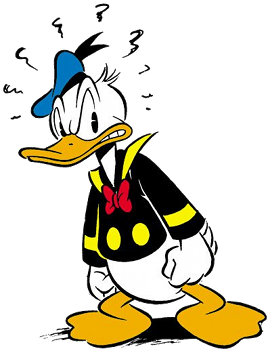
File:Donald_Duck_angry_transparent_background.png · Wikimedia Commons · See Wikimedia Commons
Donald Duck is an animated cartoon character created by Disney who has appeared in films, comic strips, and television shows since the 1930s. He is one of Disney's most recognizable and enduring characters, known for his distinctive voice and comedic personality, and has played an important role in establishing Disney as a major force in entertainment.
AI-generated from the Wikipedia summary — may contain errors.
Described at
Kalle Anka - Seriewikin
seriewikin.serieframjandet.se →Det här är en gaffelsida , d.v.s. en förteckning över olika artiklar som har samma eller liknande uppslagsord. Om du blev hitskickad via en länk, får du gärna hjälpa Seriewikin att styra om länken till den avsedda artikeln. Seriewikin har åtskilliga artiklar som relaterar till seriefiguren Kalle Anka eller Donald Duck (hans namn på originalspråket engelska) eller serierna och serietidningarna som bär hans namn.
Excerpt from a page describing this subject · 15,166 chars · not written by Vinony
Wikidata facts
- Gender
- male
- Father
- Quackmore Duck
- Mother
- Hortense McDuck
- Sibling
- Della Duck
- Occupation
- enlisted navy sailor
- Family
- Clan McDuck
- Country of origin
- United States
- Creator
- Walt Disney
- Performer
- Daniel Ross
- Conflict
- World War II
- Military branch
- United States Navy
- Official website
- mickey.disney.com/donald
- Image
- Kalle Ankas adventskalender.jpg
- Residence
- Duckburg
- Said to be same as
- Duck Avenger
Show 24 more facts
- enemy
- Humphrey the Bear
- has pet
- Tabby
- significant person
- Peter Pig
- topic's main category
- Category:Donald Duck
- Commons gallery
- Donald Duck
- present in work
- Mickey, Donald, Goofy: The Three Musketeers
- from narrative universe
- Mickey Mouse universe
- Commons category
- Donald Duck
- contributor to the creative work or subject
- Don Patterson
- pseudonym
- Unca Donald
- birth name
- Donald Fauntleroy Duck
- narrative role
- supporting character
- first appearance
- The Wise Little Hen
- inception
- 1934-06-09
- filmography
- Donald Duck filmography
- color
- orange
- wears
- swim trunks
- location of creation
- The Walt Disney Company
- name in native language
- Donald Duck
- animal breed
- domestic duck
- described at URL
- seriewikin.serieframjandet.se/index.php/Kalle_Anka
- number of viewers/listeners
- 6053034
- public domain date
- 2030-01-01
- relative
- Louie Duck
Sources (9)
via Wikidata · CC0
~40 min read
Encyclopedic overview
Donald Fauntleroy Duck is a cartoon character created by the Walt Disney Company. Donald is an anthropomorphic white duck with a yellow-orange bill, legs, and feet. He typically wears a sailor shirt and cap with a bow tie. Donald is known for his semi-intelligible speech and his volatile, boisterous, and high-energy personality. Along with his friend Mickey Mouse, Donald was included in TV Guide's list of the 50 greatest cartoon characters of all time in 2002, and has earned a star on the Hollywood Walk of Fame. He has appeared in more films than any other Disney character.
Donald Duck appeared in comedic roles in animated cartoons. Donald's first appearance was in The Wise Little Hen (1934), but it was his second appearance in Orphan's Benefit that same year that introduced him as a temperamental comic foil to Mickey Mouse. Throughout the next two decades, Donald appeared in over 150 theatrical films, several of which were recognized at the Academy Awards. In the 1930s, he typically appeared as part of a comic trio with Mickey and Goofy and was given his own film series starting with Don Donald (1937). These films introduced Donald's love interest and permanent girlfriend Daisy Duck and often included his three nephews Huey, Dewey, and Louie. After the film Chips Ahoy (1956), Donald appeared primarily in educational films before eventually returning to theatrical animation in Mickey's Christmas Carol (1983). His final appearance in a theatrical film was in Fantasia 2000 (1999). However, since then Donald has appeared in direct-to-video features such as Mickey, Donald, Goofy: The Three Musketeers (2004), television series such as Mickey Mouse Clubhouse (2006–2016), and video games such as QuackShot (1991), Donald Duck: Goin' Quackers (2000) and the Kingdom Hearts series (2002–present).
Excerpted from Wikipedia’s “Donald Duck” article, available under the CC BY-SA 4.0 licence.
Gallery (11)
Available in 98 languages
- Español
- Français
- Deutsch
- 中文
- 日本語
- Русский
- Português
- Italiano
- العربية
- हिन्दी
- Afrikaans
- Albanian
- Albanian
- Armenian
- Asturian
- Azerbaijani
- Bahasa Indonesia
- Basque
Show 79 more
- Bosnian
- Breton
- Bulgarian
- Catalan
- Cebuano
- Chamorro
- Chechen
- Croatian
- Czech
- Danish
- Egyptian Arabic
- Esperanto
- Estonian
- Faroese
- Filipino
- Finnish
- Galician
- Georgian
- Greek
- Gujarati
- Hawaiian
- Hebrew
- Hungarian
- hyw
- Icelandic
- Ido
- Interlingua
- Irish
- Javanese
- Kannada
- Kurdish
- Latin
- Latvian
- Limburgish
- Lithuanian
- Low German
- Luxembourgish
- Macedonian
- Malay
- Malayalam
- Marathi
- Mongolian
- Nederlands
- Northern Sami
- Norwegian
- Norwegian Nynorsk
- Occitan
- Pampanga
- Picard
- Polski
- Quechua
- roa_rup
- Romanian
- rsk
- Serbian
- Serbian (Latin)
- Sicilian
- simple
- Sundanese
- Svenska
- Tahitian
- Telugu
- Tibetan
- Tiếng Việt
- Türkçe
- Ukrainian
- Uzbek
- Venetian
- Waray
- Welsh
- Western Frisian
- Western Mari
- Western Panjabi
- Wu Chinese
- Yiddish
- zh_yue
- فارسی
- ไทย
- 한국어
via Wikidata sitelinks · CC0