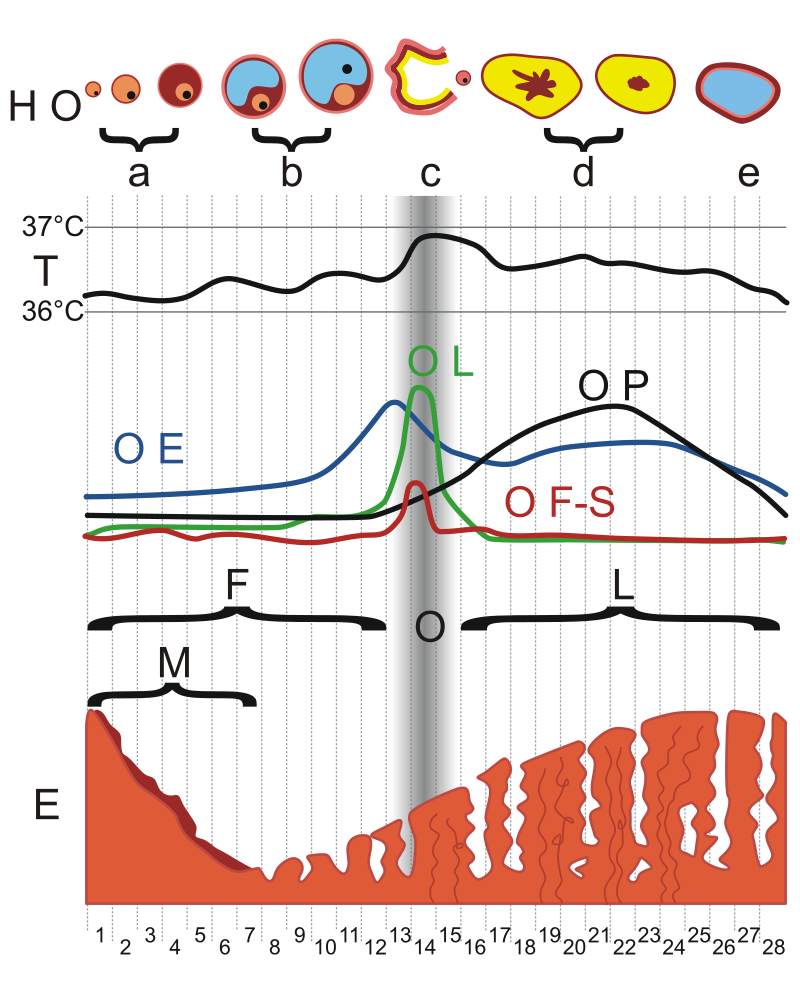
File:MenstrualCycle_gen.svg · Wikimedia Commons · See Wikimedia Commons
dysmenorrhea
Sign in to saveAlso known as menstrual cramps, period cramps, dysmenorrhoea, dysmenorrhœa
Dysmenorrhea, also known as period pain, painful periods or menstrual cramps, is pain during menstruation. Its usual onset occurs around the time that menstruation begins. Symptoms typically last less than three days. The pain is usually in the pelvis or lower abdomen. Other symptoms may include back pain, diarrhea or nausea.
OverviewAI-generated
Dysmenorrhea is a medical condition classified under the ICD-10 code for "Dysmenorrhea, unspecified." It is identified in the International Classification of Primary Care (ICPC) with the code X02. The condition is also cataloged in the NCI Thesaurus under the identifier C34559 and corresponds to the Human Phenotype Ontology term HP_0100607.
Research on dysmenorrhea is extensive, with 10,253 articles indexed in PubMed. Additionally, 450 clinical trials related to the condition are listed on ClinicalTrials.gov. The subject is referenced by 489 other encyclopedia articles, and a dedicated category exists on Wikimedia Commons.
Synthesized by Vinony from 10 facts across 5 sources: Wikidata, PubMed, ClinicalTrials.gov, Medline, Vinony graph. Generated from structured data (not the Wikipedia text) and checked against those facts — may still contain errors.
Key facts
- Medical condition (new).name
- Dysmenorrhea
- Medical condition (new).synonyms
- Dysmenorrhoea, period pain, painful periods, menstrual cramps
- Medical condition (new).image
- MenstrualCycle gen.svg
- Medical condition (new).caption
- Menstrual cycle and changes in hormone production
- Medical condition (new).field
- Gynecology
- Medical condition (new).symptoms
- Pain during first few days of menstruation, diarrhea, nausea
- Medical condition (new).onset
- Within a year of the first menstrual period
- Medical condition (new).duration
- Less than 5 days (primary dysmenorrhea)
- Medical condition (new).causes
- No underlying problem, uterine fibroids, adenomyosis, endometriosis
- Medical condition (new).diagnosis
- Pelvic exam, ultrasound
- Medical condition (new).differential
- Ectopic pregnancy, pelvic inflammatory disease, interstitial cystitis, chronic pelvic pain
- Medical condition (new).treatment
- Heating pad, medication
- Medical condition (new).medication
- NSAIDs such as ibuprofen, hormonal birth control, IUD with progestogen
- Medical condition (new).prognosis
- Often improves with age
- Medical condition (new).frequency
- 50–90% female adolescents and women of reproductive age
- Medical condition (new).image_size
- 265
via Wikipedia infobox
Health references
- ICD-10
- N94.6 — Dysmenorrhea, unspecified
- MedlinePlus
- Consumer health page →
Research
10,253 papers- [Dysmenorrhea].ReviewTherapeutische Umschau. Revue therapeutique · 1996Ludwig H
- [Severe dysmenorrhea and endometriosis].ReviewLa Revue du praticien · 2025Bautrant É, Lacoste C, Lhuillery D
- Dysmenorrhea in adolescents and young adults: a review in different country.ReviewActa bio-medica : Atenei Parmensis · 2016De Sanctis V, Soliman AT, Elsedfy H et al.
- [Dysmenorrhea, endometriosis and premenstrual syndrome].ReviewMinerva pediatrica · 2002Tonini G
- Diagnosis and management of dysmenorrhoea.ReviewBMJ (Clinical research ed.) · 2006Proctor M, Farquhar CDOI: 10.1136/bmj.332.7550.1134
- [Update on the diagnosis and treatment of dysmenorrhoea].ReviewSemergen · 2025Rubio Pérez G, Quevedo Córdoba A, Varela Silva L et al.DOI: 10.1016/j.semerg.2024.102331
- Nonsteroidal anti-inflammatory drugs for dysmenorrhoea.The Cochrane database of systematic reviews · 2015Marjoribanks J, Ayeleke RO, Farquhar C et al.DOI: 10.1002/14651858.CD001751.pub3
- Dysmenorrhoea.BMJ clinical evidence · 2014Latthe PM, Champaneria R
via PubMed
Clinical Trials
450 registered- NACOMPLETEDThe Effect of Psychoeducation on Dysmenorrhea in Nursing StudentsGazi University · NCT05646238
- NACOMPLETEDEfficacy of Transcranial Direct Current Stimulation for Severe Primary DysmenorrheaTaipei Veterans General Hospital, Taiwan · NCT03594916
- NOT_YET_RECRUITINGAssessment of the Uterus Using Ultrasonographic Elastography in Women with DysmenorrheaUfuk University · NCT06606834
- NACOMPLETEDCombined Effects of Barre and Gym Ball Exercises in Primary DysmenorhoeaRiphah International University · NCT06750393
- PHASE2COMPLETEDEfficacy and Safety Study of Lidocaine Vaginal Gel for Recurrent Dysmenorrhea (Painful Periods)Juniper Pharmaceuticals, Inc. · NCT00651313
- NACOMPLETEDThe Effect of the Menstrual Belt Stress Ball on Pain in Women With DysmenorrheaIstanbul Gedik University · NCT06949397
Wikidata facts
- Subclass of
- pelvic pain
- Image
- MenstrualCycle gen.svg
Show 7 more facts
- name
- husháana
- Commons category
- Dysmenorrhea
- health specialty
- family medicine
- ICPC 2 ID
- X02
- exact match
- purl.obolibrary.org/obo/HP_0100607
- NCI Thesaurus ID
- C34559
- facet of
- women's health
via Wikidata · CC0
~19 min read
Encyclopedic overview
16 sectionsContents
- Signs and symptoms
- Causes
- Risk factors
- Mechanism
- Diagnosis
- Further work-up
- Management
- NSAIDs
- Hormonal birth control
- Other
- Alternative medicine
- TENS
- Surgery
- Epidemiology
- References
- External links
Dysmenorrhea, also known as period pain, painful periods or menstrual cramps, is pain during menstruation. Its usual onset occurs around the time that menstruation begins. Symptoms typically last less than three days. The pain is usually in the pelvis or lower abdomen. Other symptoms may include back pain, diarrhea or nausea.
Dysmenorrhea can occur without an underlying problem. Underlying issues that can cause dysmenorrhea include uterine fibroids, adenomyosis, and most commonly, endometriosis. It is more common among those with heavy periods, irregular periods, those whose periods started before twelve years of age and those who have a low body weight. A pelvic exam and ultrasound in individuals who are sexually active may be useful for diagnosis. Conditions that should be ruled out include ectopic pregnancy, pelvic inflammatory disease, interstitial cystitis and chronic pelvic pain.
Excerpted from Wikipedia’s “dysmenorrhea” article, available under the CC BY-SA 4.0 licence.