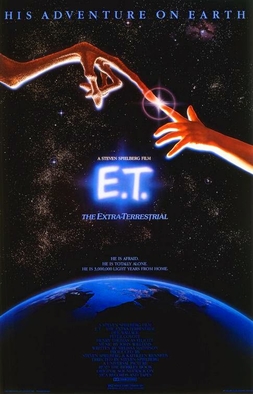
File:E_t_the_extra_terrestrial_ver3.jpg · Wikimedia Commons · See Wikimedia Commons
E.T. the Extra-Terrestrial
Sign in to saveAlso known as E.T., ET
1982 film directed by Steven Spielberg
OverviewAI-generated
*E.T. the Extra-Terrestrial* is a 1982 American science fiction and drama film directed by Steven Spielberg. The screenplay was written by Melissa Mathison, who also served as a producer alongside Spielberg and Kathleen Kennedy. The cast includes Henry Thomas, Drew Barrymore, Dee Wallace, and Peter Coyote. John Williams composed the score, while Allen Daviau handled cinematography and Carol Littleton edited the film. Produced by Amblin Entertainment and Universal Pictures, the movie was filmed in Los Angeles and distributed by Universal Pictures and Netflix.
The film has a runtime of 115 minutes and is rated PG. It received the Saturn Award for Best Science Fiction Film, the Golden Globe Award for Best Motion Picture – Drama, and the Golden Globe Award for Best Original Score. Additionally, it won the Academy Award for Best Original Score. The film was nominated for the Academy Awards for Best Director, Best Cinematography, Best Sound Editing, and Best Film Editing. It has received a Metascore of 92 and a Rotten Tomatoes rating of 99%.
Synthesized by Vinony from 47 facts across 5 sources: Wikidata, TMDb, IMDb, OMDb, Vinony graph. Generated from structured data (not the Wikipedia text) and checked against those facts — may still contain errors.
Film · TMDB
7.5An alien is left behind on Earth and saved by the 10-year-old Elliott who decides to keep him hidden in his home. While a task force hunts for the extra-terrestrial, Elliott, his brother, and his little sister Gertie form an emotional bond with their new friend, and try to help him find his way home.
Cast
- Henry Thomas as Elliott
- Drew Barrymore as Gertie
- Robert MacNaughton as Michael
- Peter Coyote as Keys
- Dee Wallace as Mary
- Erika Eleniak as Pretty Girl
Themes
- farewell
- space marine
- operation
- flying saucer
- nasa
- homesickness
- loss of loved one
- extraterrestrial technology
- prosecution
- riding a bicycle
This product uses the TMDB API but is not endorsed or certified by TMDB.
Ratings
IMDb
7.9/10
468,998 votes
Rotten Tomatoes
99%
Metacritic
92/100
- Year
- 1982
- Runtime
- 115 min
- Genres
- Adventure, Family, Sci-Fi
- Rated
- PG
- Awards
- Won 4 Oscars. 52 wins & 39 nominations total
via OMDb · IMDb
Wikidata facts
- Instance of
- film
- Part of
- National Film Registry
- Genre
- family film
- Country of origin
- United States
- Original language
- English language
- Main subject
- flying saucer
- Movement
- New Hollywood
- Director
- Steven Spielberg
- Screenwriter
- Melissa Mathison
- Cast member
- Debra Winger
- Voice actor
- Pat Welsh
- Composer
- John Williams
- Producer
- Steven Spielberg
- Production company
- Universal Pictures
- Cinematographer
- Allen Daviau
- Narrative location
- San Fernando Valley
- Filming location
- Los Angeles
- Duration
- 115
- FilmAffinity ID
- 627362
- Distribution format
- video on demand
- Image
- E.T. figure at Madame Tussauds London.jpg
Show 14 more facts
- Commons category
- E.T. the Extra-Terrestrial
- topic's main category
- Category:E.T. the Extra-Terrestrial
- film editor
- Carol Littleton
- title
- E.T.
- distributed by
- Netflix
- executive producer
- Melissa Mathison
- on focus list of Wikimedia project
- Art+Feminism
- box office
- 435110554
- capital cost
- 10500000
- film format
- 35 mm film
- set in period
- 1980s
- set during recurring event
- full moon
- publication date
- 1983-03-04
- review score
- 92/100
Sources (15)
via Wikidata · CC0
~40 min read
Encyclopedic overview
E.T. the Extra-Terrestrial (or simply E.T.) is a 1982 American science fantasy film produced and directed by Steven Spielberg and written by Melissa Mathison. It tells the story of Elliott, a boy who befriends an extraterrestrial that he names E.T. who has been stranded on Earth. Along with his friends and family, Elliott must find a way to help E.T. find his way home. The film stars Dee Wallace, Henry Thomas, Peter Coyote, Robert MacNaughton, and Drew Barrymore.
The film's concept was based on an imaginary friend that Spielberg created after his parents' divorce. In 1980, Spielberg met Mathison and developed a new story from the unrealized project Night Skies. In less than two months, Mathison wrote the first draft of the script, titled E.T. and Me, which went through two rewrites. The project was rejected by Columbia Pictures, who doubted its commercial potential. Universal Pictures eventually purchased the script for $1 million. Filming took place from September to December 1981 on a budget of $10.5 million. Unlike most films, E.T. was shot in rough chronological order to facilitate convincing emotional performances from the young cast. The animatronics for the film were designed by Carlo Rambaldi.
Excerpted from Wikipedia’s “E.T. the Extra-Terrestrial” article, available under the CC BY-SA 4.0 licence.
Gallery (20)
Available in 61 languages
- Español
- Français
- Deutsch
- 中文
- 日本語
- Русский
- Português
- Italiano
- العربية
- हिन्दी
- Afrikaans
- Aragonese
- Armenian
- Asturian
- Bahasa Indonesia
- Bangla
- Basque
- be_x_old
Show 42 more
- Belarusian
- Bulgarian
- Catalan
- Croatian
- Czech
- Danish
- Egyptian Arabic
- Esperanto
- Finnish
- Galician
- Georgian
- Greek
- Hebrew
- Hungarian
- Latin
- Latvian
- Macedonian
- Malay
- Nederlands
- Norwegian
- Polski
- Punjabi
- Romanian
- Serbian
- Serbian (Latin)
- simple
- Slovenian
- Svenska
- Tamil
- Tiếng Việt
- Türkçe
- Ukrainian
- Urdu
- Waray
- Welsh
- Wu Chinese
- Yakut
- Yiddish
- zh_yue
- فارسی
- ไทย
- 한국어
via Wikidata sitelinks · CC0