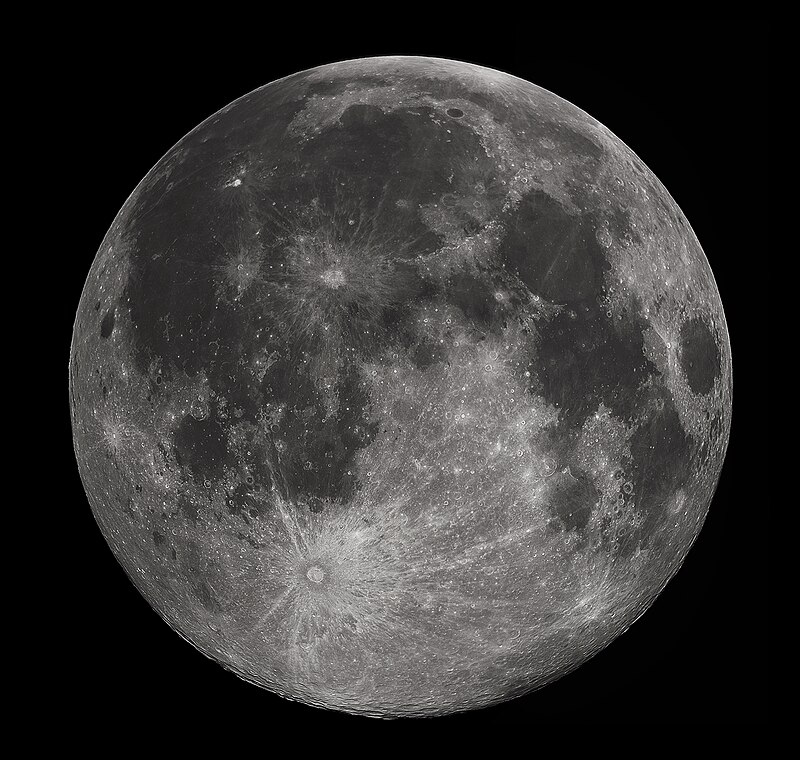
File:FullMoon2010.jpg · Wikimedia Commons · See Wikimedia Commons
A full moon is when the entire face of the moon that we can see from Earth is lit up by the sun, appearing as a complete bright circle in the sky. It occurs once every lunar month and has been important to humans throughout history for timekeeping, cultural practices, and navigation.
AI-generated from the Wikipedia summary — may contain errors.
Wikidata facts
- Instance of
- phase of the moon
- Subclass of
- planetary phase
- Image
- Phase-180.jpg
- Said to be same as
- Purnima
Show 4 more facts
- Unicode character
- 🌝
- Commons category
- Full moon
- topic's main category
- Category:Full moon
- opposite of
- new moon
via Wikidata · CC0
~21 min read
Encyclopedic overview
A full moon As the Earth revolves around the Sun, approximate axial parallelism of the Moon's orbital plane (tilted five degrees to the Earth's orbital plane) results in the revolution of the lunar nodes relative to the Earth. This causes an eclipse season approximately every six months, in which a lunar eclipse can occur at the full moon phase.
The full moon is the lunar phase when the Moon appears fully illuminated from Earth's perspective. This occurs when Earth is located between the Sun and the Moon (when the ecliptic longitudes of the Sun and Moon differ by 180°). This means that the lunar hemisphere facing Earth—the near side—is completely sunlit and appears as an approximately circular disk. The full moon occurs roughly once a month.
Excerpted from Wikipedia’s “full moon” article, available under the CC BY-SA 4.0 licence.
Gallery (7)
Available in 89 languages
- Español
- Français
- Deutsch
- 中文
- 日本語
- Русский
- Português
- Italiano
- العربية
- हिन्दी
- Afrikaans
- Albanian
- Armenian
- Asturian
- azb
- Azerbaijani
- Bahasa Indonesia
- Balinese
Show 70 more
- Bangla
- Belarusian
- Betawi
- Bulgarian
- Burmese
- Catalan
- Central Kurdish
- Chuvash
- Colognian
- Czech
- dag
- Danish
- Esperanto
- Estonian
- Finnish
- fiu_vro
- Galician
- Georgian
- Greek
- Haitian Creole
- Irish
- Kashubian
- Kurdish
- Latin
- Latvian
- Lithuanian
- Low German
- Luxembourgish
- Malagasy
- Malay
- Malayalam
- Manipuri
- Nederlands
- Norwegian
- Occitan
- Polski
- Punjabi
- Quechua
- Romanian
- Santali
- Serbian
- Shona
- Sinhala
- Slovak
- Slovenian
- Standard Moroccan Tamazight
- Sundanese
- Svenska
- Swahili
- Tajik
- Tamil
- Telugu
- Tiếng Việt
- Türkçe
- Ukrainian
- Urdu
- Uzbek
- Veps
- Walloon
- Waray
- Welsh
- Western Frisian
- Western Panjabi
- Wu Chinese
- zh_min_nan
- zh_yue
- Zhuang
- فارسی
- ไทย
- 한국어
via Wikidata sitelinks · CC0