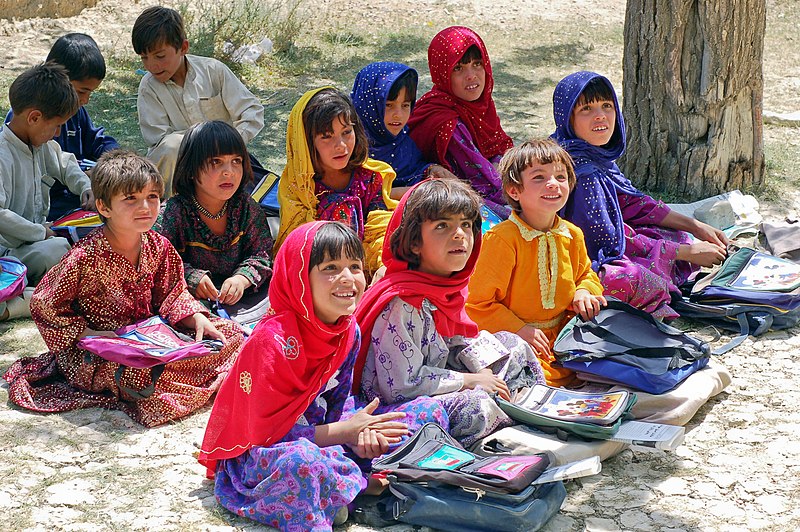
File:Schoolgirls_in_Bamozai.JPG · Wikimedia Commons · See Wikimedia Commons
educazione
Sign in to saveprocesso e attività volta allo sviluppo e alla formazione di conoscenze e facoltà mentali, sociali e comportamentali in un individuo
OverviewAI-generated
Education is a branch of science and a social process involving knowledge sharing. It is a service characterized by educational stages and includes learning, teaching, and self-education. The subject is partially coincident with teaching and education. It is practiced by educators, teachers, and lecturers, and is studied by pedagogy, sociology of education, and educational sciences.
The topic is classified under code 13, including subcodes 13.01 and 13.0101. It is described by sources such as the Jewish Encyclopedia of Brockhaus and Efron, the Brockhaus and Efron Encyclopedic Dictionary, The Catholic Encyclopedia, and Gujin Tushu Jicheng. Education is maintained by WikiProject Education and has a dedicated portal. It is referenced by 9,368 other encyclopedia articles.
Synthesized by Vinony from 24 facts across 3 sources: Wikidata, PubMed, Vinony graph. Generated from structured data (not the Wikipedia text) and checked against those facts — may still contain errors.
Research
2,865,596 papers- Faculty Development: Using Education for Career Advancement.ReviewThoracic surgery clinics · 2019Rushing GD, Mokadam NADOI: 10.1016/j.thorsurg.2019.03.009
- Pain neuroscience education for patients with chronic pain: A scoping review from teaching-learning strategies, educational level, and cultural perspective.Patient education and counseling · 2024Salazar-Méndez J, Cuyul-Vásquez I, Ponce-Fuentes F et al.DOI: 10.1016/j.pec.2024.108201
- Harnessing the benefits of ChatGPT for radiography education: A discussion paper.ReviewRadiography (London, England : 1995) · 2024Amedu C, Ohene-Botwe BDOI: 10.1016/j.radi.2023.11.009
- Prioritizing science education.Science (New York, N.Y.) · 2010Alberts BDOI: 10.1126/science.1190788
- Effects of Covid-19: The Need to Assess the Real Value of Anatomy Education.Anatomical sciences education · 2021Evans DJR, Pawlina WDOI: 10.1002/ase.2061
- Ultrasound imaging in medical student education: Impact on learning anatomy and physical diagnosis.ReviewAnatomical sciences education · 2017So S, Patel RM, Orebaugh SLDOI: 10.1002/ase.1630
- Teaching Artificial Intelligence Literacy: A Challenge in the Education of Radiology Residents.Academic radiology · 2023Mello-Thoms CDOI: 10.1016/j.acra.2023.04.035
- Multimodal education in anatomy: The perfect opportunity.Anatomical sciences education · 2014Drake RL, Pawlina WDOI: 10.1002/ase.1426
via PubMed
Wikidata facts
- Subclass of
- social process
- Has part
- self-education
- Image
- 1887 Bettannier Der Schwarze Fleck anagoria.jpg
Show 16 more facts
- Commons category
- Education
- topic's main category
- Category:Education
- Classification of Instructional Programs code
- 13.0101
- topic's main Wikimedia portal
- Portal:Education
- topic has template
- Template:Infobox education in country
- different from
- Education
- has effect
- education
- maintained by WikiProject
- WikiProject Education
- studied by
- sociology of education
- WordLift URL
- data.thenextweb.com/tnw/entity/education
- has characteristic
- educational stage
- Mastodon instance URL
- mastodon.education
- partially coincident with
- education
- facet of
- paedology
- social media followers
- 21400
- P8168
- Negishi Line
Sources (8)
via Wikidata · CC0
Article · Italiano
L'educazione (dal verbo latino educĕre o educare, entrambi con il significato di «trarre fuori») è l'attività, influenzata nei diversi periodi storici dalle varie culture, volta allo sviluppo e alla formazione di conoscenze e facoltà mentali, sociali e comportamentali in un individuo. Il termine è spesso ritenuto complementare a insegnamento o istruzione anche se quest'ultima tende a indicare metodologie più spiccatamente "trasmissive" dei saperi. Tuttavia, sebbene le strategie istruzionali possano essere parte di un percorso educativo, il significato di educazione è più ampio e mira a estrapolare e potenziare anche qualità e competenze inespresse.Se dal punto di vista etimologico il significato della parola appare chiaro, nella lingua italiana il suo utilizzo, rispetto a termini come istruzione o formazione, è talvolta equivoco anche in testi normativi e pedagogici. In italiano il termine educato è anche sinonimo di un individuo che segua una condotta sociale corretta rispetto a norme non necessariamente codificate (benché di generale condivisione), le cosiddette "buone maniere" quali la "gentilezza", l'"urbanità", ecc. Un altro motivo di confusione è dovuto al diverso uso che si fa del termine educazione in altre lingue (ad es. nella lingua inglese con "education" si tende spesso a indicare "istruzione"). La stretta connessione che c'è tra il sapere acquisito da un individuo e il suo comportamento rendono le due parole apparentemente sinonime in vari contesti. Esistono tre tipi di educazione: la , la e l'. La prima disciplina che studiò sistematicamente i problemi dell'educazione fu la pedagogia, che si concentrò sull'educazione infantile. In tempi moderni nacquero poi le scienze dell'educazione e della formazione, che trattarono anche l' in età adulta, rendendo questa accezione di "formazione" un sinonimo di educazione.
Abstract from DBpedia / Wikipedia · CC BY-SA
Gallery (42)
Available in 202 languages
- Español
- Français
- Deutsch
- 中文
- 日本語
- Русский
- Português
- Italiano
- العربية
- हिन्दी
- Afrikaans
- Albanian
- Amharic
- Aragonese
- Armenian
- Arpitan
- Assamese
- Asturian
Show 183 more
- Awadhi
- azb
- Azerbaijani
- Bahasa Indonesia
- Balinese
- Bangla
- Bashkir
- Basque
- bat_smg
- be_x_old
- Belarusian
- Betawi
- Bhojpuri
- Bikol
- blk
- Bosnian
- Breton
- btm
- Bulgarian
- Buriat
- Burmese
- Catalan
- cdo
- Cebuano
- Central Dusun
- Central Kurdish
- Chechen
- Chuvash
- Cornish
- Corsican
- Croatian
- Czech
- Danish
- Egyptian Arabic
- Esperanto
- Estonian
- Extremaduran
- Faroese
- Fiji Hindi
- Filipino
- Finnish
- fiu_vro
- Friulian
- Galician
- gcr
- Georgian
- Greek
- Guarani
- Haitian Creole
- Hakka Chinese
- Hawaiian
- Hebrew
- Hungarian
- Iban
- Icelandic
- Ido
- Igbo
- igl
- Iloko
- Ingush
- Interlingua
- Interlingue
- Inuktitut
- Irish
- Jamaican Creole English
- Javanese
- Kannada
- Kanuri
- Kara-Kalpak
- Karachay-Balkar
- Kashmiri
- Kazakh
- Khmer
- Kurdish
- Kyrgyz
- Lao
- Latin
- Latvian
- Limburgish
- Lingua Franca Nova
- Lithuanian
- lld
- Lojban
- Lombard
- Low German
- Luxembourgish
- Macedonian
- Madurese
- Maithili
- Malagasy
- Malay
- Malayalam
- Maltese
- Manipuri
- Manx
- map_bms
- Marathi
- Minangkabau
- Mirandese
- mnw
- Moksha
- Mongolian
- Moroccan Arabic
- Neapolitan
- Nederlands
- Nepali
- Newari
- Northern Sami
- Norwegian
- Norwegian Nynorsk
- Novial
- nrm
- Occitan
- Old English
- olo
- Ossetic
- Pampanga
- Pashto
- Picard
- Piedmontese
- Polski
- Punjabi
- Quechua
- Romanian
- Rusyn
- Samoan
- Santali
- Sardinian
- Scots
- Scottish Gaelic
- Serbian
- Serbian (Latin)
- Shona
- Sicilian
- simple
- Sindhi
- Sinhala
- Slovak
- Slovenian
- Somali
- South Ndebele
- Southern Sotho
- Standard Moroccan Tamazight
- Sundanese
- Svenska
- Swahili
- szy
- Tamil
- Tatar
- Telugu
- Tetum
- Tibetan
- Tiếng Việt
- Tigrinya
- Tok Pisin
- Toki Pona
- Tsonga
- Tswana
- Türkçe
- Turkmen
- Tyap
- Ukrainian
- Urdu
- Uzbek
- Venetian
- Veps
- Volapük
- Waray
- Wayuu
- Welsh
- Western Frisian
- Western Panjabi
- Wu Chinese
- Xhosa
- Yakut
- Yiddish
- zh_min_nan
- zh_yue
- Zhuang
- Zulu
- فارسی
- ไทย
- 한국어
via Wikidata sitelinks · CC0