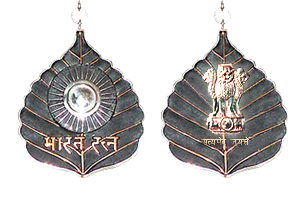
File:Bharat_Ratna_Award.png · Wikimedia Commons · See Wikimedia Commons
Bharat Ratna
Sign in to saveIndia's highest civilian award
Key facts
- Type
- National Civilian
- Description
- Highest Civilian Award of the Republic of India
- Country
- India
- Presented by
- President of India
- Obverse
- An image of the Sun along with the words "Bharat Ratna", inscribed in Devanagari script, on a peepal ( Ficus religiosa ) leaf
- Reverse
- A platinum State Emblem of India placed in the centre with the national motto, " Satyameva Jayate " (Truth alone triumphs) in Devanagari script
- Established
- 1954 ; 72 years ago ( 1954 )
- First award
- 1955 C. Rajagopalachari Sarvepalli Radhakrishnan C. V. Raman
- Latest award
- 2024 Karpoori Thakur (posthumous) Lal Krishna Advani Charan Singh (posthumous) P. V. Narasimha Rao (posthumous) M. S. Swaminathan (posthumous)
- Website
- www .padmaawards .gov .in
- Next higher
- None
- Next lower
- Param Vir Chakra (military), Padma Vibhushan (civilian)
via Wikipedia infobox
Wikidata facts
- Instance of
- civil decoration
- Country
- India
- Official website
- dashboard-padmaawards.gov.in/?Award=Bharat%20Ratna
- Image
- Bharat Ratna.jpg
Show 6 more facts
- Commons category
- Bharat Ratna
- inception
- 1954-06-02
- native label
- भारत रत्न
- quantity
- 43
- next lower rank
- Padma Vibhushan
- category for recipients of this award
- Category:Recipients of the Bharat Ratna
Sources (1)
via Wikidata · CC0
~20 min read
Encyclopedic overview
The Bharat Ratna ( Sanskrit pronunciation: [bʱaːɾət̪ ɾət̪n̪(ᵊ)]; lit. 'Jewel of India') is the highest civilian award of the Republic of India. Instituted on 2 January 1954, the award is conferred in recognition of "exceptional service/performance of the highest order", without distinction of race, occupation, position or gender. The award was originally limited to achievements in the arts, literature, science, and public services, but the Government of India expanded the criteria to include "any field of human endeavor" in December 2011. The recipients receive a Sanad (certificate) signed by the president and a peepal leaf-shaped medallion. Bharat Ratna recipients rank seventh in the Indian order of precedence.
The first recipients of the Bharat Ratna were: the former governor-general of the Union of India C. Rajagopalachari, the former president of the Republic of India Sarvepalli Radhakrishnan; and the Indian physicist C. V. Raman, who were honoured in 1954. Since then, the award has been bestowed upon 53 individuals, including 18 who were awarded posthumously. The original statutes did not provide for posthumous awards but were amended in January 1966 to permit them to honor former prime minister Lal Bahadur Shastri, the first individual to be honored posthumously. In 2014, cricketer Sachin Tendulkar, then aged 40, became the youngest recipient, while social reformer Dhondo Keshav Karve was the oldest recipient when he was awarded on his 100th birthday. Though usually conferred on India-born citizens, the award has been conferred on one naturalized citizen, Mother Teresa, and on two non-Indians: Abdul Ghaffar Khan (born in British India and later a citizen of Pakistan) and Nelson Mandela, a citizen of South Africa.
Excerpted from Wikipedia’s “Bharat Ratna” article, available under the CC BY-SA 4.0 licence.