
El Salvador
Sign in to saveAlso known as sv, Republic of El Salvador, ESA, Salvador
El Salvador, officially the Republic of El Salvador, is a country in Central America. It is bordered on the northeast by Honduras, on the northwest by Guatemala, and on the south by the Pacific Ocean. El Salvador's capital and largest city is San Salvador. El Salvador's population in 2024 was estimated to be 6 million.
OverviewAI-generated
El Salvador, officially the Republic of El Salvador, is a sovereign state in Central America. It shares borders with Honduras and Guatemala. The capital is San Salvador. The country is located in North America. Its highest point is Cerro El Pital. The official language is Spanish. The head of state is Nayib Bukele.
The population is reported as 6,029,976 or 6,338,193. The area is 21,041. The GDP is 35,364,960,000 USD. Life expectancy is 72.302 years. Unemployment is 3.303 percent. Urban population is 75.067 percent. Internet users comprise 66.477 percent. Forest area is 27.527 percent. Renewable energy is 21.9 percent. The currency includes the United States dollar, Salvadoran colón, and Bitcoin.
El Salvador became independent on February 2, 1841. It is a member of the United Nations, World Trade Organization, International Bank for Reconstruction and Development, and International Development Association. The legislative body is the Legislative Assembly of El Salvador. The top-level Internet domain is .sv. The telephone country code is +503. The anthem is the National anthem of El Salvador. The flag is the flag of El Salvador.
Synthesized by Vinony from 67 facts across 9 sources: Wikidata, Openweathermap, Open Meteo, World Bank, OpenStreetMap, REST Countries, PubMed, Vinony graph, Geo. Generated from structured data (not the Wikipedia text) and checked against those facts — may still contain errors.
Weather now
7-day forecast
via Open-Meteo
Country
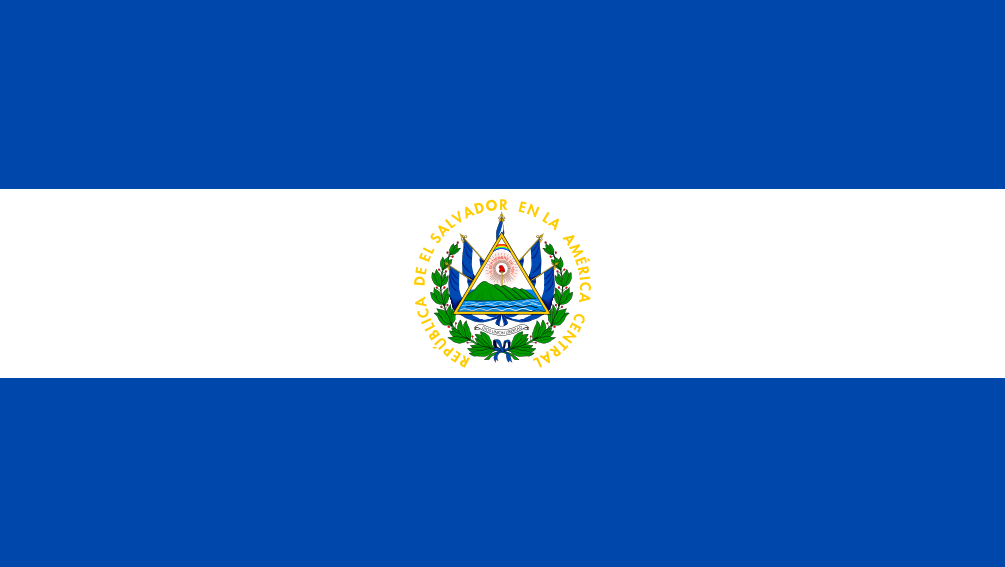
- Capital
- San Salvador
- Population
- 6,029,976
- Region
- Americas · Central America
- Demonym
- Salvadoran
- Currencies
- USD ($)
- Languages
- Spanish
- Calling code
- +503
- Drives on
- Right
- Gini
- 38.8 (2019)
- FIFA code
- SLV
- TLD
- .sv
- Timezones
- UTC-06:00
- Borders
- GTM, HND
via REST Countries
Indicators · World Bank
- GDP
- $35.4B(2024)
- Population
- 6,338,193(2024)
- Life expectancy
- 72.3 yrs(2024)
- Unemployment
- 3.3 %(2025)
- Urban population
- 75.1 %(2024)
- Internet users
- 66.5 %(2024)
- Forest area
- 27.5 %(2023)
- Renewable energy
- 21.9 %(2021)
via World Bank Open Data · CC BY 4.0
Place details
- Locality
- San Salvador
- Region
- San Salvador
- Country
- El Salvador
- Population
- 6,420,744
- Timezone
- America/El_Salvador
via OpenStreetMap · GeoNames
Wikipedia views (30d)
146,067 totalvia Wikimedia Pageviews API
Research
4,362 papers- El Salvador.Department of State publication. Background notes series · 1993United States. Department of State. Bureau of Public Affairs. Office of Public Communication
- Epidemiology of snakebites in El Salvador (2014-2019).Toxicon : official journal of the International Society on Toxinology · 2020Gutiérrez JM, Castillo L, de Naves KMD et al.DOI: 10.1016/j.toxicon.2020.07.027
- El Salvador.Department of State publication. Background notes series · 1987United States. Department of State. Bureau of Public Affairs
- Malaria Elimination: Lessons from El Salvador.The American journal of tropical medicine and hygiene · 2018Bennett A, Smith JLDOI: 10.4269/ajtmh.18-0390
- El Salvador's malaria elimination success story.The Lancet. Microbe · 2021Balakrishnan VSDOI: 10.1016/S2666-5247(21)00096-3
- El Salvador.Maryland medicine : MM : a publication of MEDCHI, the Maryland State Medical Society · 2007Cymet T
- Ticks and tick-borne Rickettsia in El Salvador.Experimental & applied acarology · 2021Romero L, Costa FB, Labruna MBDOI: 10.1007/s10493-021-00610-w
- Hospital El Salvador: broader questions remain.The Lancet. Global health · 2021Amaral A, Wenham CDOI: 10.1016/S2214-109X(21)00048-6
via PubMed
Wikidata facts
- Instance of
- country
- Part of
- Latin America
- Named after
- Redeemer
- Official name
- la République du Salvador
- Demonym
- Salvadorianerin
- Country
- El Salvador
- Contains
- Ahuachapán Department
- Continent
- North America
- Capital
- San Salvador
- Official language
- Spanish
- Currency
- Bitcoin
- Population
- 6029976
- Area
- 21041
- Head of government
- Francisco Flores
- Head of state
- Nayib Bukele
- Form of government
- presidential system
- Legislature
- Legislative Assembly of El Salvador
- Shares border with
- Guatemala
- Highest point
- Cerro El Pital
- Official website
- elsalvador.travel/en
- Image
- ES JoyadeCeren 06 2011 Estructura 9 Area 2 Tamazcal 2106 zoom out.jpg
- Life expectancy
- 71
- Nominal GDP
- 32488720000
Show 61 more facts
- Unemployment rate
- 6
- Calling code
- +503
- Licence plate code
- ES
- Mains voltage
- 115
- Motto
- The 45 Minute Country
- Coat of arms
- coat of arms of El Salvador
- top-level Internet domain
- .sv
- Commons category
- El Salvador
- topic's main category
- Category:El Salvador
- topic's main Wikimedia portal
- Portal:El Salvador
- inception
- 1841-02-02
- category for people born here
- Category:Births in El Salvador
- category for people who died here
- Category:Deaths in El Salvador
- category of associated people
- Category:Salvadoran people
- diplomatic relation
- Kosovo
- history of topic
- history of El Salvador
- IPA transcription
- ɛlˈsɑlʋɑdoːɾ
- Commons gallery
- El Salvador
- mobile country code
- 706
- lowest point
- Pacific Ocean
- driving side
- right
- geography of topic
- Geography of El Salvador
- age of majority
- 18
- marriageable age
- 18
- office held by head of government
- President of El Salvador
- number of out-of-school children
- 266571
- office held by head of state
- President of El Salvador
- has characteristic
- free country
- total fertility rate
- 1.931
- maritime identification digits
- 359
- Unicode character
- 🇸🇻
- central bank
- Central Reserve Bank of El Salvador
- language used
- Salvadoran Sign Language
- suicide rate
- 13.4
- GS1 country code
- 741
- culture
- culture of El Salvador
- VAT rate
- 13
- BTI Status Index
- 6.46
- BTI Governance Index
- 5.63
- economy of topic
- economy of El Salvador
- demographics of topic
- demographics of El Salvador
- different from
- Salvador
- native label
- República de El Salvador
- Democracy Index
- 5.90
- Human Development Index
- 0.675
- P11012
- Julius Caesar
- hashtag
- ElSalvador
- on focus list of Wikimedia project
- Wikipedia:Vital articles/Level/4
- Gini coefficient
- 38.3
- Happy Planet Index score
- 56.3
- Inequality-adjusted Human Development Index
- 0.548
- P12749
- Lombardy
- birth rate
- 15.803
- male population
- 2848533
- death rate
- 8.173
- rural population
- 1598862
- female population
- 3181443
- urban population
- 4737530
- located in/on physical feature
- Central America
- name in native language
- República de El Salvador
Sources (15)
via Wikidata · CC0
Travel guide
Understand
The country sits between Guatemala, to the northwest, and Honduras, to the northeast.
Although El Salvador only covers an area of about 21,040 km2 (the smallest country in Central America), it is the most densely populated. El Salvador is home to more than 6,500,000 people. It is divided into 14 sections called departamentos. It has 25 volcanoes, 14 lakes, and four large cities and is divided in to East, Central and West with the capital San Salvador in the central region, Santa Ana in the west, and San Miguel, the largest city in the east.
Get in
thumb|450px|Citizens of countries marked in green enjoy visa-free travel to El Salvador
Get around
thumb|250px|Office high-rise buildings in [[San Salvador]]
See
thumb|right|300px| Chaparrastique, [[San Miguel (El Salvador)|San Miguel - One of the most active volcanoes in El Salvador]]
A well-maintained and practically deserted national park is found in the west at Bosque El Imposible. Additionally, there is Montecristo Cloud Forest, and a quaint fishing village with incredible local hospitality and remote coconut islands in La Isla de Méndez. Isla de Olomega in the department of San Miguel is an excellent eco-tourism destination, as are the beautiful Isla El Cajete in Sonsonate, Isla San Sebastian, Conchagua, Conchaguita, Isla Conejo, Isla Teopan, and Isla Meanguera.
One should also visit the colonial towns of Apaneca, Juayua, Panchimalco, and Suchitoto as well as the Mayan sites of San Andrés, Joya de Cerén (the Pompeii of Central America and a UNESCO World Heritage Site), and Tazumal, whose main pyramid rises some 33 m (75 feet) into the air. The on-site museum showcases artifacts from the Pipil culture (the builders of Tazumal), and paintings that illustrate life in pre-Hispanic El Salvador. Souvenir hunters will find some of the best artisans in San Juan el Espino and in La Palma (the artisan capital of El Salvador).
The capital, San Salvador, is a cosmopolitan city with good restaurants highlighting the country’s fresh seafood, and plenty of shopping, entertainment and nightlife.
San Miguel in the East offers tourists a more authentic way to see El Salvador by getting off the beaten track to see its countryside, coastline an…
Do
Surfing El Salvador is gaining a reputation for having some of the best surfing in the world. Tourists from all over Central America are discovering the surfing meccas of La Libertad (near San Salvador), El Sunzal, El Zonte (Bitcoin Beach) and El Cuco (near San Miguel ), transforming El Salvador into the fastest growing surf tourism hot-spot in Central America. Stand-up paddleboarding at the famous Intipuca Beach Water skiing, tubing, wakeboarding, parasailing, jet skiing in Playa El Esteron, one of the most beautiful beaches in El Salvador Windsurfing, swimming, jet skiing at Coatepeque Lake near Santa Ana Volcano hiking: on volcanoes such as Santa Ana, Chaparrastique, Izalco, El Boqueron, and El Impossible which are among the most famous ones Nature hikes and lake tours to Isla de Olomega on Lake Olomega Waterfalls and hot springs
Eat
thumb|Traditional Salvadoran dish, The Pupusa
The restaurant scene in El Salvador is influenced by many different cultures. Food options include Italian, Korean, Japanese, French, Chilean, American, Peruvian, Mexican, Spanish, Middle Eastern, German, Chinese, Argentinian and others. You can also easily find American fast food chains such as Burger King, McDonald's, Wendy's, KFC, Subway, Quiznos, Pizza Hut, Little Caesar's, and Domino's, in the largest cities in the country such as San Salvador, Merliot/Santa Tecla, and Santa Ana. Other franchises include Tony Romas', Bennigans and others. Some of the best restaurants are located in Zona Rosa.
The typical Salvadoran diet includes lots of rice and beans, seafood (particularly among those who live on the coast), and the most common Salvadoran dish, the famous Pupusa, a round corn tortilla filled with cheese and other elements, usually chicharon (shredded pork meat). It's widely agreed that the best pupusas in the country can be bought in Olocuilta, which you can get to along the highway on the way to the Comalapa airport. You will find more than 50 pupusa stands there, competing for business.
Also Salvadorans eat fried sliced plantains (platanos) usually with beans, sour cream, cheese and sometimes eggs, yuca con chicharron, pastelitos de carne, panes con pavo (turkey sandwiches), hand made tortillas among other very delicious Salvadoran foods.
If you are staying on the coast, make sure you try the cóctel de conchas. It is a…
Sleep
San Miguel has high end hotels on Av. Roosevelt by the Metrocentro mall and budget hotels near the bus terminal
Stay safe
thumb|Night view of [[San Salvador]] El Salvador has a bad reputation due to the civil war of the 1980s. Crime has historically been an issue just as in neighboring Honduras and Guatemala, with most of it attributed to street gangs. Since 2019, there has been a change in combatting crime and gang activity making El Salvador have one of the lowest crime rates in the world. The government is combatting the gangs with a tactic called "Super Mano Dura" which means "Super Strong Hand" and this has had an effect with homicide rates declining from 103 per 100,000 in 2015 to just 2.3 per 100,000 in 2023. This tactic includes a “State of Exception” which allows constitutional rights to be suspended for anyone suspected of gang activity with harsh prison conditions.
You should use common sense and avoid entering into a zone that does not appear safe, just like you do in any country of the world. Avoid carrying fancy items such as jewelry, expensive cameras, and watches if you are walking on the public streets. Women should avoid traveling alone as they may catch the occasional cat-calling and perhaps get felt up on tightly packed buses. As a foreigner the kind of response you might get from the police is "hit or miss." If you have been pick-pocketed or otherwise robbed without harm to your person, a visit to the police station will almost certainly be an exercise in frustration.
Due to strong local conservatism, El Salvador is not an LGBT+ traveler's friendly country. There is wide…
Stay healthy
If you are not accustomed to food sold by street vendors, you might want to stay away from food sold on the streets until you acclimatize. If you want to try a pupusa, you should try to find a restaurant to taste this popular dish rather than buying them from street vendors. Street food that you see cooked can sometimes be safer than restaurant food that you do not see cooked.
'Agua en bolsa' (water in a plastic bag) is very commonly sold in the streets and corner stores of El Salvador. Don't drink tap water.
Pharmacies are easily found all over the country. Take a first-aid kit if you travel to the countryside and to archaeological sites. Mosquito repellent comes in handy.
Respect
Salvadorans are known for their great hospitality. They are among the nicest people in the world. They are friendly, industrious people always willing to help anyone. That is what has earned El Salvador the nickname of "the country with a smile". When speaking with people you don't know, it is customary to address them in a formal manner, using señor, señora and/or usted.
Travel guide from Wikivoyage (CC BY-SA 4.0)
~40 min read
Encyclopedic overview
El Salvador, officially the Republic of El Salvador, is a country in Central America. It is bordered on the northeast by Honduras, on the northwest by Guatemala, and on the south by the Pacific Ocean. El Salvador's capital and largest city is San Salvador. El Salvador's population in 2024 was estimated to be 6 million.
Among the Mesoamerican nations that historically controlled the region are the Maya and then the Cuzcatlecs. Archaeological monuments also suggest an early Olmec presence around the first millennium BC. In the early 16th century, the Spanish Empire conquered the Central American territory, incorporating it into the Viceroyalty of New Spain ruled from Mexico City. However, the Viceroyalty of New Spain had little to no influence in the daily affairs of the isthmus, which was colonized in 1524. In 1609, the area was declared the Captaincy General of Guatemala by the Spanish, which included the territory that would become El Salvador until its independence from Spain in 1821. It was forcibly incorporated into the First Mexican Empire, then seceded, joining the Federal Republic of Central America in 1823. When the federation dissolved in 1841, El Salvador became a sovereign state. It then formed a short-lived union with Honduras and Nicaragua, called the Greater Republic of Central America, which lasted from 1896 to 1898.
Excerpted from Wikipedia’s “El Salvador” article, available under the CC BY-SA 4.0 licence.
Gallery (16)
On the map
2 mapped locations
Available in 235 languages
- Español
- Français
- Deutsch
- 中文
- 日本語
- Русский
- Português
- Italiano
- العربية
- हिन्दी
- Achinese
- Adyghe
- Afrikaans
- Albanian
- Albanian
- Amharic
- ami
- Angika
Show 216 more
- Aragonese
- Armenian
- Arpitan
- Asturian
- Aymara
- azb
- Azerbaijani
- Bahasa Indonesia
- Balinese
- Bambara
- Bangla
- Bashkir
- Basque
- bat_smg
- Batak Toba
- Bavarian
- be_x_old
- Belarusian
- Betawi
- Bhojpuri
- Bikol
- Bishnupriya
- Bislama
- Bosnian
- Breton
- Bulgarian
- Buriat
- Burmese
- Catalan
- cbk_zam
- cdo
- Cebuano
- Central Kurdish
- Chechen
- Cornish
- Crimean Tatar
- Croatian
- Czech
- dag
- Danish
- Divehi
- dty
- Egyptian Arabic
- Erzya
- Esperanto
- Estonian
- Ewe
- Extremaduran
- Faroese
- Fiji Hindi
- Filipino
- Finnish
- fiu_vro
- Fula
- Gagauz
- Galician
- gcr
- Georgian
- Gilaki
- Goan Konkani
- Greek
- Guarani
- Haitian Creole
- Hakka Chinese
- Hausa
- Hebrew
- Hungarian
- Icelandic
- Ido
- Iloko
- Inari Sami
- Interlingua
- Interlingue
- Inupiaq
- Irish
- Jamaican Creole English
- Javanese
- Kabardian
- Kabyle
- Kannada
- Kara-Kalpak
- Karachay-Balkar
- Kashubian
- Kazakh
- kbp
- Kinyarwanda
- Komi
- Kotava
- Kurdish
- Kyrgyz
- Ladino
- Lao
- Latin
- Latvian
- Ligurian
- Limburgish
- Lingala
- Lingua Franca Nova
- Lithuanian
- lld
- Lojban
- Lombard
- Low German
- Lower Sorbian
- Luxembourgish
- Macedonian
- Madurese
- Malagasy
- Malay
- Malayalam
- Maltese
- Manipuri
- Manx
- Māori
- map_bms
- Marathi
- Mari
- Mazanderani
- Minangkabau
- Mingrelian
- Mirandese
- Moksha
- Mongolian
- Moroccan Arabic
- nds_nl
- Neapolitan
- Nederlands
- Nepali
- Newari
- Northern Frisian
- Northern Sami
- Norwegian
- Norwegian Nynorsk
- Novial
- Occitan
- Odia
- Old English
- olo
- Oromo
- Ossetic
- Pampanga
- Papiamento
- Picard
- Piedmontese
- Polski
- ppl
- Punjabi
- Quechua
- roa_rup
- Romanian
- Rusyn
- Samoan
- Sanskrit
- Sardinian
- Scots
- Scottish Gaelic
- Serbian
- Serbian (Latin)
- Shan
- Shona
- Sicilian
- Silesian
- simple
- Sindhi
- Sinhala
- Slovak
- Slovenian
- Somali
- Standard Moroccan Tamazight
- Sundanese
- Svenska
- Swahili
- Swati
- szy
- Tachelhit
- Tajik
- Talysh
- Tamil
- Taroko
- Tatar
- Telugu
- Tetum
- Tibetan
- Tiếng Việt
- Toki Pona
- Tongan
- Türkçe
- Udmurt
- Ukrainian
- Upper Sorbian
- Urdu
- Uyghur
- Uzbek
- Venetian
- Veps
- Volapük
- Waray
- Welsh
- Western Frisian
- Western Mari
- Western Panjabi
- Wolof
- Wu Chinese
- Yakut
- Yiddish
- Yoruba
- Zaza
- Zeelandic
- zh_classical
- zh_min_nan
- zh_yue
- Zhuang
- Zulu
- فارسی
- ไทย
- 한국어
via Wikidata sitelinks · CC0