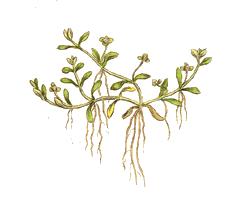
File:Elatine_tripetala.jpg · Wikimedia Commons · See Wikimedia Commons
Elatinaceae
Sign in to saveElatinaceae is a family of flowering plants with ca 35 (to perhaps 50) species in two genera: Elatine and Bergia. The Elatine are mostly aquatic herbs, and the Bergia are subshrubs to shrubs. Elatine species are widely distributed throughout the world from temperate to tropical zones, with its greatest diversity found in temperate zones. Bergia is found in temperate to tropical Eurasia and Africa, with two tropical and one tropical to temperate species in the Americas. The center for biodiversity of Bergia is the Old World tropics, and this is also the center for biodiversity for the family. N
OverviewAI-generated
Elatinaceae is a family of flowering plants within the order Malpighiales and class Magnoliopsida. It belongs to the phylum Tracheophyta and kingdom Plantae. The taxonomic type for this group is Elatine. The authority for the name is Dumort. Common names include Glaskroosfamilie, 물별과, and 沟繁缕科.
The family is found in brackish and freshwater habitats. Records indicate occurrences in Mexico, the United States, India, Brasil, and Bolivia. Institutions holding specimens include IGL-UNAM, UNM, CAS, CENARGEN, and MO. The status of Elatinaceae is accepted.
Synthesized by Vinony from 34 facts across 7 sources: Wikidata, GBIF, Gbif Occ, Plants of the World, WoRMS, iDigBio, Vinony graph. Generated from structured data (not the Wikipedia text) and checked against those facts — may still contain errors.
Species
FAMILY
- KingdomPlantae
- PhylumTracheophyta
- ClassMagnoliopsida
- OrderMalpighiales
- FamilyElatinaceae
溝繁縷科只有两个属共大约40种,绝大部分都是水生植物,一年生草本,分布在欧亚大陆的温带和热带地区,葉子呈現對生倒卵狀或轮生,花一至數朵聚生、2至5瓣,果实通常為橢圓。一般來說,該種植物都生長在季節性溼地,水田溝渠。 几种沟繁缕如六蕊沟繁缕(Elatine hexandra)、马蹄沟繁缕(Elatine hydropiper)和大花沟繁缕(Elatine macropoda)经常被用作水族箱中的水草。
via GBIF · Kew POWO
Museum specimens
- Specimen records
- 23
- With media
- 16
- Family
- Elatinaceae
- Collections
- IGL-UNAM, UNM, CAS, CENARGEN, MO, NHMUK
- Recorded in
- Mexico, United States, India, Brasil, Bolivia, Colombia, Paraguay, Indonesia
Wikidata facts
- Instance of
- taxon
- Image
- Elatine tripetala.jpg
Show 7 more facts
- Commons category
- Elatinaceae
- taxon rank
- family
- taxon name
- Elatinaceae
- topic's main category
- Category:Elatinaceae
- taxon common name
- 沟繁缕科
- taxonomic type
- Elatine
Sources (1)
via Wikidata · CC0
~1 min read
Encyclopedic overview
1 sectionsContents
- References
Elatinaceae is a family of flowering plants with ca 35 (to perhaps 50) species in two genera: Elatine and Bergia. The Elatine are mostly aquatic herbs, and the Bergia are subshrubs to shrubs. Elatine species are widely distributed throughout the world from temperate to tropical zones, with its greatest diversity found in temperate zones. Bergia is found in temperate to tropical Eurasia and Africa, with two tropical and one tropical to temperate species in the Americas. The center for biodiversity of Bergia is the Old World tropics, and this is also the center for biodiversity for the family. Neither genus is found in arctic ecosystems.
Members of the family have bisexual flowers, usually small flowers, single, or in cymes, with two to five overlapping petals. The plants have opposite or whorled leaves, which may have glands along their margins, and have stipules. The aquatic herbs in the genus Elatine often have reduced characteristics as part of their adaptation to an aquatic habitat.
Excerpted from Wikipedia’s “Elatinaceae” article, available under the CC BY-SA 4.0 licence.