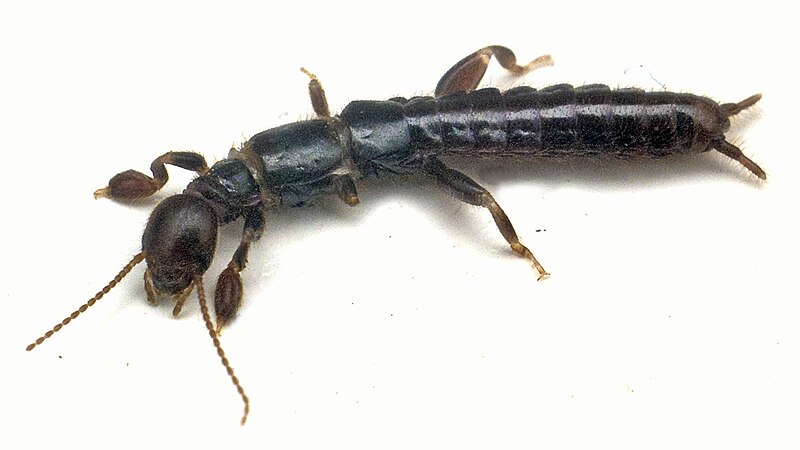
File:Notoligotoma_nitens.jpg · Wikimedia Commons · See Wikimedia Commons
Embioptera
Sign in to saveAlso known as webspinner
The order Embioptera, commonly known as webspinners or footspinners, are a small group of mostly tropical and subtropical insects, classified under the subclass Pterygota. The order has also been called Embiodea or Embiidina. More than 400 species in 11 families have been described, the oldest known fossils of the group being from the mid-Jurassic. Species are very similar in appearance, having long, flexible bodies, short legs, and only males having wings.
OverviewAI-generated
Embioptera is an order of insects within the class Insecta, phylum Arthropoda, and kingdom Animalia. It belongs to the superorder Polyneoptera. The taxon was described by Lameere in 1900 and is currently accepted. Common names for this group include Webspinners, 足丝蚁, 丝蚁, and 纺足目. The order dates back to about 199 million years ago.
Records of Embioptera have been documented in the United States, Bonaire, Sint Eustatius And Saba, Madagascar, Israel, and Myanmar. Specimens are held by institutions such as UCSB, UAM, MNA, SDNHM, and TTU. The taxon is referenced in 134 other encyclopedia articles.
Synthesized by Vinony from 29 facts across 6 sources: Wikidata, GBIF, Gbif Occ, WoRMS, iDigBio, Vinony graph. Generated from structured data (not the Wikipedia text) and checked against those facts — may still contain errors.
Species
Embioptera
ORDER
- KingdomAnimalia
- PhylumArthropoda
- ClassInsecta
- OrderEmbioptera
本条目没有列出任何参考或来源。(2012年3月21日) 維基百科所有的內容都應該可供查證。请协助添加来自可靠来源的引用以改善这篇条目。无法查证的内容可能被提出异议而移除。 科 下分2亚目10科: Andesembiidae Anisembiidae Australembiidae Clothodidae Embiidae Embonychidae Notoligotomidae Oligotomidae Teratembiidae Sorellembiidae 纺足目是分布于热带及亚热带的一小类昆虫,通称足丝蚁,丝蚁。其学名Embioptera源于希腊文ἔμβιος活的,和πτερὀν翅,或谓其能快速前后翻飞的翅膀。中文名源于其能分泌丝线的前足附节,更贴切的概括了此目主要特征。 这是一篇與动物相關的小作品。你可以通过编辑或修订扩充其内容。 查 论 编 取自“https://zh.wikipedia.org/w/index.php?title=纺足目&oldid=25623674” 分类:新翅下綱 隐藏分类: 自2012年3月缺少来源的条目 本地相关图片与维基数据相同 全部小作品 动物小作品
via GBIF
Museum specimens
- Specimen records
- 104
- With media
- 10
- Collections
- UCSB, UAM, MNA, SDNHM, TTU, DMNS
- Recorded in
- United States, Bonaire, Sint Eustatius And Saba, Madagascar, Israel, Myanmar, Mexico, United Arab Emirates, Australia
Wikidata facts
- Instance of
- taxon
- Image
- Embia major.jpg
Show 6 more facts
- taxon name
- Embioptera
- Commons category
- Embioptera
- taxon rank
- order
- topic's main category
- Category:Embioptera
- taxon common name
- 纺足目
- start time
- 199000000-
Sources (2)
via Wikidata · CC0
~18 min read
Encyclopedic overview
17 sectionsContents
- Name and entomology
- Evolution
- Fossil history
- Phylogeny
- Description
- Life cycle
- Behaviour and ecology
- Behaviour
- Silk web production
- Galleries
- Diet
- Parasites and predators
- Associates
- Distribution and habitat
- References
- Further reading
- External links
The order Embioptera, commonly known as webspinners or footspinners, are a small group of mostly tropical and subtropical insects, classified under the subclass Pterygota. The order has also been called Embiodea or Embiidina. More than 400 species in 11 families have been described, the oldest known fossils of the group being from the mid-Jurassic. Species are very similar in appearance, having long, flexible bodies, short legs, and only males having wings.
Webspinners are gregarious, living subsocially in galleries of fine silk which they spin from glands on their forelegs. Members of these colonies are often related females and their offspring; adult males do not feed and die soon after mating. Males of some species have wings and are able to disperse, whereas the females remain near where they were hatched. Newly mated females may vacate the colony and establish a new one nearby. Others may emerge to search for a new food source to which the galleries can be extended, but in general, the insects rarely venture from their galleries.
Excerpted from Wikipedia’s “Embioptera” article, available under the CC BY-SA 4.0 licence.
Gallery (29)
Available in 48 languages
- Español
- Français
- Deutsch
- 中文
- 日本語
- Русский
- Português
- Italiano
- العربية
- Azerbaijani
- Bahasa Indonesia
- Belarusian
- Bulgarian
- Catalan
- Cebuano
- Czech
- Egyptian Arabic
- Finnish
Show 29 more
via Wikidata sitelinks · CC0