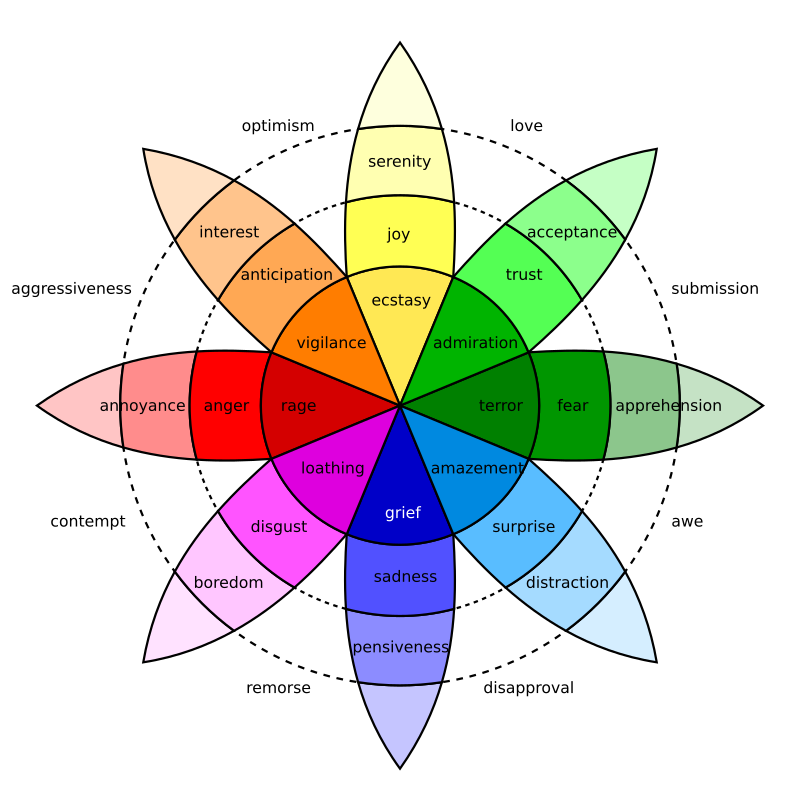
File:Plutchik-wheel.svg · Wikimedia Commons · See Wikimedia Commons
I cannot write an accurate overview of emotion based solely on this image caption, as it only describes a historical artwork depicting facial expressions rather than explaining what emotion is or why it matters. To provide factually grounded information, I would need access to substantive context about emotion itself.
AI-generated from the Wikipedia summary — may contain errors.
Research
710,513 papers- Emotion and cognition: insights from studies of the human amygdala.ReviewAnnual review of psychology · 2006Phelps EADOI: 10.1146/annurev.psych.56.091103.070234
- Attention-Emotion-Enhanced Convolutional LSTM for Sentiment Analysis.IEEE transactions on neural networks and learning systems · 2022Huang F, Li X, Yuan C et al.DOI: 10.1109/TNNLS.2021.3056664
- Emotion in Organizations: Theory and Research.ReviewAnnual review of psychology · 2023Elfenbein HADOI: 10.1146/annurev-psych-032720-035940
- Emotion regulation through listening to music in everyday situations.Cognition & emotion · 2012Thoma MV, Ryf S, Mohiyeddini C et al.DOI: 10.1080/02699931.2011.595390
- Parental emotion and emotion regulation: A critical target of study for research and intervention to promote child emotion socialization.ReviewDevelopmental psychology · 2020Hajal NJ, Paley BDOI: 10.1037/dev0000864
- Emotion in remediation: A scoping review of the medical education literature.Medical education · 2021Mills LM, Boscardin C, Joyce EA et al.DOI: 10.1111/medu.14605
- Emotion Regulation by Psychological Distance and Level of Abstraction: Two Meta-Analyses.Personality and social psychology review : an official journal of the Society for Personality and Social Psychology, Inc · 2022Moran T, Eyal TDOI: 10.1177/10888683211069025
- Emotion recognition in nonhuman primates: How experimental research can contribute to a better understanding of underlying mechanisms.ReviewNeuroscience and biobehavioral reviews · 2021Nieuwburg EGI, Ploeger A, Kret MEDOI: 10.1016/j.neubiorev.2020.11.029
via PubMed
Wikidata facts
- Subclass of
- qualia
- Image
- Plutchik-wheel in arabic.png
Show 10 more facts
- Commons category
- Emotion
- topic has template
- Template:Emotion navbox
- on focus list of Wikimedia project
- Wikipedia:Vital articles/Level/4
- Stack Exchange tag
- psychology.stackexchange.com/tags/emotion
- has effect
- feeling
- has characteristic
- valence
- maintained by WikiProject
- WikiProject Neuroscience
- exact match
- semanticscience.org/resource/SIO_000276
- P8168
- Giovanni Arcangeli
via Wikidata · CC0
Article · Español
Las emociones son reacciones psicofisiológicas que representan modos de adaptación del individuo cuando percibe un objeto, persona, lugar, suceso o recuerdo importante. Psicológicamente, las emociones alteran la atención, hacen subir de rango ciertas conductas guía de respuestas del individuo y activan redes asociativas relevantes en la memoria. Los sentimientos son el resultado de las emociones, son más duraderos en el tiempo y pueden ser verbalizados (palabras).Fisiológicamente, las emociones organizan rápidamente las respuestas de distintos sistemas biológicos, incluidas las expresiones faciales, los músculos, la voz, la actividad del SNA y la del sistema endocrino, pudiendo tener como fin el establecer un medio interno óptimo para el comportamiento más efectivo. Los diversos estados emocionales son causados por la liberación de neurotransmisores (o neuromediadores) u hormonas, que luego convierten estas emociones en sentimientos y finalmente en el lenguaje. Conductualmente, las emociones sirven para establecer nuestra posición con respecto a nuestro entorno, y nos impulsan hacia ciertas personas, objetos, acciones, ideas y nos alejan de otros. Las emociones actúan también como depósito de influencias innatas y aprendidas. Poseen ciertas características invariables y otras que muestran cierta variación entre individuos, grupos y culturas (Levenson, 1994).
Abstract from DBpedia / Wikipedia · CC BY-SA
Gallery (22)
Available in 145 languages
- Español
- Français
- Deutsch
- 中文
- 日本語
- Русский
- Português
- Italiano
- العربية
- हिन्दी
- Afrikaans
- Albanian
- Albanian
- Aragonese
- Armenian
- Assamese
- Asturian
- azb
Show 126 more
- Azerbaijani
- Bahasa Indonesia
- Balinese
- Bangla
- Bashkir
- Basque
- bat_smg
- Bavarian
- be_x_old
- Belarusian
- Bhojpuri
- Bikol
- Bosnian
- Breton
- btm
- Bulgarian
- Burmese
- Catalan
- cdo
- Central Kurdish
- Chechen
- Chuvash
- Cornish
- Corsican
- Crimean Tatar
- Croatian
- Czech
- Danish
- Egyptian Arabic
- eml
- Esperanto
- Estonian
- Fiji Hindi
- Filipino
- Finnish
- Friulian
- Galician
- Gan Chinese
- gcr
- Georgian
- Greek
- guw
- Hakka Chinese
- Hausa
- Hebrew
- Hungarian
- Icelandic
- Ido
- Iloko
- Interlingua
- Irish
- Jamaican Creole English
- Kannada
- Kanuri
- Kara-Kalpak
- Kazakh
- kbp
- Komi-Permyak
- Kyrgyz
- Lao
- Latin
- Latvian
- Limburgish
- Lithuanian
- Lombard
- Low German
- Macedonian
- Malagasy
- Malay
- Malayalam
- Mazanderani
- Mingrelian
- Mirandese
- Mongolian
- Nederlands
- Nepali
- Newari
- Norwegian
- Norwegian Nynorsk
- Occitan
- Oromo
- Papiamento
- Pashto
- Piedmontese
- Polski
- Punjabi
- Romanian
- Rusyn
- Serbian
- Serbian (Latin)
- Sicilian
- simple
- Sindhi
- Sinhala
- Slovak
- Slovenian
- Somali
- Svenska
- Swahili
- Tajik
- Tamil
- Tatar
- Telugu
- Tibetan
- Tiếng Việt
- Toki Pona
- Tsonga
- Türkçe
- Tyap
- Ukrainian
- Urdu
- Uzbek
- Waray
- Welsh
- Western Frisian
- Western Panjabi
- Wu Chinese
- Yakut
- Yiddish
- zh_min_nan
- zh_yue
- Zhuang
- Zulu
- فارسی
- ไทย
- 한국어
via Wikidata sitelinks · CC0