Encyclopedia of Life · EOL (see source)
Species
SPECIES
- KingdomAnimalia
- PhylumNematoda
- ClassChromadorea
- OrderRhabditida
- FamilyOxyuridae
Der Madenwurm, Springwurm, Pfriemenschwanz oder die Aftermade (Enterobius vermicularis, Synonym: Oxyuris vermicularis von griechisch ὀξύς oxýs ‚Spitze‘, οὐρά ‚Schwanz‘ und lateinisch vermiculus ‚Würmchen‘) ist eine parasitisch in menschlichen Gedärmen lebende Fadenwurmart von bis zu 13 Millimetern Länge. Der Madenwurm ist in Europa der häufigste Eingeweidewurm beim Menschen und einer der häufigsten Parasiten des Menschen. Die Art ist auf menschliche Wirte spezialisiert und im Allgemeinen stark auf diese Wirtsart festgelegt. Seltener werden auch Affen befallen (in Tiergärten) und möglicherweise auch Kakerlaken. Etwa 500 Millionen Infektionen werden, unabhängig von Alter und sozialem Status des Infizierten, weltweit pro Jahr verzeichnet. Die ebenfalls zu findende Bezeichnung Kindermadenwurm, des vor allem bei Kindern mit nächtlichem Juckreiz am After und dadurch beeinträchtigter Leistungsfähigkeit beobachteten Wurms, dessen Eier durch Kratzen am After unter die Fingernägel und von da aus in den Mund gelangen können, ist insofern irreführend. Etwa 50 % aller Menschen werden mindestens einmal im Leben befallen. Der krankhafte Wurmbefall selbst wird als Enterobiasis, Enterobiose, Oxyuri
via GBIF
Museum specimens
- Specimen records
- 114
- With media
- 64
- Family
- Oxyuridae
- Collections
- CMN, USNM, YPM, QM
- Recorded in
- United States, Canada, Germany, Japan, Taiwan, Philippines, Nicaragua, Australia
Wikidata facts
- Instance of
- taxon
- Parent taxon
- Enterobius
- Image
- Evermicularis SC posterior.jpg
Show 6 more facts
- taxon name
- Enterobius vermicularis
- Commons category
- Enterobius vermicularis
- taxon rank
- species
- Commons gallery
- Enterobius vermicularis
- short name
- E. vermicularis
- described by source
- New International Encyclopedia
Sources (2)
via Wikidata · CC0
~12 min read
Encyclopedic overview
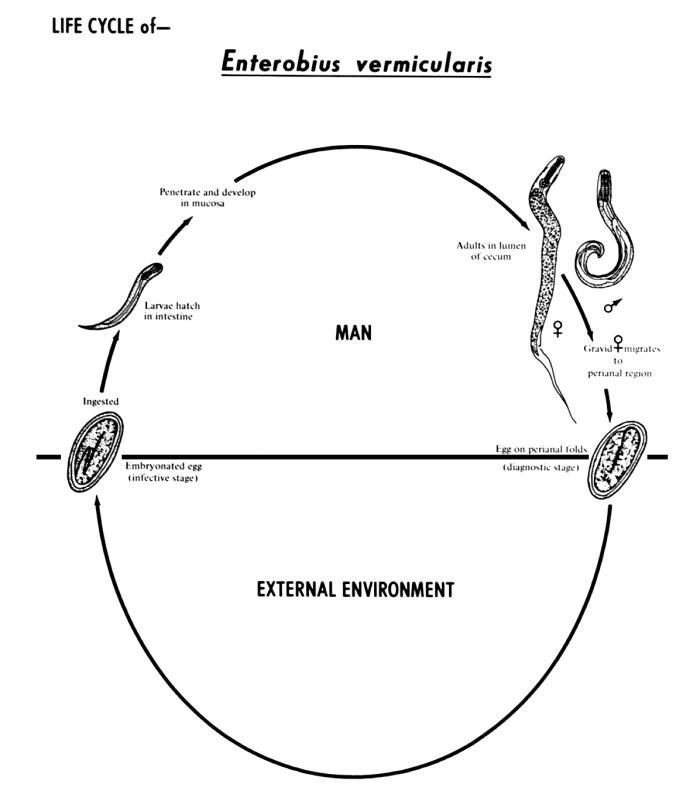
The pinworm (species Enterobius vermicularis), also known as threadworm (in the United Kingdom, Australia and New Zealand) or seatworm, is a parasitic worm. It is a nematode (roundworm) and a common intestinal parasite or helminth, especially in humans. The medical condition associated with pinworm infestation is known as pinworm infection (enterobiasis) (a type of helminthiasis) or less precisely as oxyuriasis in reference to the family Oxyuridae.
Other than human, Enterobius vermicularis were reported from bonnet macaque. Other species seen in primates include Enterobius buckleyi in Orangutan and Enterobius anthropopitheci in chimpanzee. Enterobius vermicularis is common in human children and transmitted via the faecal-oral route. Humans are the only natural host of Enterobius vermicularis. Enterobius gregorii, another human species is morphologically indistinguishable from Enterobius vermicularis except the spicule size. Throughout this article, the word "pinworm" refers to Enterobius. In British usage, however, pinworm refers to Strongyloides, while Enterobius is called threadworm.
Excerpted from Wikipedia’s “Enterobius vermicularis” article, available under the CC BY-SA 4.0 licence.