File:Geologic_time_scale_-_spiral_-_ICS_colours_(light)_-_path_text.svg · Wikimedia Commons · See Wikimedia Commons
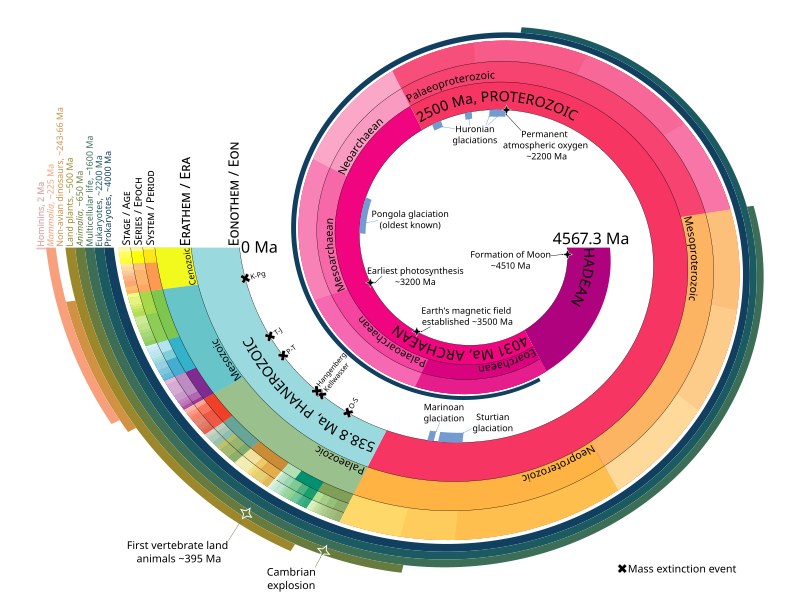
An eon is a major division of Earth's history used by geologists to organize the planet's past into manageable time periods. It's longer than an era but shorter than a supereon, making it a middle-level unit in the hierarchical system scientists use to understand how life and geology have changed over billions of years.
AI-generated from the Wikipedia summary — may contain errors.
Wikidata facts
- Has part
- era
Show 5 more facts
- Commons category
- Geologic eons
- topic's main category
- Category:Geological eons
- different from
- aeon
- studied by
- geochronology
- standards body
- International Commission on Stratigraphy
Sources (1)
via Wikidata · CC0
Article · Polski
Eon (z łac. aeon z gr. αἰών aiōn 'czas, trwanie, wiek, wieczność') – największa formalna jednostka geochronologiczna, dzieląca się na ery i wynosząca co najmniej 500 mln lat. Eon odpowiada jednostce chronostratygraficznej (jednostce skalnej) o nazwie eonotem. W historii geologicznej Ziemi ustanowiono w zasadzie trzy eony: archaik, proterozoik i fanerozoik. Niekiedy w randze eonu jest wyróżniany hadeik, jednak ustalenia ICS nie określają dolnej granicy archaiku i nie przewidują dodatkowego eonu.
Abstract from DBpedia / Wikipedia · CC BY-SA