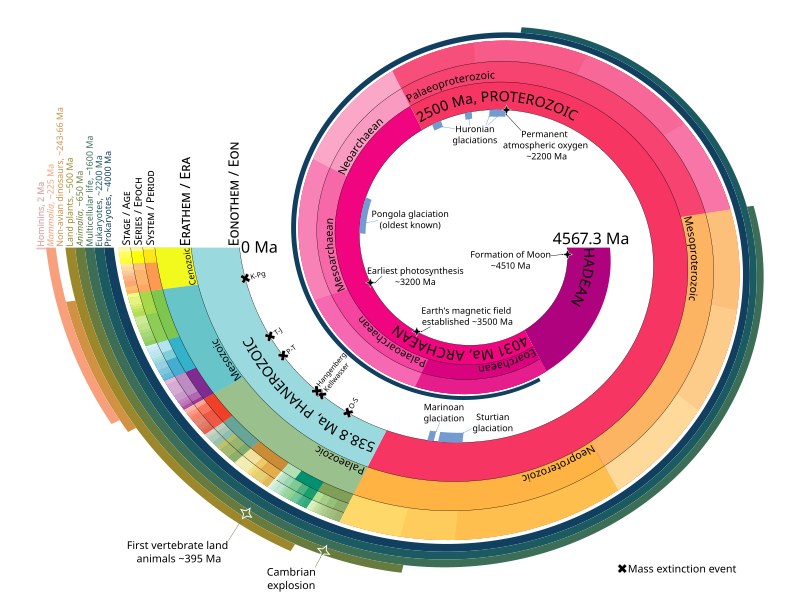
File:Geologic_time_scale_-_spiral_-_ICS_colours_(light)_-_path_text.svg · Wikimedia Commons · See Wikimedia Commons
Also known as geological eon
геохронологическая единица времени, длиннее эры и короче суперэона
An eon is a major division of Earth's history used by geologists to organize the planet's past into manageable time periods. It's longer than an era but shorter than a supereon, making it a middle-level unit in the hierarchical system scientists use to understand how life and geology have changed over billions of years.
AI-generated from the Wikipedia summary — may contain errors.
Wikidata facts
- Has part
- era
Show 5 more facts
- Commons category
- Geologic eons
- topic's main category
- Category:Geological eons
- different from
- aeon
- studied by
- geochronology
- standards body
- International Commission on Stratigraphy
Sources (1)
via Wikidata · CC0
Article · Русский
Эон (др.-греч. αἰών — век, эпоха) в геологии — отрезок времени геологической истории Земли, длительный этап развития литосферы и биосферы Земли, в течение которого формировалась эонотема. Эон объединяет несколько геологических эр, в международной шкале геологического времени, принятой в 1991 году, это — наиболее крупное подразделение.Термин предложен Дж. Дана в 1875 году. Текущий эон — длящийся более 540 миллионов лет фанерозой.
Abstract from DBpedia / Wikipedia · CC BY-SA