Eriodictyon · Kew POWO · Kew Plants of the World Online
Eriodictyon
Sign in to saveEriodictyon is a genus of plants known by the common name yerba santa within the family Namaceae. They are distributed throughout the southwestern United States and Mexico.
Species
GENUS
- KingdomPlantae
- PhylumTracheophyta
- ClassMagnoliopsida
- OrderBoraginales
- FamilyNamaceae
via GBIF · Kew POWO
Museum specimens
- Specimen records
- 149
- With media
- 82
- Family
- Namaceae
- Collections
- IBUNAM, CHSC, CAS, UCSB, A, RSA
- Recorded in
- Mexico, United States
Research
33 papers- Eriodictyon angustifolium extract, but not Eriodictyon californicum extract, reduces human hair greying.International journal of cosmetic science · 2020
- Dietary Eriodictyon angustifolium Tea Supports Prevention of Hair Graying by Reducing DNA Damage in CD34+ Hair Follicular Keratinocyte Stem Cells.Biological & pharmaceutical bulletin · 2020
- Chemical characterization and quantitative determination of flavonoids and phenolic acids in yerba santa (Eriodictyon spp.) using UHPLC/DAD/Q-ToF.Journal of pharmaceutical and biomedical analysis · 2023
- Conservation Genetics of the Endangered Lompoc Yerba Santa (Eriodictyon capitatum Eastw., Namaceae), including Phylogenomic Insights into the Evolution of Eriodictyon.Plants (Basel, Switzerland) · 2023
- Isolation of potential cancer chemopreventive agents from Eriodictyon californicum.Journal of natural products · 1992
via PubMed
Wikidata facts
Show 5 more facts
- taxon rank
- genus
- taxon name
- Eriodictyon
- Commons category
- Eriodictyon
- topic's main category
- Category:Eriodictyon
Sources (1)
via Wikidata · CC0
~2 min read
Encyclopedic overview
6 sectionsContents
- Description
- Taxonomy
- Etymology
- Species
- References
- External links
Eriodictyon is a genus of plants known by the common name yerba santa within the family Namaceae. They are distributed throughout the southwestern United States and Mexico.
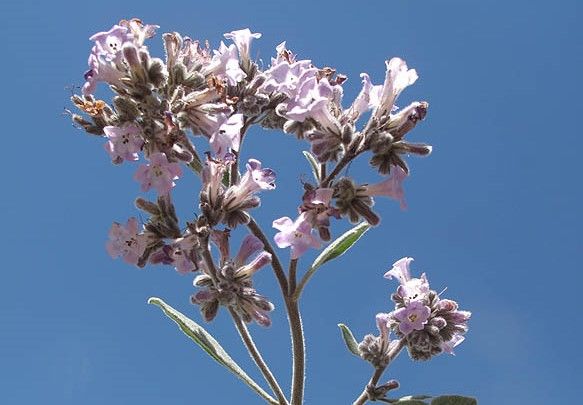
== Description == Most species grow as either perennial herbs or shrubs. They grow in a prostrate to ascending or erect stance. The stems are characterized by shredding barking. The leaves are cauline and alternate. The inflorescence is generally open and terminal. The corolla is funnel to urn shaped, and white, lavender or purple, and generally hairy on the abaxial surface. The sexual organs of the plant, including the stamens, filaments, and ovaries, are also generally hairy. The fruits are 1 to 3 mm wide. The fruits are schizocarpic, and not all mericarpids are fertile. The seeds are striated, and colored a dark brown or black.
Excerpted from Wikipedia’s “Eriodictyon” article, available under the CC BY-SA 4.0 licence.