File:Victoria_1892_beer_duty_revenue_stamp.jpg · Wikimedia Commons · See Wikimedia Commons
excise
Sign in to saveAlso known as tax in rem, in rem, excise tax, Excise Tax
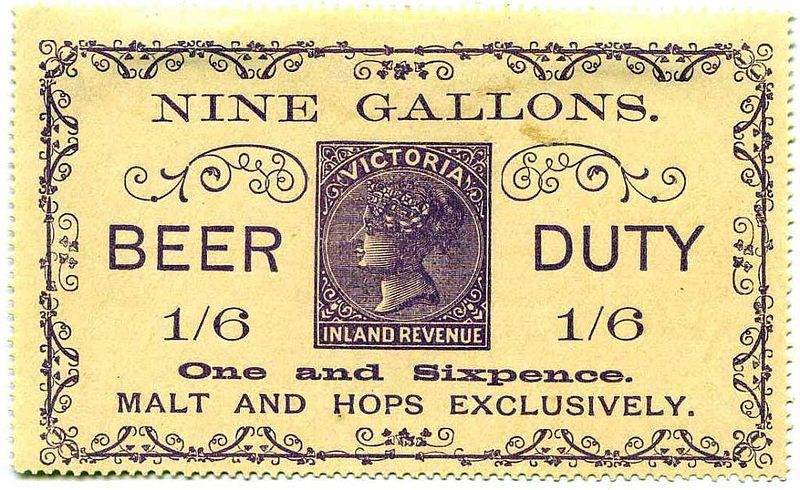
thumb|A 1892 beer duty stamp, noting the cost of the duty (one shilling and sixpence), the unit taxed (Firkin (unit)|9 gallons), its target (malt and hops exclusively), and its source (inland revenue).
An excise is a tax that a government places on specific goods produced or sold within the country, such as the beer tax shown on this 1892 stamp. It matters because it allows governments to raise revenue and can be used to discourage consumption of certain products by making them more expensive.
AI-generated from the Wikipedia summary — may contain errors.
Wikidata facts
- Subclass of
- consumption tax
Show 1 more fact
- topic's main category
- Category:Excises
Sources (3)
via Wikidata · CC0
~38 min read
Encyclopedic overview
31 sectionsContents
- History and rationale
- Theoretical foundations on specific taxation
- Targets of taxation
- Tobacco, alcohol and gasoline
- Cannabis
- Narcotics
- Gambling
- Prostitution
- Unhealthy products
- Environmentally harmful products
- Other types
- Salt, paper and coffee
- Window and related tax
- Newspapers and advertising
- Machinery of implementation
- Around the world
- Australia
- Canada
- China
- European Union
- France
- Germany
- India
- Indonesia
- Japan
- United Kingdom
- United States
- Criticisms
- See also
- References
- External links
thumb|A 1892 beer duty stamp, noting the cost of the duty (one shilling and sixpence), the unit taxed (Firkin (unit)|9 gallons), its target (malt and hops exclusively), and its source (inland revenue).
An excise, or excise tax, is any duty on a category of goods that is normally levied by a government at the moment of manufacture for domestic consumption. This makes excise different from a sales tax or value-added tax (which are levied at a point of sale) or from customs duties (which are levied on goods when they cross a designated border).
Excerpted from Wikipedia’s “excise” article, available under the CC BY-SA 4.0 licence.
Gallery (7)
Available in 63 languages
- Español
- Français
- Deutsch
- 中文
- 日本語
- Русский
- Português
- Italiano
- العربية
- हिन्दी
- Albanian
- Armenian
- Azerbaijani
- Bahasa Indonesia
- Bangla
- Bashkir
- Basque
- be_x_old
Show 44 more
- Belarusian
- Bulgarian
- Croatian
- Czech
- Danish
- Esperanto
- Estonian
- Filipino
- Finnish
- Greek
- Hebrew
- Hungarian
- Ido
- Kannada
- Kara-Kalpak
- Kazakh
- Kyrgyz
- Latvian
- Lithuanian
- Macedonian
- Marathi
- Nederlands
- Nepali
- Norwegian
- Polski
- Romanian
- Serbian
- Silesian
- simple
- Sindhi
- Slovenian
- Svenska
- Tajik
- Tatar
- Telugu
- Tiếng Việt
- Ukrainian
- Uzbek
- Venetian
- Wu Chinese
- zh_yue
- فارسی
- ไทย
- 한국어
via Wikidata sitelinks · CC0