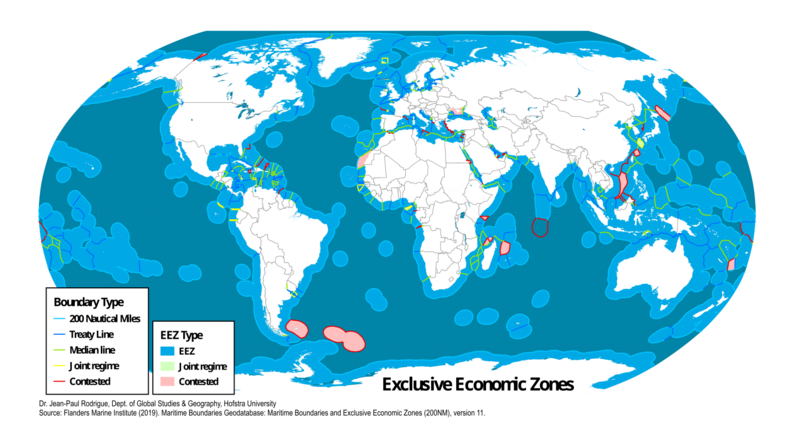
File:Exclusive_Economic_Zones_by_boundary_type.png · Wikimedia Commons · See Wikimedia Commons
exclusive economic zone
Sign in to saveAlso known as EEZ, maritime continental margin
UN maritime zone
# Exclusive Economic Zone Overview An exclusive economic zone (EEZ) is a maritime area extending 200 nautical miles from a country's coast where that country has special rights to explore and use resources like fish and oil. This matters because it allows countries to control valuable natural resources in nearby ocean waters while balancing the interests of other nations that can still pass through these zones.
AI-generated from the Wikipedia summary — may contain errors.
Wikidata facts
- Image
- Exclusive Economic Zones - World.svg
- Width
- 188
Show 5 more facts
- Commons category
- Exclusive economic zones
- topic's main category
- Category:Exclusive economic zones
- different from
- special economic zone
- short name
- IEZ
- facet of
- maritime law
Sources (6)
via Wikidata · CC0
~32 min read
Encyclopedic overview
The world's exclusive economic zones by boundary types and EEZ types An exclusive economic zone (EEZ), as prescribed by the 1982 United Nations Convention on the Law of the Sea, is an area of the sea in which a sovereign state has exclusive rights regarding the exploration and use of marine resources, including energy production from water and wind.
It stretches from the outer limit of the territorial sea at 12 nautical miles (22 km; 14 mi) from the coast to 200 nautical miles (370 km; 230 mi) from the coast of the state in question. It is also referred to as a maritime continental margin and, in colloquial usage, may include the continental shelf. The term does not include either the territorial sea or the continental shelf beyond the 200 nautical mile limit. The difference between the territorial sea and the exclusive economic zone is that the first confers full sovereignty over the waters, whereas the second is merely a "sovereign right" which refers to the coastal state's rights below the surface of the sea. The surface waters are international waters.
Excerpted from Wikipedia’s “exclusive economic zone” article, available under the CC BY-SA 4.0 licence.
Gallery (12)
Available in 63 languages
- Español
- Français
- Deutsch
- 中文
- 日本語
- Русский
- Português
- Italiano
- العربية
- हिन्दी
- Albanian
- Armenian
- Asturian
- Azerbaijani
- Bahasa Indonesia
- Basque
- Bosnian
- Breton
Show 44 more
- Bulgarian
- Catalan
- Croatian
- Czech
- Danish
- Esperanto
- Estonian
- Filipino
- Finnish
- Galician
- Georgian
- Greek
- Hebrew
- Icelandic
- Kannada
- Kazakh
- Khmer
- Latvian
- Lithuanian
- Malay
- Maltese
- Nederlands
- Northern Frisian
- Norwegian
- Norwegian Nynorsk
- Occitan
- Papiamento
- Pashto
- Polski
- Romanian
- Serbian
- Serbian (Latin)
- simple
- Slovak
- Somali
- Tamil
- Tiếng Việt
- Türkçe
- Ukrainian
- Urdu
- Wu Chinese
- فارسی
- ไทย
- 한국어
via Wikidata sitelinks · CC0