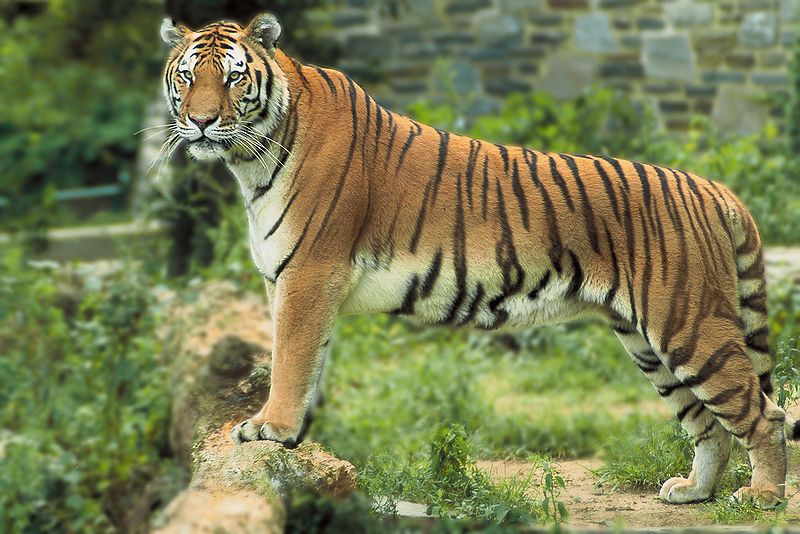
File:Panthera_tigris_tigris_edit2.jpg · Wikimedia Commons · See Wikimedia Commons
Felidae
Sign in to saveAlso known as felids, cat family, feline family, felid, cat
Felidae ( ) is the family of mammals in the order Carnivora colloquially referred to as cats. A member of this family is also called a felid ( ).
OverviewAI-generated
Felidae is a family of mammals within the order Carnivora and class Mammalia. The taxon was described by Fischer von Waldheim in 1817 and has an accepted status. Its taxonomic type is Felis, and it belongs to the parent taxa Feloidea and Feliformia. Members of this group are capable of producing a purr.
The family includes species found in freshwater habitats. Records indicate occurrences in the United States, with specimens held by institutions including USNM, CM, SDNHM, and UTEP. The group has been referenced by 1,625 other encyclopedia articles.
Felidae originated approximately 25 million years ago. The scientific name is Felidae, with common names including kattefamilien, mačke, and kotowate. The topic is listed as a vital article on Wikipedia and has a main category of Category:Felids.
Synthesized by Vinony from 40 facts across 7 sources: Wikidata, GBIF, PubMed, Gbif Occ, WoRMS, iDigBio, Vinony graph. Generated from structured data (not the Wikipedia text) and checked against those facts — may still contain errors.
Species
Felidae
FAMILY
- KingdomAnimalia
- PhylumChordata
- ClassMammalia
- OrderCarnivora
- FamilyFelidae
貓科包括獅子、老虎和豹等動物,是食肉目的9個科中最為肉食性的哺乳動物。第一種的貓科動物出現於漸新世,人們更熟悉的家貓和人類在一万年前開始有關連。家貓的野生種親戚野貓,仍然生存在歐洲、非洲和亞洲東部等地,雖然棲地破壞限制了其居住範圍。 其他貓科動物中知名的成員有包括如獅子、老虎、豹和美洲豹等大貓,以及其他如美洲獅、獵豹、猞猁、獰貓和短尾貓等貓亚科动物。已滅絕的劍齒虎亞科為真的貓科動物,而其他如袋劍齒虎和獵貓等相似的動物則不是。
via GBIF
Museum specimens
- Specimen records
- 1,157
- With media
- 79
- Family
- Felidae
- Collections
- USNM, CM, SDNHM, UTEP
- Recorded in
- United States
Research
148,746 papers- Emerging viruses in the Felidae: shifting paradigms.ReviewViruses · 2012O'Brien SJ, Troyer JL, Brown MA et al.DOI: 10.3390/v4020236
- Felinine: a urinary amino acid of Felidae.ReviewComparative biochemistry and physiology. Part B, Biochemistry & molecular biology · 1995Hendriks WH, Moughan PJ, Tarttelin MF et al.DOI: 10.1016/0305-0491(95)00130-1
- Fleas (Siphonaptera) From the Puma, Puma concolor (Carnivora: Felidae), A Rangewide Review and New Records from Utah and Texas, USA.ReviewJournal of medical entomology · 2022Oliver GV, Eckerlin RPDOI: 10.1093/jme/tjac119
- Evolution of feline immunodeficiency virus in Felidae: implications for human health and wildlife ecology.ReviewVeterinary immunology and immunopathology · 2008Pecon-Slattery J, Troyer JL, Johnson WE et al.DOI: 10.1016/j.vetimm.2008.01.010
- The natural cytotoxicity receptor genes in the family Felidae.HLA · 2022Bubenikova J, Futas J, Oppelt J et al.DOI: 10.1111/tan.14803
- [Summary of phylogeny in family Felidae of Carnivora].ReviewYi chuan = Hereditas · 2012Wang JF, Zhang YP, Yu LDOI: 10.3724/sp.j.1005.2012.01365
- Cats.ReviewCurrent biology : CB · 2004O'Brien SJDOI: 10.1016/j.cub.2004.11.017
- Iliac auricular surface morphofunctional study in felidae.Zoology (Jena, Germany) · 2020Pallandre JP, Cornette R, Placide MA et al.DOI: 10.1016/j.zool.2019.125714
via PubMed
Wikidata facts
- Instance of
- taxon
- Parent taxon
- Feliformia
- Image
- Panthera tigris tigris edited2.jpg
Show 11 more facts
- taxon rank
- family
- taxon name
- Felidae
- Commons category
- Felidae
- topic's main category
- Category:Felids
- produced sound
- purr
- start time
- 25000000-0
- topic has template
- Template:Felidae nav
- taxon common name
- kotowate
- on focus list of Wikimedia project
- Wikipedia:Vital articles/Level/4
- taxonomic type
- Felis
- topic's main Wikimedia portal
- Portal:Cats
via Wikidata · CC0
~13 min read
Encyclopedic overview
7 sectionsContents
- Characteristics
- Evolutionary history
- Classification
- Phylogeny
- See also
- References
- External links
Felidae ( ) is the family of mammals in the order Carnivora colloquially referred to as cats. A member of this family is also called a felid ( ).
The 41 extant Felidae species exhibit the greatest diversity in fur patterns of all terrestrial carnivores. Cats have retractile claws, slender muscular bodies and strong flexible forelimbs. Their teeth and facial muscles allow for a powerful bite. They are all obligate carnivores, and most are solitary predators ambushing or stalking their prey. Wild cats occur in Africa, Europe, Asia and the Americas. Some wild cat species are adapted to forest and savanna habitats, some to arid environments, and a few also to wetlands and mountainous terrain. Their activity patterns range from nocturnal and crepuscular to diurnal, depending on their preferred prey species.
Excerpted from Wikipedia’s “Felidae” article, available under the CC BY-SA 4.0 licence.
Gallery (56)
Available in 133 languages
- Español
- Français
- Deutsch
- 中文
- 日本語
- Русский
- Português
- Italiano
- العربية
- हिन्दी
- Adyghe
- Afrikaans
- Albanian
- Amharic
- Aragonese
- Armenian
- Asturian
- azb
Show 114 more
- Azerbaijani
- Bahasa Indonesia
- Balinese
- Bangla
- Basque
- be_x_old
- Belarusian
- Bosnian
- Breton
- Bulgarian
- Burmese
- Catalan
- Cebuano
- Central Kurdish
- Cherokee
- Cheyenne
- Chuvash
- Corsican
- Croatian
- Czech
- Danish
- Egyptian Arabic
- Esperanto
- Estonian
- Filipino
- Finnish
- Gagauz
- Galician
- Georgian
- Greek
- Guarani
- Hakka Chinese
- Hawaiian
- Hebrew
- Hungarian
- Icelandic
- Ingush
- Interlingua
- Javanese
- Kabardian
- Kabyle
- Komi-Permyak
- Kotava
- Kurdish
- Kyrgyz
- Latgalian
- Latin
- Latvian
- Ligurian
- Limburgish
- Lingua Franca Nova
- Lithuanian
- Lombard
- Lower Sorbian
- Luxembourgish
- Macedonian
- Malay
- Malayalam
- Marathi
- Mari
- Mingrelian
- Mongolian
- Moroccan Arabic
- Navajo
- Nederlands
- Northern Frisian
- Norwegian
- Norwegian Nynorsk
- Occitan
- Old English
- Oromo
- Ossetic
- Pashto
- Polski
- Romanian
- Scots
- Scottish Gaelic
- Serbian
- Serbian (Latin)
- Sicilian
- simple
- Sindhi
- Slovak
- Slovenian
- Somali
- Sundanese
- Svenska
- Tajik
- Tamil
- Tatar
- Telugu
- Tiếng Việt
- Türkçe
- Ukrainian
- Upper Sorbian
- Urdu
- Uyghur
- Uzbek
- Veps
- Walloon
- Waray
- West Flemish
- Western Frisian
- Western Mari
- Western Panjabi
- Wu Chinese
- Yakut
- Yiddish
- zh_min_nan
- zh_yue
- Zulu
- فارسی
- ไทย
- 한국어
via Wikidata sitelinks · CC0