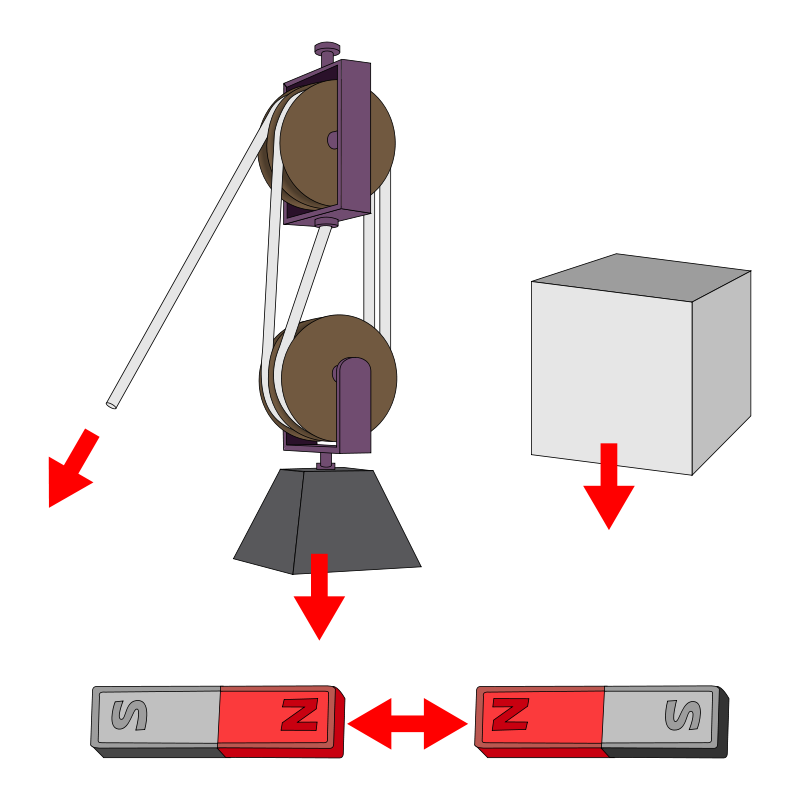
File:Force_examples.svg · Wikimedia Commons · See Wikimedia Commons
Also known as mass times acceleration
物体の状態を変化させる原因となる作用
A force is a push or pull that can change how fast or in what direction an object is moving, change its shape, or affect fluids and other forces. Because both how strong a force is and which direction it points matter, scientists use vectors to represent forces mathematically, measuring them in units called newtons.
AI-generated from the Wikipedia summary — may contain errors.
Key facts
- Physical quantity.name
- Force
- Physical quantity.image
- 200px
- Physical quantity.caption
- Forces can be described as a push or pull on an object. They can be due to phenomena such as gravity, magnetism, or anything that might cause a mass to accelerate.
- Physical quantity.unit
- newton (N)
- Physical quantity.otherunits
- dyne, pound-force, poundal, kip, kilopond
- Physical quantity.symbols
- \vec F, ,
- Physical quantity.baseunits
- kg·m·s−2
- Physical quantity.dimension
- wikidata
via Wikipedia infobox
Wikidata facts
- Subclass of
- physical quantity
- Part of
- interaction
- Image
- Force examples.svg
- Said to be same as
- strength
Show 10 more facts
- Commons category
- Forces (physics)
- topic's main category
- Category:Force
- described by source
- Granat Encyclopedic Dictionary
- on focus list of Wikimedia project
- Wikipedia:Vital articles/Level/4
- quantity symbol (string)
- F
- has cause
- fundamental interaction
- Stack Exchange tag
- physics.stackexchange.com/tags/forces
- has characteristic
- point
- has effect
- interaction
- maintained by WikiProject
- WikiProject Mathematics
Sources (3)
via Wikidata · CC0
Article · 日本語
物理学における力(ちから、(英: force)とは、物体の状態を変化させる原因となる作用であり、その作用の大きさを表す物理量である。特に質点の動力学においては、質点の運動状態を変化させる状態量のことをいう。広がりを持つ物体の場合は、運動状態とともにその形状を変化させる。 本項ではまず、古代の自然哲学における力の扱いから始め近世に確立された「ニュートン力学」や、古典物理学における力学、すなわち古典力学の発展といった歴史について述べる。 次に歴史から離れ、現在の一般的視点から古典力学における力について説明し、その後に古典力学と対置される量子力学について少し触れる。 最後に、力の概念について時折なされてきた、「形而上的である」といったような批判などについて、その重要さもあり、項を改めて扱う。
Abstract from DBpedia / Wikipedia · CC BY-SA
Gallery (38)
Available in 157 languages
- Español
- Français
- Deutsch
- 中文
- 日本語
- Русский
- Português
- Italiano
- العربية
- हिन्दी
- Afrikaans
- Albanian
- Albanian
- Amharic
- Aragonese
- Armenian
- Assamese
- Asturian
Show 138 more
- azb
- Azerbaijani
- Bahasa Indonesia
- Bangla
- Bashkir
- Basque
- bat_smg
- Bavarian
- be_x_old
- Belarusian
- Bhojpuri
- Bikol
- blk
- Bosnian
- Bulgarian
- Buriat
- Burmese
- Catalan
- Cebuano
- Central Kurdish
- Chuvash
- Croatian
- Czech
- Danish
- Egyptian Arabic
- Esperanto
- Estonian
- Extremaduran
- Fiji Hindi
- Filipino
- Finnish
- Galician
- Gan Chinese
- Ganda
- gcr
- Georgian
- Greek
- Guarani
- Gujarati
- Haitian Creole
- Hakka Chinese
- Hebrew
- Hungarian
- hyw
- Icelandic
- Ido
- Inari Sami
- Interlingua
- Interlingue
- Irish
- Jamaican Creole English
- Javanese
- Kabyle
- Kannada
- Kara-Kalpak
- Kashmiri
- Kazakh
- kbp
- Khmer
- Kurdish
- Latin
- Latvian
- Limburgish
- Lingua Franca Nova
- Lithuanian
- Lombard
- Low German
- Macedonian
- Malagasy
- Malay
- Malayalam
- Manx
- Marathi
- Mazanderani
- Moksha
- Mongolian
- Nederlands
- Nepali
- Newari
- Northern Frisian
- Norwegian
- Norwegian Nynorsk
- Occitan
- Odia
- Oromo
- Piedmontese
- Polski
- Punjabi
- Quechua
- rki
- Romanian
- Rusyn
- Sanskrit
- Sardinian
- Scots
- Serbian
- Serbian (Latin)
- Shona
- Sicilian
- simple
- Sindhi
- Sinhala
- Slovak
- Slovenian
- Somali
- Sundanese
- Svenska
- Swahili
- Tajik
- Tamil
- Tatar
- Telugu
- Tiếng Việt
- Toki Pona
- Türkçe
- Turkmen
- Tuvinian
- Ukrainian
- Urdu
- Uzbek
- Venetian
- Veps
- Waray
- Welsh
- Western Frisian
- Western Panjabi
- Wu Chinese
- Xhosa
- Yakut
- Yiddish
- Yoruba
- zh_classical
- zh_min_nan
- zh_yue
- Zulu
- فارسی
- ไทย
- 한국어
via Wikidata sitelinks · CC0