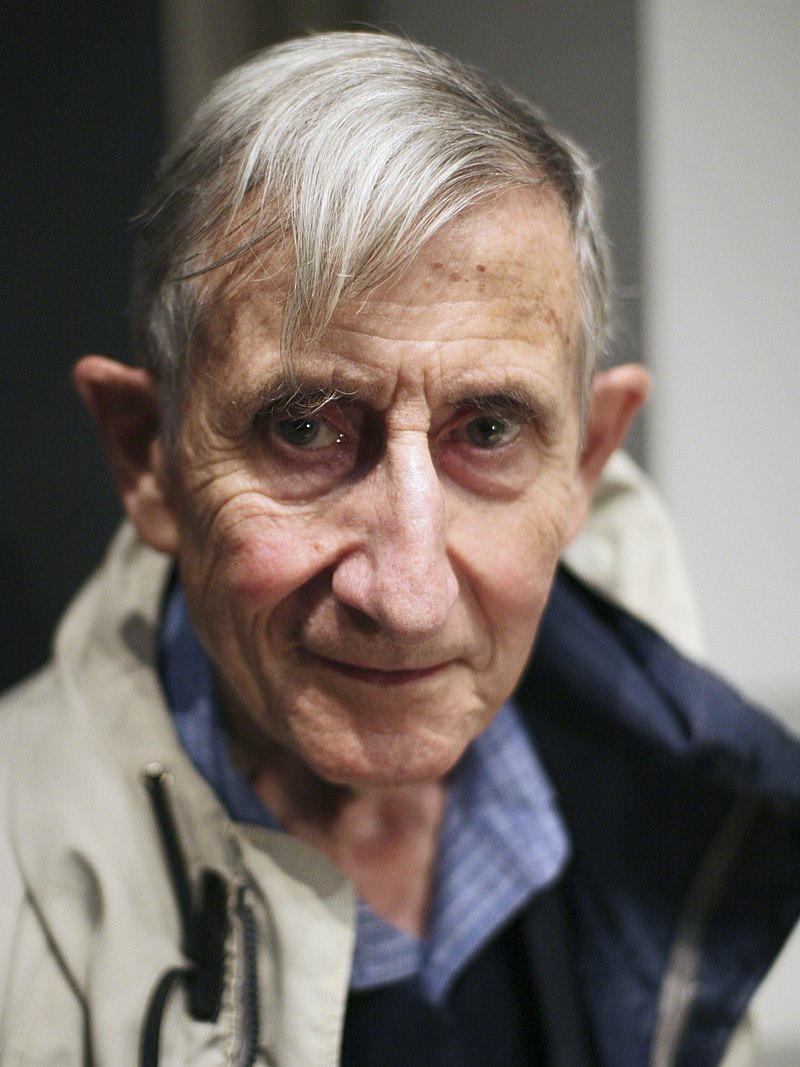
File:Freeman_Dyson_(2005).jpg · Wikimedia Commons · See Wikimedia Commons
Freeman Dyson
Sign in to saveAlso known as Freeman J. Dyson
theoretical physicist and mathematician (1923–2020)
Freeman Dyson was a theoretical physicist and mathematician who lived from 1923 to 2020 and made significant contributions to fundamental physics. His work bridged mathematics and physics in ways that influenced modern scientific understanding, making him an important figure in 20th-century science.
AI-generated from the Wikipedia summary — may contain errors.
Film & TV
Crowthorne, Berkshire, England, UK
Freeman John Dyson FRS was an English-American theoretical physicist and mathematician known for his works in quantum field theory, astrophysics, random matrices, mathematical formulation of quantum mechanics, condensed matter physics, nuclear physics, and engineering.
Known for
- The Fantastic Mr Feynman — Self (archive footage)2013
- The Trials of J. Robert Oppenheimer — Self2008
- To Mars by A-Bomb: The Secret History of Project Orion — Self2003
- 2001 and Beyond — Self2001
- Van de Schoonheid en de Troost — himself2000
- No Ordinary Genius — Self1993
- A Glorious Accident — himself1993
- Gaia Symphony — Self1992
- The Day After Trinity — Self1980
via TMDB
Wikidata facts
- Instance of
- human
- Given name
- John
- Gender
- male
- Citizenship
- United States
- Place of birth
- Crowthorne
- Place of death
- Princeton
- Spouse
- Verena Huber-Dyson
- Child
- George Dyson
- Father
- George Dyson
- Occupation
- university teacher
- Position held
- professor
- Educated at
- Winchester College
- Employer
- Imperial College London
- Languages spoken
- English language
- Academic degree
- doctorate
- Field of work
- mathematics
- Official website
- www.ias.edu/sns/dyson
- Image
- Freeman Dyson.jpg
- Residence
- United States
Show 15 more facts
- topic's main category
- Category:Freeman Dyson
- member of
- American Physical Society
- birth name
- Freeman John Dyson
- writing language
- English language
- date of birth
- 1923-12-15
- Commons category
- Freeman Dyson
- Erdős number
- 2
- Commons gallery
- Freeman Dyson
- nominated for
- Nobel Prize in Physics
- influenced by
- Richard Feynman
- date of death
- 2020-02-28
- maintained by WikiProject
- WikiProject Mathematics
- name in native language
- Freeman Dyson
- ethnic group
- English people
- P12749
- Survivor Series (2003)
Sources (11)
via Wikidata · CC0
~37 min read
Encyclopedic overview
Freeman John Dyson (15 December 1923 – 28 February 2020) was a British-American theoretical physicist and mathematician known for his works in quantum field theory, astrophysics, random matrices, mathematical formulation of quantum mechanics, condensed matter physics, nuclear physics, and engineering. He was professor emeritus in the Institute for Advanced Study in Princeton and a member of the board of sponsors of the Bulletin of the Atomic Scientists.
Dyson originated several concepts that bear his name, such as Dyson's transform, a fundamental technique in additive number theory, which he developed as part of his proof of Mann's theorem; the Dyson tree, a hypothetical genetically engineered plant capable of growing in a comet; the Dyson series, a perturbative series where each term is represented by Feynman diagrams; the Dyson sphere, a thought experiment that attempts to explain how a space-faring civilization would meet its energy requirements with a hypothetical megastructure that completely encompasses a star and captures a large percentage of its power output; and Dyson's eternal intelligence, a means by which an immortal society of intelligent beings in an open universe could escape the prospect of the heat death of the universe by extending subjective time to infinity while expending only a finite amount of energy.
Excerpted from Wikipedia’s “Freeman Dyson” article, available under the CC BY-SA 4.0 licence.
Gallery (7)
Available in 59 languages
- Español
- Français
- Deutsch
- 中文
- 日本語
- Русский
- Português
- Italiano
- العربية
- Afrikaans
- Albanian
- Aragonese
- Armenian
- azb
- Bahasa Indonesia
- Bangla
- Basque
- bat_smg
Show 40 more
- Belarusian
- Bosnian
- Bulgarian
- Catalan
- Czech
- Danish
- Egyptian Arabic
- Esperanto
- Estonian
- Finnish
- Galician
- Georgian
- Greek
- Haitian Creole
- Hebrew
- Hungarian
- Irish
- Kyrgyz
- Latvian
- Malay
- Malayalam
- Mingrelian
- Nederlands
- Norwegian
- Occitan
- Pashto
- Polski
- Romanian
- Scottish Gaelic
- Serbian
- simple
- Slovak
- Slovenian
- Svenska
- Tajik
- Türkçe
- Ukrainian
- Urdu
- فارسی
- 한국어
via Wikidata sitelinks · CC0