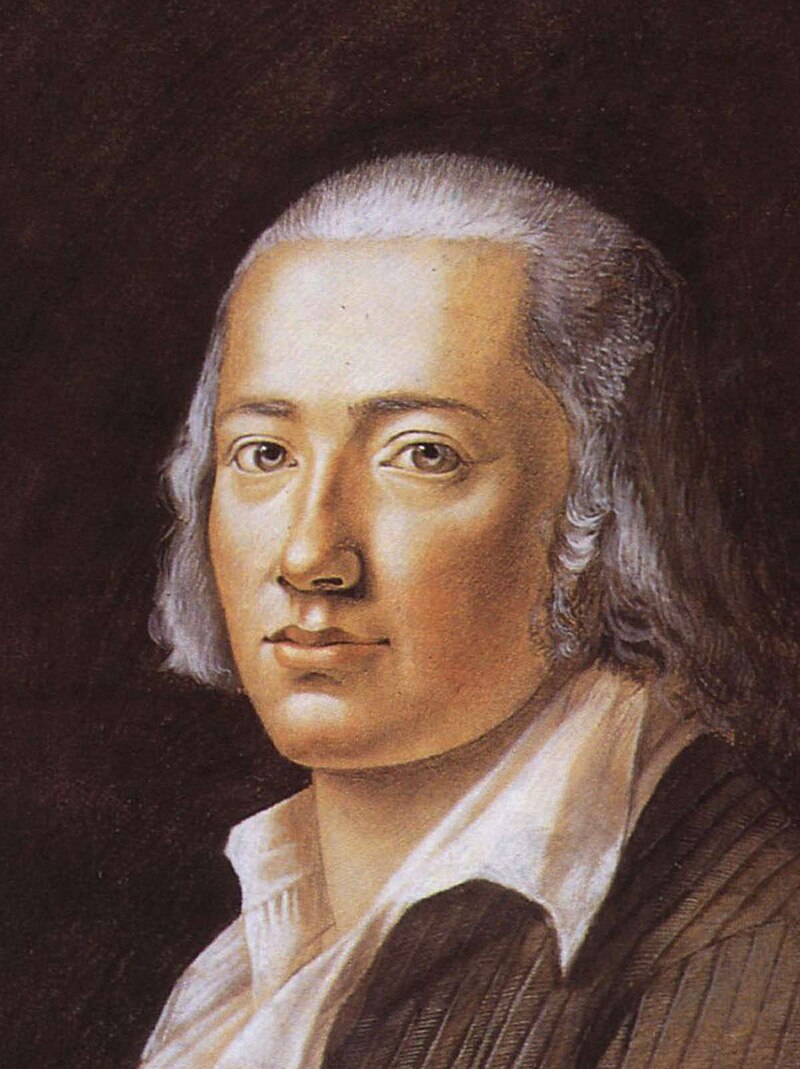
File:FK_Hiemer_-_Friedrich_Hölderlin_(Pastell_1792).jpg · Wikimedia Commons · See Wikimedia Commons
Friedrich Hölderlin
Sign in to saveAlso known as Johann Christian Friedrich Hölderlin, Frederich Holderlin
German poet
OverviewAI-generated
Friedrich Hölderlin was a German male author whose professional activity spanned from 1797 to 1820. Born on 20 March 1770, he died on 7 June 1843. His literary output includes works such as *Hyperion*, *Trauerspiele des Sophokles*, *Das philosophische Licht um mein Fenster*, *Hölderlin und Diotima*, and *Poemas*. He is associated with the genre of German literature and has been linked to other writers including Heinrich Heine, Hugo von Hofmannsthal, Rainer Maria Rilke, Hermann Hesse, and Charles Baudelaire.
Hölderlin’s writings have been recorded in various collections, with one source listing 389 works while others cite a count of 5. A notable quote attributed to him is "Wer das Tiefste gedacht, liebt das Lebendigste." His legacy is preserved through an official website and a Commons category dedicated to his name.
Synthesized by Vinony from 27 facts across 8 sources: Wikidata, Last.fm, Crossref, Wikiquote, MusicBrainz, Open Library, Europeana Sparql, Vinony graph. Generated from structured data (not the Wikipedia text) and checked against those facts — may still contain errors.
Wikidata facts
- Instance of
- human
- Given name
- Friedrich
- Gender
- male
- Citizenship
- Kingdom of Württemberg
- Place of birth
- Lauffen am Neckar
- Place of death
- Tübingen
- Occupation
- hofmeister
- Languages spoken
- French
- Native language
- German
- Field of work
- prose
- Movement
- German idealism
- Official website
- www.hoelderlin-gesellschaft.de
- Image
- FK Hiemer - Friedrich Hölderlin (Pastell 1792).jpg
Show 14 more facts
- date of birth
- 1770-01-01
- topic's main category
- Category:Friedrich Hölderlin
- date of death
- 1842-00-00
- Commons category
- Friedrich Hölderlin
- influenced by
- Pietism
- Commons gallery
- Friedrich Hölderlin
- IPA transcription
- /ˈfʁiːdʁɪç ˈhœldɐliːn/
- writing language
- German
- start of work period
- 1797-00-00
- name in native language
- Johann Christian Friedrich Hölderlin
- end of work period
- 1820-00-00
- P12674
- Heinrich Ranke
- archives at
- Württembergische Landesbibliothek
via Wikidata · CC0
Works in European collections
5 objects attributed to Friedrich Hölderlin, held across European museums, libraries & archives · via Europeana


~33 min read
Encyclopedic overview
Johann Christian Friedrich Hölderlin ( UK: /ˈhɜːldərliːn/, US: /ˈhʌl-/; German: [ˈfʁiːdʁɪç ˈhœldɐliːn] ; 20 March 1770 – 7 June 1843) was a German poet and philosopher. Described by Norbert von Hellingrath as "the most German of Germans", Hölderlin was a key figure of German Romanticism. Particularly due to his early association with and philosophical influence on Georg Wilhelm Friedrich Hegel and Friedrich Wilhelm Joseph Schelling, he was also an important thinker in the development of German Idealism.
Born in Lauffen am Neckar, Hölderlin had a childhood marked by bereavement. His mother intended for him to enter the Lutheran ministry, and he attended the Tübinger Stift, where he was friends with Hegel and Schelling. He graduated in 1793 but could not devote himself to the Christian faith, instead becoming a tutor. Two years later, he briefly attended the University of Jena, where he interacted with Johann Gottlieb Fichte and Novalis, before resuming his career as a tutor. He struggled to establish himself as a poet, and was plagued by mental illness. He was sent to a clinic in 1806 but deemed incurable and instead given lodging by a carpenter, Ernst Zimmer. He spent the final 36 years of his life in Zimmer's residence, and died in 1843 at the age of 73.
Excerpted from Wikipedia’s “Friedrich Hölderlin” article, available under the CC BY-SA 4.0 licence.
Gallery (11)
Available in 65 languages
- Español
- Français
- Deutsch
- 中文
- 日本語
- Русский
- Português
- Italiano
- العربية
- Afrikaans
- Albanian
- Aragonese
- Armenian
- Asturian
- azb
- Bahasa Indonesia
- Basque
- be_x_old
Show 46 more
- Belarusian
- Bosnian
- Breton
- Bulgarian
- Catalan
- Central Kurdish
- Croatian
- Czech
- Danish
- Egyptian Arabic
- Esperanto
- Estonian
- Finnish
- Galician
- Greek
- Haitian Creole
- Hebrew
- Hungarian
- hyw
- Ido
- Interlingua
- Interlingue
- Latin
- Latvian
- Lithuanian
- Low German
- Luxembourgish
- Macedonian
- Nederlands
- Norwegian
- Norwegian Nynorsk
- Piedmontese
- Polski
- Romanian
- Serbian
- Serbian (Latin)
- simple
- Slovak
- Slovenian
- Svenska
- Türkçe
- Ukrainian
- Welsh
- Wu Chinese
- فارسی
- 한국어
via Wikidata sitelinks · CC0