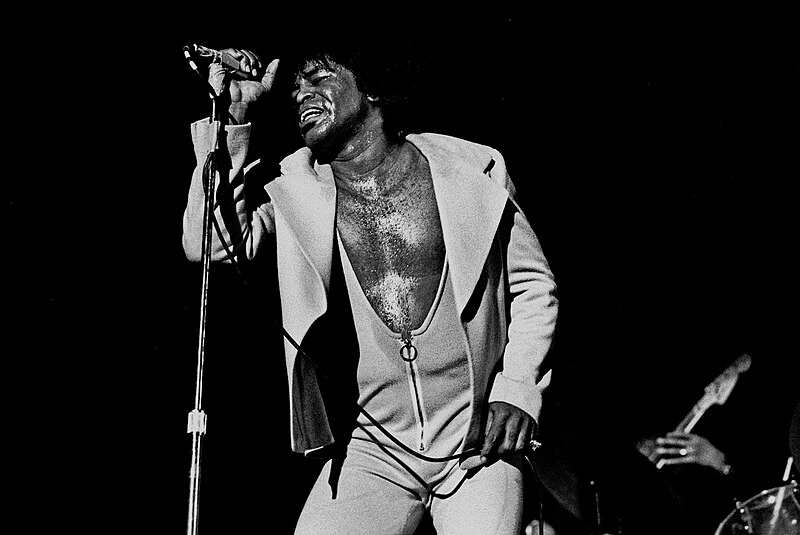
File:James-Brown_1973.jpg · Wikimedia Commons · See Wikimedia Commons
funk
Sign in to saveAlso known as funk music, funky, funky music, music funk
Funk is a music genre that originated in African-American communities in the mid-1960s when musicians created a rhythmic, danceable new form of music through a mixture of various music genres that were popular among African-Americans in the mid-20th century. It deemphasizes melody and chord progressions and focuses on a strong rhythmic groove of a bassline played by an electric bassist and a drum part played by a percussionist, often at slower tempos than other popular music. Funk typically consists of a complex percussive groove with rhythm instruments playing interlocking grooves that create
Funk is a music genre that emerged in African-American communities in the mid-1960s, defined by its emphasis on strong rhythmic grooves rather than melody, with the electric bass and drums working together to create a danceable sound. It matters because it introduced a new approach to popular music that prioritized complex, interlocking rhythms and became influential in shaping how musicians thought about groove and rhythm in contemporary music.
AI-generated from the Wikipedia summary — may contain errors.
Key facts
- Music genre <! See Wikipedia:WikiProject_Music_genres >.name
- Funk
- Music genre <! See Wikipedia:WikiProject_Music_genres >.image
- James-Brown 1973.jpg
- Music genre <! See Wikipedia:WikiProject_Music_genres >.cultural_origins
- Mid-1960s, United States
- Music genre <! See Wikipedia:WikiProject_Music_genres >.caption
- James Brown, a pioneer of funk, in 1973
via Wikipedia infobox
Wikidata facts
- Image
- Earth Wind and Fire.jpg
Show 3 more facts
- Commons category
- Funk
- inception
- 1965-01-01
- native label
- Funk
Sources (9)
via Wikidata · CC0
~60 min read
Article
38 sectionsContents
- Etymology
- Characteristics
- Rhythm and tempo
- Harmony
- Improvisation
- Instruments
- Bass guitar
- Drums
- Electric guitar
- Keyboards
- Vocals and lyrics
- Other instruments
- Costumes and style
- History
- New Orleans
- 1960s
- James Brown
- Parliament-Funkadelic
- Late 1960s – early 1970s
- 1970s
- Jazz funk
- 1980s synth-funk
- Late 1980s to 2000s nu-funk
- 2010s funktronica
- Derivatives
- Funk rock
- Avant-funk
- Go-go
- Boogie
- Electro funk
- Funk metal
- G-funk
- Timba funk
- Social impact
- Women and funk
- See also
- References
- Further reading
Funk is a music genre that originated in African-American communities in the mid-1960s when musicians created a rhythmic, danceable new form of music through a mixture of various music genres that were popular among African-Americans in the mid-20th century. It deemphasizes melody and chord progressions and focuses on a strong rhythmic groove of a bassline played by an electric bassist and a drum part played by a percussionist, often at slower tempos than other popular music. Funk typically consists of a complex percussive groove with rhythm instruments playing interlocking grooves that create a "hypnotic" and "danceable" feel. Early funk, specifically James Brown, fused jazz and blues, and added a syncopated drum groove.
Funk originated in the mid-1960s, with James Brown's development of a signature groove that emphasized the downbeat—with a heavy emphasis on the first beat of every measure ("The One"), and the application of swung 16th notes and syncopation on all basslines, drum patterns, and guitar riffs. Rock- and psychedelia-influenced musicians Sly and the Family Stone and Parliament-Funkadelic fostered more eclectic examples of the genre beginning in the late 1960s. Other musical groups developed Brown's innovations during the 1970s and the 1980s, including Kool and the Gang, Ohio Players, Fatback Band, Jimmy Castor Bunch, Bootsy Collins, Earth, Wind & Fire, B.T. Express, Hamilton Bohannon, One Way, Lakeside, Dazz Band, The Gap Band, Slave, Aurra, Roger Troutman & Zapp, Con Funk Shun, Cameo, Bar-Kays and Chic.
Gallery (52)
Available in 71 languages
- Español
- Français
- Deutsch
- 中文
- 日本語
- Русский
- Português
- Italiano
- العربية
- Albanian
- Armenian
- Asturian
- Bahasa Indonesia
- Basque
- Belarusian
- Breton
- Bulgarian
- Catalan
Show 52 more
- Central Kurdish
- Crimean Tatar
- Croatian
- Czech
- Danish
- Egyptian Arabic
- Esperanto
- Estonian
- Finnish
- Galician
- Georgian
- Greek
- Hebrew
- Hungarian
- Icelandic
- Ido
- Interlingua
- Kazakh
- Latvian
- Lithuanian
- Lombard
- Macedonian
- Malay
- nah
- nds_nl
- Nederlands
- Norwegian
- Norwegian Nynorsk
- Polski
- Punjabi
- Romanian
- Scots
- Scottish Gaelic
- Serbian
- Serbian (Latin)
- simple
- Slovak
- Slovenian
- Svenska
- Tamil
- Tiếng Việt
- Türkçe
- Ukrainian
- Uyghur
- Uzbek
- Western Frisian
- Wu Chinese
- zh_min_nan
- zh_yue
- فارسی
- ไทย
- 한국어
via Wikidata sitelinks · CC0