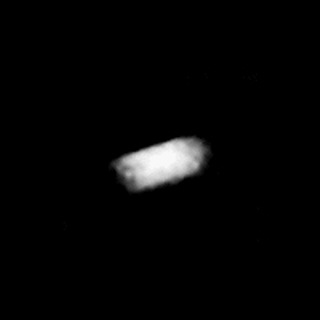
File:Galatea_moon.jpg · Wikimedia Commons · See Wikimedia Commons
AI overview
Galatea is a small moon that orbits Neptune, discovered in 1989 by the Voyager 2 spacecraft. It is notable for its close proximity to Neptune's ring system, which makes it scientifically important for understanding how planetary rings form and are maintained.
AI-generated from the Wikipedia summary — may contain errors.
Wikidata facts
- Instance of
- shepherd moon
- Named after
- Galatea
- Parent body
- Neptune
- Radius
- 88
- Mass
- 3.7
- Orbital period
- 0.42874431
- Image
- Galatea moon.jpg
Show 10 more facts
- Commons gallery
- Galatea (moon)
- discoverer or inventor
- Voyager 2
- Commons category
- Galatea (moon)
- provisional designation
- S/1989 N 4
- time of discovery or invention
- 1989-07-28
- albedo
- 0.08
- apparent magnitude
- 21.9
- orbital eccentricity
- 0.00004
- semi-major axis of an orbit
- 61593
- orbital inclination
- 0.052
via Wikidata · CC0
Gallery (2)
Available in 67 languages
- Español
- Français
- Deutsch
- 中文
- 日本語
- Русский
- Português
- Italiano
- العربية
- हिन्दी
- Afrikaans
- Aragonese
- Armenian
- azb
- Azerbaijani
- Bahasa Indonesia
- Bangla
- Basque
Show 48 more
- Belarusian
- Bosnian
- Bulgarian
- Burmese
- Catalan
- cdo
- Central Kurdish
- Croatian
- Czech
- Danish
- Esperanto
- Estonian
- Filipino
- Finnish
- Galician
- Greek
- Haitian Creole
- Hebrew
- Hungarian
- Komi
- Latvian
- Lithuanian
- Low German
- Macedonian
- Malayalam
- Nederlands
- Norwegian
- Norwegian Nynorsk
- Polski
- Romanian
- Serbian
- simple
- Slovak
- Slovenian
- Svenska
- Tajik
- Tamil
- Tiếng Việt
- Türkçe
- Ukrainian
- Urdu
- Waray
- Welsh
- Wu Chinese
- zh_min_nan
- zh_yue
- فارسی
- 한국어
via Wikidata sitelinks · CC0