Geijera · Kew POWO · Kew Plants of the World Online
Geijera
Sign in to saveGeijera is a genus of shrubs and trees in the family Rutaceae and are native to New Guinea, Australia and New Caledonia. They have simple leaves arranged alternately, panicles of bisexual flowers usually with five, sometimes four, sepals, petals and stamens and fruit containing shiny black seeds.
In the Vinony graph
Vinony's link graph records 11 inbound references to Geijera, and connects out to plant, leaf and Wikidata.
It sits within the topics Geijera, Taxa named by Heinrich Wilhelm Schott and Zanthoxyloideae genera.
Vinony links it to 7 Wikipedia language editions.
Species
GENUS
- KingdomPlantae
- PhylumTracheophyta
- ClassMagnoliopsida
- OrderSapindales
- FamilyRutaceae
General: and New Caledonia with a single species in New Guinea, Geijera
via GBIF · Kew POWO
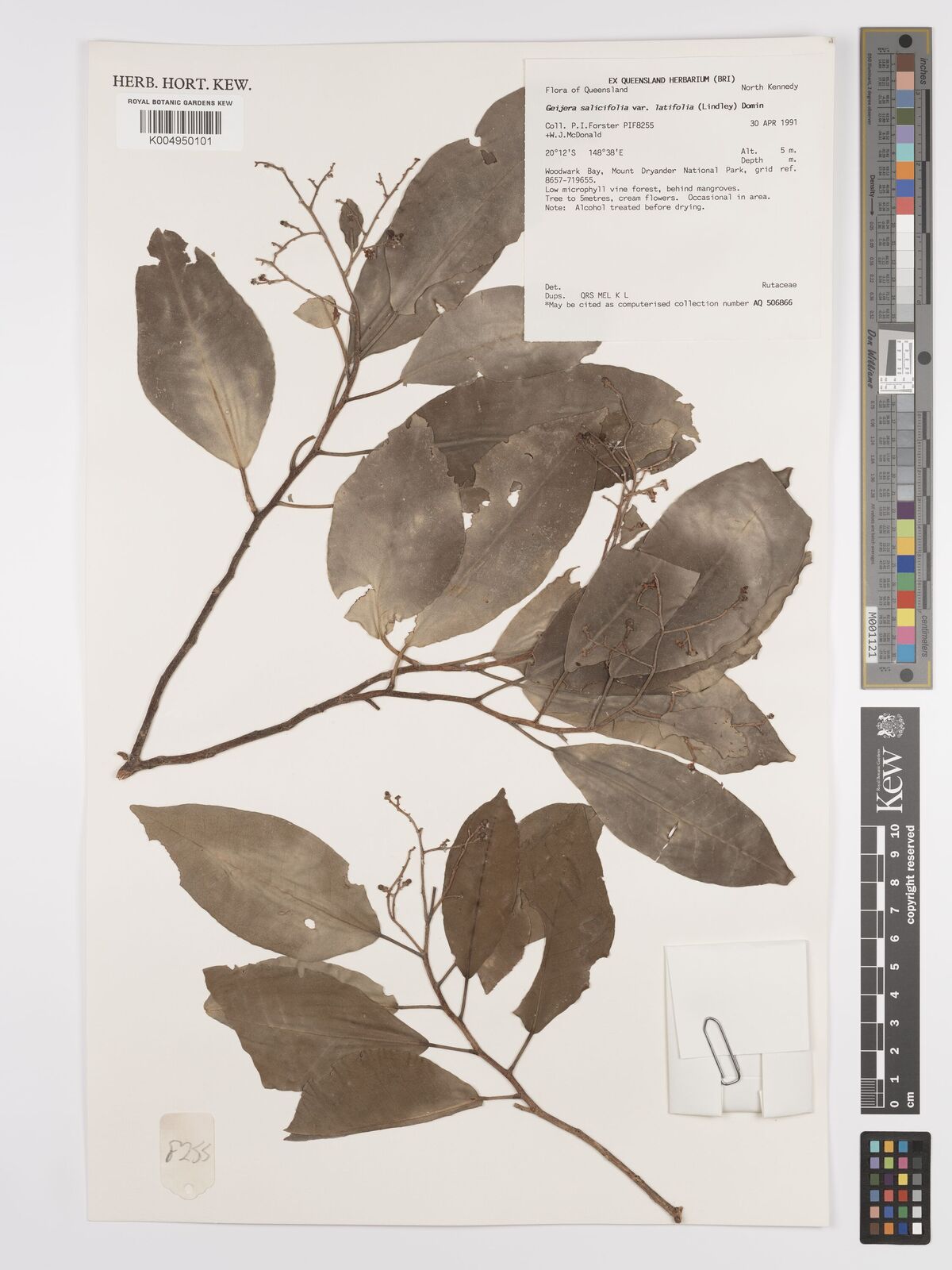
Museum specimens
- Specimen records
- 56
- With media
- 38
- Family
- Rutaceae
- Collections
- MO, MNHN, MEL, BPBM, NY
- Recorded in
- New Caledonia, Nouvelle-CaléDonie, Australia
Wikidata facts
Show 6 more facts
- Commons category
- Geijera
- topic's main category
- Category:Geijera
- taxon name
- Geijera
- taxon rank
- genus
- taxon common name
- 钩瓣常山属
Sources (1)
via Wikidata · CC0
~2 min read
Encyclopedic overview
5 sectionsContents
- Description
- Taxonomy
- Species list
- Distribution and habitat
- References
Geijera is a genus of shrubs and trees in the family Rutaceae and are native to New Guinea, Australia and New Caledonia. They have simple leaves arranged alternately, panicles of bisexual flowers usually with five, sometimes four, sepals, petals and stamens and fruit containing shiny black seeds.
==Description== Plants in the genus Geijera are shrubs or trees with simple leaves arranged alternately. They have small, bisexual flowers arranged in many-flowered panicles in upper leaf axils and on the ends of branchlets and usually have five, sometimes four sepals, petals and stamens. The sepals are fused at the base, up to long, and persist in the fruit. The petals are white or cream-coloured, up to long and the stamens are up to long and arranged opposite the sepals. The fruit consists of up to five more or less spherical follicles joined at the base each with a single shiny black seed.
Excerpted from Wikipedia’s “Geijera” article, available under the CC BY-SA 4.0 licence.