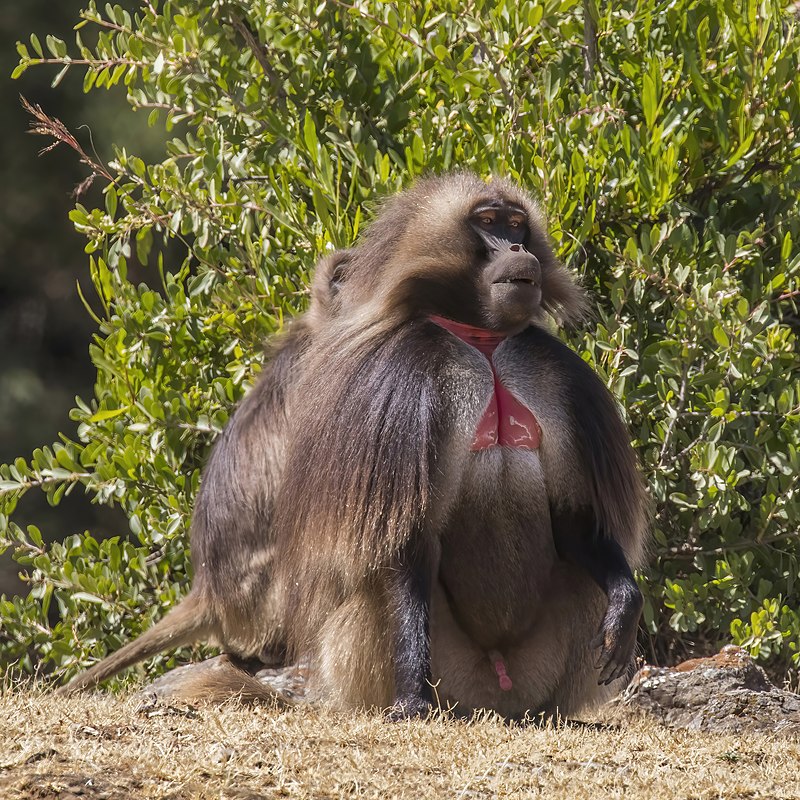
File:Gelada_(Theropithecus_gelada_gelada)_male_2.jpg · Wikimedia Commons · See Wikimedia Commons
Gelada
Sign in to saveAlso known as Theropithecus gelada
The gelada (Theropithecus gelada, , ), sometimes called the bleeding-heart monkey or the gelada baboon, is a species of Old World monkey found only in the Ethiopian Highlands, living at elevations of above sea level. It is the only living member of the genus Theropithecus, a name derived from the Greek root words for "beast-ape" (θηρο-πίθηκος : thēro-píthēkos). Like its close relatives in genus Papio, the baboons, it is largely terrestrial, spending much of its time foraging in grasslands, with grasses comprising up to 90% of its diet.
OverviewAI-generated
The Gelada, scientifically named *Theropithecus gelada*, is a species within the genus *Theropithecus*. It belongs to the family Cercopithecidae, order Primates, class Mammalia, phylum Chordata, and kingdom Animalia. Common names for this taxon include Gélada, Gelada Baboon, and Dschelada. The species was described in sources such as the Brockhaus and Efron Encyclopedic Dictionary and the Encyclopædia Britannica 11th edition.
Its primary food source is grass. The longest observed lifespan for the Gelada is 36 years. According to the IUCN Red List, its conservation status is Least Concern as of 2025. Records from iDigBio indicate the presence of the species in Ethiopia, with specimens held by institutions including NHMUK.
Synthesized by Vinony from 35 facts across 7 sources: Wikidata, GBIF, iNaturalist, Gbif Occ, IUCN Red List, iDigBio, Vinony graph. Generated from structured data (not the Wikipedia text) and checked against those facts — may still contain errors.
Species
Least ConcernGelada
Gelada
GENUS
- KingdomAnimalia
- PhylumChordata
- ClassMammalia
- OrderPrimates
- FamilyCercopithecidae
Theropithecus gelada • Singe-lion Le Gélada (Theropithecus gelada) est un primate de la famille des cercopithécidés et seule espèce vivante du genre Theropithecus. Ce grand singe ressemble au babouin et vit sur les haut-plateaux d'Érythrée et en Éthiopie. Le gélada est aussi grand que beaucoup de babouins, il a une face allongée et il est sujet au même dimorphisme sexuel. Il est également apparenté aux mangabeys et aux macaques. La face allongée caractéristique très voyante chez les babouins est différente chez le gélada. Sommaire 1 Étymologie et dénominations 2 Description 3 Écologie et comportement 3.1 Régime alimentaire 3.2 Vie sociale et reproduction 4 Répartition géographique et habitat 5 Liste des sous-espèces 6 Menaces et conservation 7 Notes et références 8 Liens externes Étymologie et dénominations L'espèce est également appelée Singe-lion[1]. Description Sentinelle gélada Femelle et petits Au lieu d'être prolongée en un long museau étroit avec les narines au bout, la face du gélada est profonde avec des mâchoires massives et un nez légèrement camus et non situé à l'extrémité de son épais museau carré. La face porte des sillons des deux côtés du museau. La coloration de la
via GBIF · IUCN
Wikidata facts
- Instance of
- taxon
- Parent taxon
- Theropithecus
- Image
- Southern gelada (Theropithecus gelada obscura) female with baby.jpg
Show 10 more facts
- taxon rank
- species
- IUCN conservation status
- Least Concern
- taxon name
- Theropithecus gelada
- Commons category
- Theropithecus gelada
- Commons gallery
- Theropithecus gelada
- taxon common name
- xelada
- described by source
- Encyclopædia Britannica 11th edition
- longest observed lifespan
- 36
- sequenced genome URL
- www.ensembl.org/Theropithecus_gelada
- main food source
- grass
Sources (2)
via Wikidata · CC0
~19 min read
Encyclopedic overview
11 sectionsContents
- Taxonomy and evolution
- Common name
- Description
- Range and ecology
- Behavior
- Social structure
- Reproduction and parenting
- Communication
- Conservation status and human interactions
- References
- External links
The gelada (Theropithecus gelada, , ), sometimes called the bleeding-heart monkey or the gelada baboon, is a species of Old World monkey found only in the Ethiopian Highlands, living at elevations of above sea level. It is the only living member of the genus Theropithecus, a name derived from the Greek root words for "beast-ape" (θηρο-πίθηκος : thēro-píthēkos). Like its close relatives in genus Papio, the baboons, it is largely terrestrial, spending much of its time foraging in grasslands, with grasses comprising up to 90% of its diet.
It has buff to dark brown hair with a dark face and pale eyelids. Adult males have longer hair on their backs and a conspicuous bright red patch of skin shaped like an hourglass on their chests. Females also have a bare patch of skin but it is less pronounced, except during estrus, when it brightens and exhibits a "necklace" of fluid-filled blisters. Males average and females average in weight. The head-body length is with a tail of .
Excerpted from Wikipedia’s “Gelada” article, available under the CC BY-SA 4.0 licence.