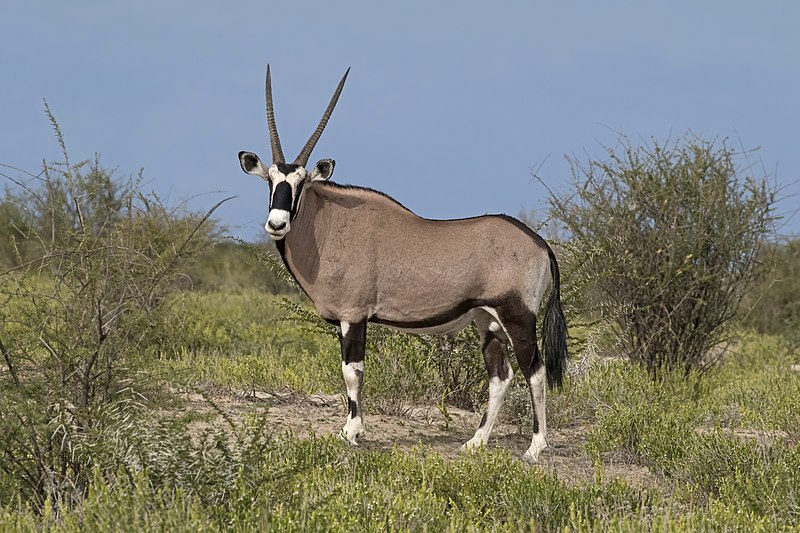
File:Gemsbok_(Oryx_gazella)_male.jpg · Wikimedia Commons · See Wikimedia Commons
Gemsbok
Sign in to saveAlso known as Oryx gazella, South African oryx, gemsbuck
The gemsbok (Oryx gazella), or South African oryx, is a large antelope in the genus Oryx. It is endemic to the dry and barren regions of Botswana, Namibia, South Africa and (parts of) Zimbabwe, mainly inhabiting the Kalahari and Namib Deserts, areas in which it is supremely adapted for survival. Previously, some sources classified the related East African oryx, or beisa oryx (Oryx beisa), as a subspecies.
The gemsbok is a large antelope native to the deserts of southern Africa, particularly the Kalahari and Namib Deserts, where it is exceptionally well-adapted to survive in harsh, dry conditions. It matters as a remarkable example of how large mammals can thrive in some of Earth's most barren environments through specialized adaptations.
AI-generated from the Wikipedia summary — may contain errors.
Species
Least Concernvia IUCN
Wikidata facts
Show 10 more facts
- taxon rank
- species
- IUCN conservation status
- Least Concern
- taxon name
- Oryx gazella
- Commons category
- Oryx gazella
- described by source
- Nordisk familjebok
- Commons gallery
- Oryx gazella
- taxon common name
- óriz d'el cabu
- gestation period
- 9.25
- longest observed lifespan
- 23.8
- different from
- chamois
via Wikidata · CC0
~8 min read
Encyclopedic overview
12 sectionsContents
- Name
- Description
- Horns
- Distribution and habitat
- Ecology and biology
- Diet
- Reproduction
- Introduction to North America
- Potential invasive status
- Significance to humans
- References
- External links
The gemsbok (Oryx gazella), or South African oryx, is a large antelope in the genus Oryx. It is endemic to the dry and barren regions of Botswana, Namibia, South Africa and (parts of) Zimbabwe, mainly inhabiting the Kalahari and Namib Deserts, areas in which it is supremely adapted for survival. Previously, some sources classified the related East African oryx, or beisa oryx (Oryx beisa), as a subspecies.
==Name== The name gemsbok is from Afrikaans, which itself is from the Dutch word of the same spelling, meaning "male chamois", composed of ("chamois") + ("buck, male goat"). The Dutch is further from German ("chamois"). Although some superficial similarities in appearance (especially in the facial pattern) are noticed, the chamois and the oryx are not closely related. The usual pronunciation in English is .
Excerpted from Wikipedia’s “Gemsbok” article, available under the CC BY-SA 4.0 licence.